All species › Swifts › Hummingbirds › Santa Marta Sabrewing
Santa Marta Sabrewing | Campylopterus phainopeplus
Santamartasabelvleugel | Alasable de Santa Marta | Asa-de-sabre-de-santa-marta
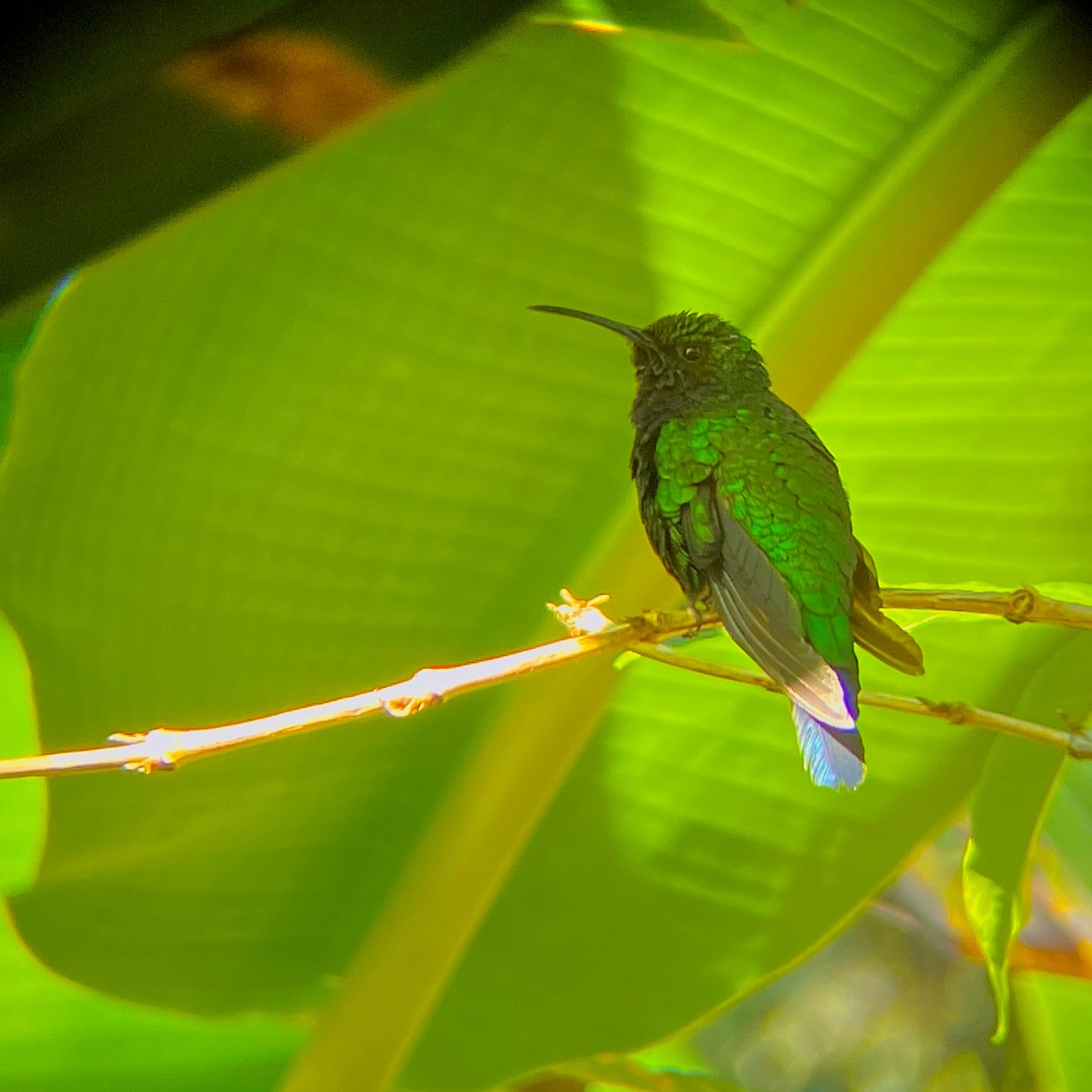
The Santa Marta Sabrewing is a large, dark hummingbird found only in the Sierra Nevada de Santa Marta in northern Colombia. The male is glossy green with a glittering blue throat and breast. The species moves up and down the mountain slopes with the seasons and was photographed again in 2010 after a long period without confirmed records.
Voice
Males sing in groups inside the forest with a long series of twittering, squeaky and rattling notes. The call is a sharp chip.
Recording: Andrés M. Cuervo — CC BY-SA 4.0 · xeno-canto
Identification
13 cm, with a slightly decurved, black bill. The male is glossy green, with a glittering blue throat and breast and a steel-blue tail. The female is green above and grey below, with pale grey tips to the outer tail feathers. The male has broadened shafts to the outer primaries.
Confusion species
Lazuline Sabrewing Campylopterus falcatus, which also occurs in the Sierra Nevada, is smaller and has a largely rufous tail; the female also has a rufous tail. Female Fork-tailed Woodnymphs Thalurania furcata are smaller, with a shorter, straight bill and a forked tail. Brown Violetear Colibri delphinae is brownish, with a violet ear patch.
Habitat
In the rainy season in humid montane forest and forest edges, mainly between about 1200 and 1800 m, where it breeds. In the dry season it moves higher, to cloud forest, elfin forest and the edge of the páramo, locally above 3000 m. It forages at flowering shrubs, including bananas and Heliconia in the lower zone, and catches insects. Little is known about the nest.
Where the bird is most at home, classified by the vegetation units of the Andes and the west coast.


Range and movements
In Colombia only in the Sierra Nevada de Santa Marta (Magdalena, Cesar, La Guajira). Absent from Ecuador, Peru, Bolivia and the Galápagos. Not found outside the guide area.
How and when to look
Search in the Sierra Nevada de Santa Marta along the road to San Lorenzo, at forest edges and ravines with flowering shrubs; in the rainy season males sing at fixed sites in the forest.
Conservation status
Critically Endangered. The range is very small and the population small. Much of the forest in the Sierra Nevada has been cleared or burned for agriculture, and its seasonal movements make the species dependent on forest at different elevations.
Scientific name
Campylopterus phainopeplus | Salvin & Godman, 1879
Salvin & Godman described the species in 1879 and placed it straight away in the genus where it still stands. The genus Campylopterus was introduced in 1827 by Swainson. The genus name combines Greek kampulos, 'bent', with pteron, 'wing', referring to the thickened, curved shafts of the outer primaries. The species name combines Greek phaeinos, 'shining', with peplos, 'robe'. The specimen the first description was based on came from San José, Sierra Nevada de Santa Marta, Colombia.