All species › Swifts › Hummingbirds › Bronze-tailed Plumeleteer
Bronze-tailed Plumeleteer | Chalybura urochrysia
Bronsstaartpluimkolibrie | Colibrí patirrojo | Beija-flor-de-cauda-bronzeada
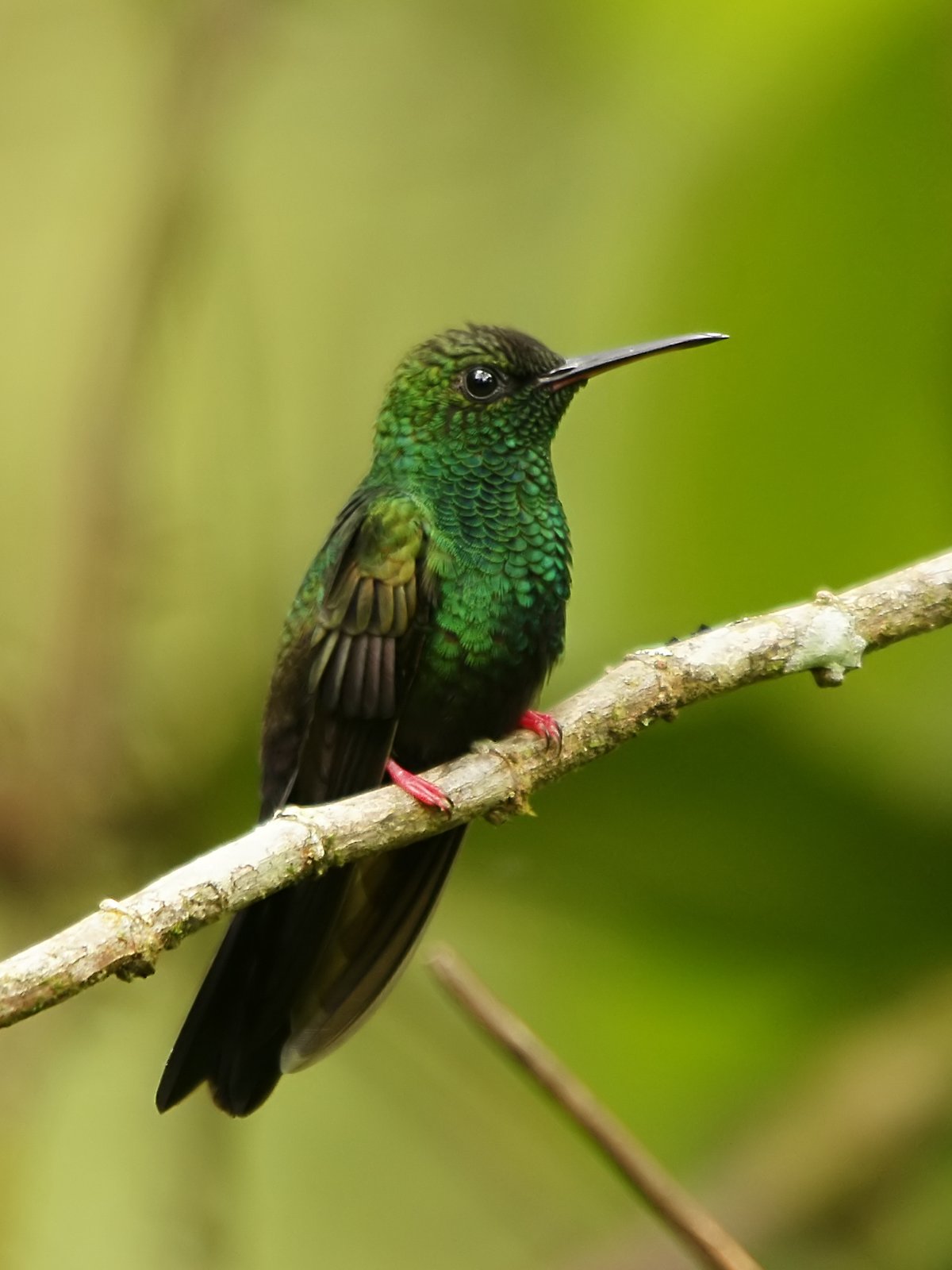
The Bronze-tailed Plumeleteer is a medium-sized, green hummingbird of humid lowland forest on the Pacific side of Colombia and in north-western Ecuador. The name plumeleteer refers to the long, downy undertail coverts. Unlike most hummingbirds it has pink feet, a feature of both sexes.
Voice
Dry, hard tchik calls, often repeated, and a sharp twittering during chases. A distinct song has been little described.
Recording: Olaf Jahn — CC BY-NC-SA 4.0 · xeno-canto
Identification
11–12 cm, with a fairly long, slightly decurved black bill and pink feet. The male is glossy green, glittering slightly bluish on the throat and breast, with a bronze to coppery tail and grey, white-fringed undertail coverts. The female is green above and plain grey below, with a bronzy tail whose outer feathers have grey tips. Young birds resemble the female.
Confusion species
White-vented Plumeleteer Chalybura buffonii has dark feet, a blue-black tail and pure white undertail coverts; both species occur in northern Colombia. The female Crowned Woodnymph Thalurania colombica is smaller, with a shorter bill, a grey throat and white tail tips. Rufous-tailed Hummingbird Amazilia tzacatl has a rufous tail and a red bill base.
Habitat
Lower and middle levels of humid lowland forest, forest edges, old secondary forest and plantations with shade trees, from sea level to about 900 m. It visits flowers of heliconias and others and catches small insects. It often defends a flowering plant against other hummingbirds. The nest is a cup of plant down on a twig or leaf.
Where the bird is most at home, classified by the vegetation units of the Andes and the west coast.


Range and movements
In Colombia in the Pacific lowlands and in the north, up into the lower valleys of the Cauca and Magdalena. In Ecuador in the north-west. Absent from Peru, Bolivia and the Galápagos. Outside the guide area from Honduras to Panama.
- Resident
- dark = core range, pale = thinly spread
How and when to look
Wait at flowering heliconias along forest trails and edges in the Chocó and north-western Ecuador; in the dim understorey look for the pink feet.
Conservation status
Least Concern. Deforestation in the Pacific lowlands affects its habitat locally, but the species tolerates secondary forest.
Scientific name
Chalybura urochrysia | (Gould, 1861)
Gould described the species in 1861 as Hypuroptila urochrysia; because it was later moved to another genus, the author and year stand in brackets. The genus Chalybura was introduced in 1854 by Reichenbach. The genus name combines Greek khalups, 'steel', with -ouros, '-tailed'. The species name combines Greek oura, 'tail', with khrusos, 'gold', referring to the bronzy-golden tail. The specimen the first description was based on came from Western Colombia.