All species › Swifts › Hummingbirds › White-vented Plumeleteer
White-vented Plumeleteer | Chalybura buffonii
Buffons pluimkolibrie | Colibrí de Buffon | Beija-flor-de-crisso-branco
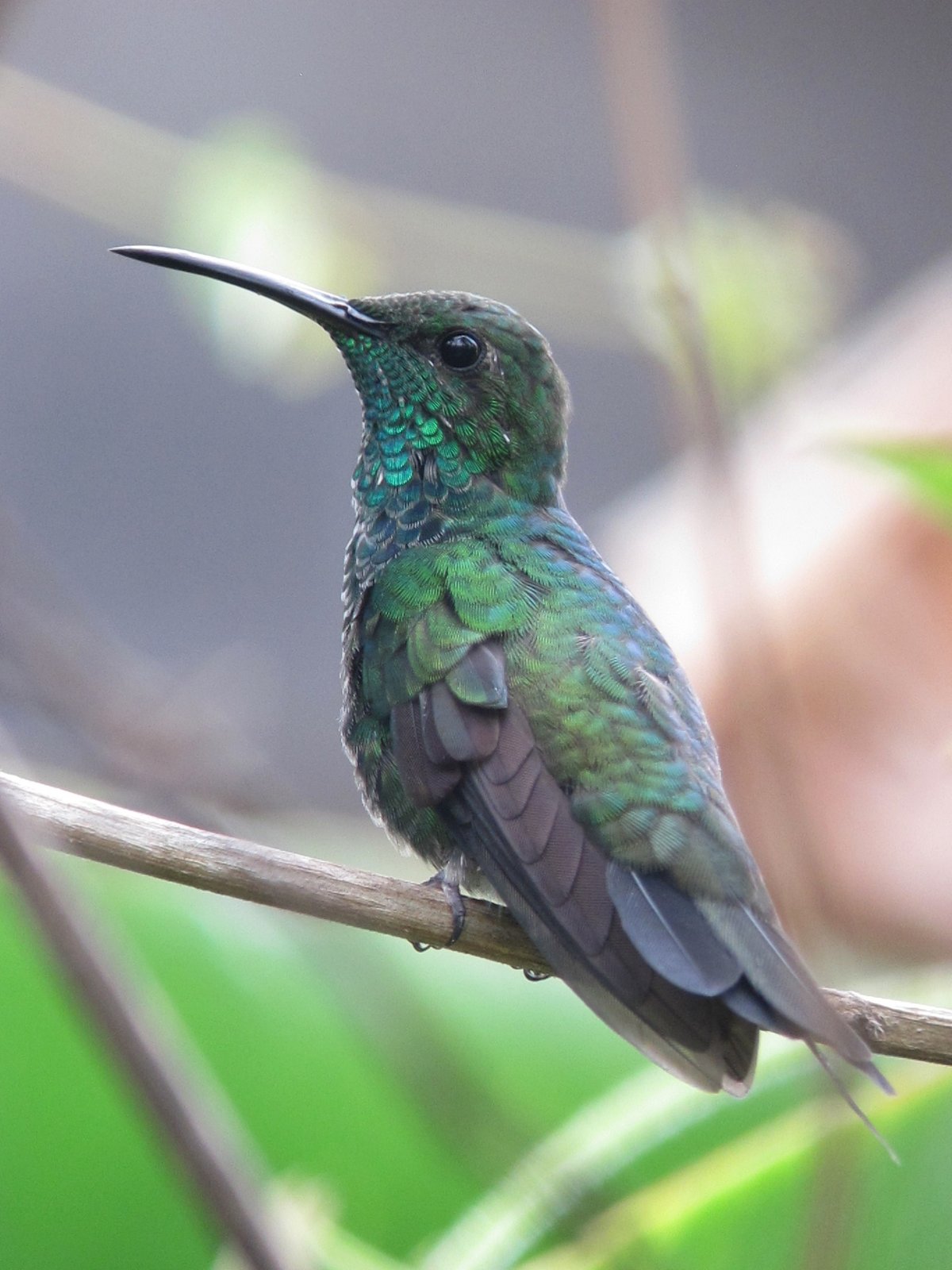
The White-vented Plumeleteer is a medium-sized, green hummingbird of forest edges, dry forest and scrub in northern Colombia and, as a separate subspecies, in south-western Ecuador and the far north-west of Peru. Its main feature is the pure white, downy undertail coverts, from which it takes its name. Birds are aggressive at flowers and chase off other hummingbirds.
Voice
A dry, repeated tchik and, during chases, a sharp, rolling twitter.
Recording: Nick Athanas — CC BY-NC-SA 3.0 · xeno-canto
Identification
11–12 cm, with a fairly long, slightly decurved black bill and dark feet. The male is glossy green, glittering green to blue-green on the throat and breast, with a blue-black, slightly forked tail and long, pure white undertail coverts. The female is green above and grey below, with white undertail coverts and grey tips to the outer tail feathers. Young birds resemble the female.
Confusion species
Bronze-tailed Plumeleteer Chalybura urochrysia has pink feet, a bronzy tail and grey undertail coverts. The female Crowned Woodnymph Thalurania colombica is smaller, with a shorter bill and white tail tips. Steely-vented Hummingbird Saucerottia saucerottei is smaller, with a shorter bill and a steel-blue tail without white undertail coverts.
Habitat
Forest edges, dry and semi-humid forest, gallery forest, scrub, plantations and gardens, from sea level to about 1600 m. In south-western Ecuador and north-western Peru in deciduous and semi-humid forest. It visits flowers at all levels of the forest and catches small insects. The nest is a cup of plant down on a twig.
Where the bird is most at home, classified by the vegetation units of the Andes and the west coast.


Range and movements
In Colombia in the Caribbean lowlands, in the Magdalena and Cauca valleys and locally at the foot of the eastern slope of the Andes. In Ecuador in the south-west. In Peru only in the far north-west, in Tumbes. Absent from Bolivia and the Galápagos. Outside the guide area in eastern Panama and northern Venezuela.
- Resident
- dark = core range, pale = thinly spread
How and when to look
Check flowering trees and shrubs along forest edges in the Caribbean lowlands of Colombia or in the dry forest of south-western Ecuador; the white vent shows well in flight.
Conservation status
Least Concern. The species tolerates secondary forest and man-made landscapes.
Scientific name
Chalybura buffonii | (Lesson, 1832)
Lesson described the species in 1832 as Trochilus buffonii; because it was later moved to another genus, the author and year stand in brackets. The genus Chalybura was introduced in 1854 by Reichenbach. The genus name combines Greek khalups, 'steel', with -ouros, '-tailed'. The species name honours Georges-Louis Leclerc, Comte de Buffon (1707–1788), a French naturalist and author of the Histoire naturelle. The specimen the first description was based on came from Bogotá region, Colombia.