All species › Swifts › Hummingbirds › Crowned Woodnymph
Crowned Woodnymph | Thalurania colombica
Kroonbosnimf | Ninfa coronada | Beija-flor-coroado
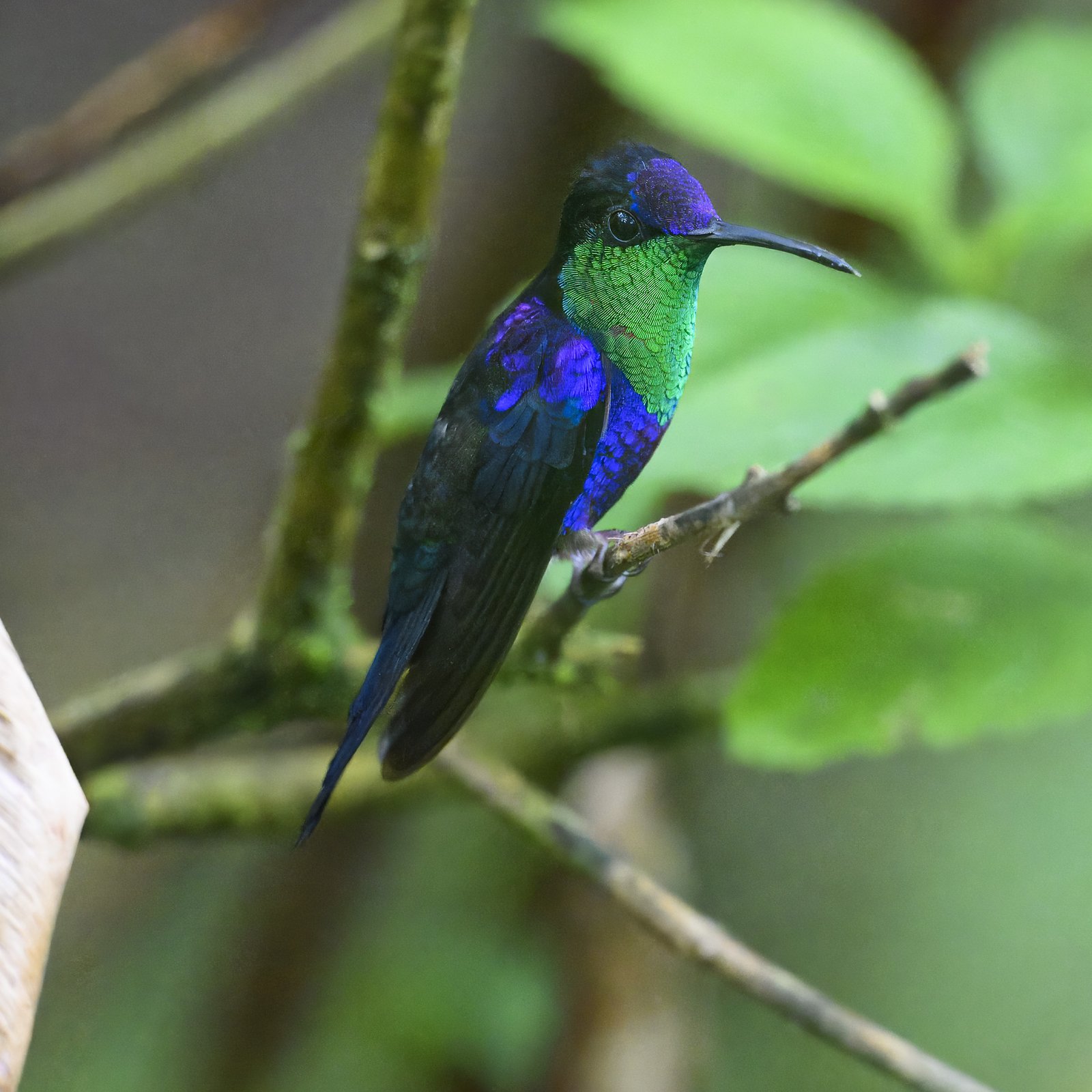
The Crowned Woodnymph is the woodnymph of the lowlands and lower slopes west and north of the Andes. The male is glittering green and violet-blue, with a deeply forked tail; the female is much plainer. Within the guide area the subspecies differ mainly in crown colour.
Voice
A dry, repeated tchip or tchik, and a fast, sharp twitter during chases.
Recording: Kent Livezey — CC BY-NC-SA 4.0 · xeno-canto
Identification
9–11 cm, the male larger than the female, with a straight black bill. The male has a glittering green throat and breast, a violet-blue belly and shoulders and a deeply forked, blue-black tail. In northern Colombia the crown is violet-blue; in western Colombia and Ecuador it is glittering green, and in south-western Ecuador and north-western Peru the belly is also largely green. The female is green above and grey below, paler on the throat, with a less deeply forked tail with white tips to the outer feathers. Young males are duller.
Confusion species
Fork-tailed Woodnymph Thalurania furcata lives east of the Andes and has a dark, non-glittering crown; the two ranges barely meet. Violet-bellied Hummingbird Chlorestes julie is smaller, with a short, rounded tail and a pink lower mandible. The female Bronze-tailed Plumeleteer Chalybura urochrysia is larger, with pink feet and a bronzy tail without white tips.
Habitat
Lower and middle levels of humid and semi-humid forest, forest edges, old secondary forest and shade plantations, from sea level to about 1800 m. It feeds along a regular route at scattered flowers and also catches small insects in flight. The nest is a cup of plant down and moss on a twig, often low above the ground.
Where the bird is most at home, classified by the vegetation units of the Andes and the west coast.


Range and movements
In Colombia west of the Eastern Andes: in the Pacific lowlands, in the Cauca and Magdalena valleys, in the north and in the Sierra Nevada de Santa Marta and the Serranía de Perijá. In Ecuador in the west. In Peru only in the far north-west, in Tumbes. Absent from Bolivia and the Galápagos. Outside the guide area from Guatemala through Central America to Panama and in western Venezuela.
- Resident
- dark = core range, pale = thinly spread
How and when to look
Wait at flowering shrubs and heliconias along forest trails in the Chocó and on the western slope in Ecuador; males often fly past quickly and perch briefly on a low twig.
Conservation status
Least Concern. Deforestation affects its habitat locally, but the species tolerates secondary forest.
Scientific name
Thalurania colombica | (Bourcier, 1843)
Bourcier described the species in 1843 as Ornismya colombica; because it was later moved to another genus, the author and year stand in brackets. The genus Thalurania was introduced in 1848 by Gould. The genus name combines Greek thalos, 'child', with ouranos, 'heaven'. The specific name refers to Colombia, not necessarily the exact type locality. The specimen the first description was based on came from Colombia.