All species › Swifts › Hummingbirds › Fork-tailed Woodnymph
Fork-tailed Woodnymph | Thalurania furcata
Vorkstaartbosnimf | Ninfa tijereta | Beija-flor-tesoura-verde
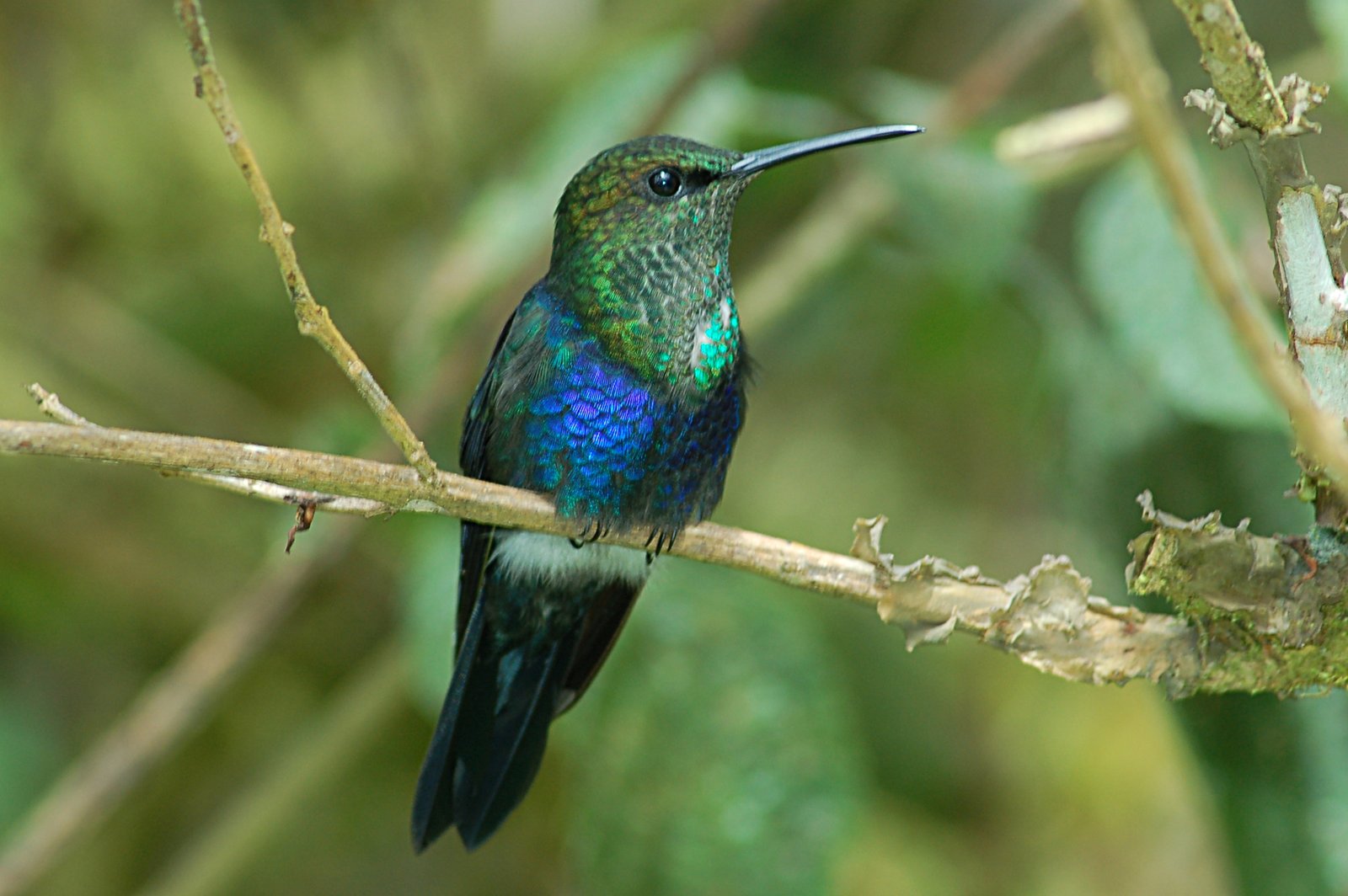
The Fork-tailed Woodnymph is one of the most widespread hummingbirds of the Amazonian forest. The male is glittering green and violet-blue with a deeply forked tail, the female green and grey. It lives mainly in the forest understorey, where it defends flowering plants.
Voice
A dry, repeated tchip and a fast, dry twitter during chases. The song is a series of high, thin chips.
Recording: Wim Jacobs — CC BY-NC-SA 4.0 · xeno-canto
Identification
9–11 cm, the male larger than the female, with a straight black bill. The male has a dark, dull crown, a glittering green throat and breast, a violet-blue belly, a violet-blue band across the upper back and a deeply forked, blue-black tail. The female is green above and pale grey below, with a less deeply forked tail with white tips to the outer feathers. Young males are duller, with less blue.
Confusion species
Crowned Woodnymph Thalurania colombica lives west and north of the Andes and has a glittering crown. Golden-tailed Sapphire Chrysuronia oenone has a blue head and a coppery tail and lacks the violet-blue on the belly. Glittering-throated Emerald Chionomesa fimbriata has a white central stripe on the belly and a rounded tail.
Habitat
Lower and middle levels of terra firme rainforest, várzea and foothill forest, forest edges and old secondary forest, from the lowlands to about 1200 m, locally higher. It follows a regular route at scattered flowers and also catches small insects. The nest is a cup of plant down on a twig or leaf, low above the ground.
Where the bird is most at home, classified by the vegetation units of the Andes and the west coast.


Range and movements
In Colombia in the lowlands east of the Andes and at the foot of the eastern slope. In Ecuador in Amazonia. In Peru throughout the eastern lowlands and the Andean foothills. In Bolivia in the north and east, up into the Yungas. Absent from the Galápagos. Outside the guide area in Venezuela, the Guianas, much of Brazil, Paraguay and northern Argentina.
- Resident
- dark = core range, pale = thinly spread
How and when to look
Wait in Amazonian forest at flowering shrubs and heliconias in the understorey or along trails; also at light gaps and forest edges along rivers.
Conservation status
Least Concern. The species has a very large range and tolerates secondary forest.
Scientific name
Thalurania furcata | (Gmelin, 1788)
Gmelin described the species in 1788 as Trochilus furcatus; because it was later moved to another genus, the author and year stand in brackets. The genus Thalurania was introduced in 1848 by Gould. The genus name combines Greek thalos, 'child', with ouranos, 'heaven'. The specific name comes from Latin furcatus, 'forked', after the forked tail. The specimen the first description was based on came from Cayenne, French Guiana.