All species › Swifts › Hummingbirds › Pirre Hummingbird
Pirre Hummingbird | Goldmania bella
Roodwangkolibrie | Colibrí del Pirre | Beija-flor-de-pirre
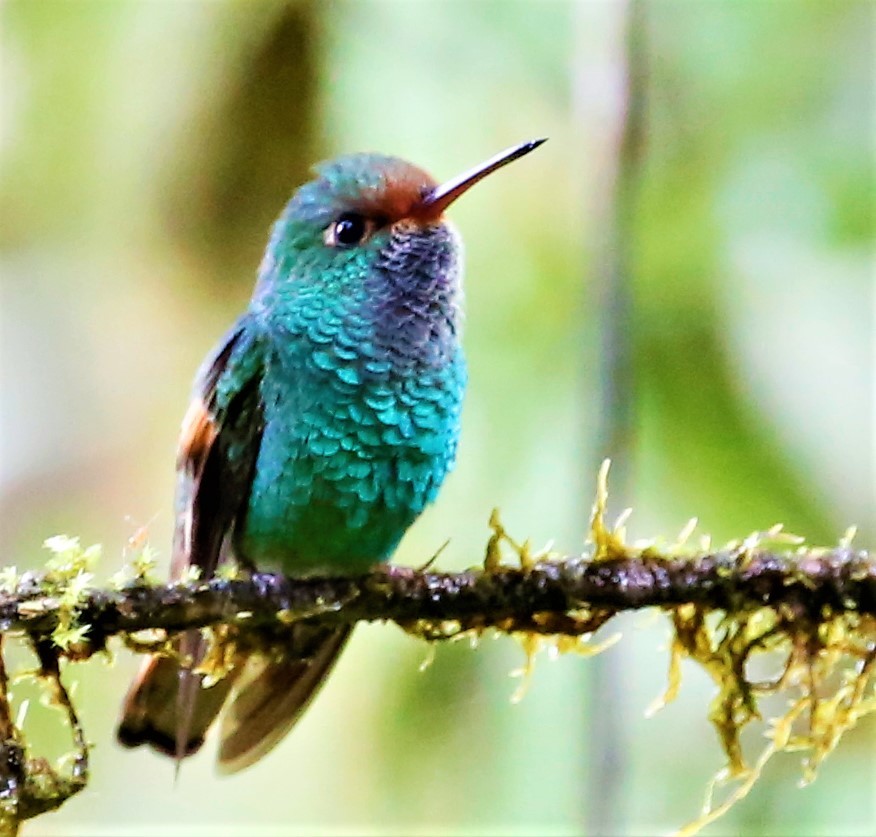
The Pirre Hummingbird is a small hummingbird found only in the Darién mountains on the border between Panama and Colombia. It was long placed in a genus of its own, but is now included with Violet-capped Hummingbird. In the guide area it is known only from the far north-west of Colombia.
Voice
Little described; short, dry chipping notes.
No recording with a suitable Creative Commons licence is available for this species yet.
Identification
9–10 cm, with a straight, dark bill. The male is green above and largely green below, with rufous lores, chin and cheeks, a pale cinnamon patch in the wing and a rufous to pale brown tail with bronzy tips; the belly is greyish. The female is paler below, grey to pale cinnamon, with less rufous on the head.
Confusion species
Violet-capped Hummingbird Goldmania violiceps lacks the rufous head and the pale wing patch; the male has a violet-blue crown. The female Crowned Woodnymph Thalurania colombica is grey below, with a blue-black tail with white tips.
Habitat
Humid montane forest and cloud forest, including low, mossy ridge-top forest, roughly between 600 and 1650 m. It feeds in the understorey and at forest edges at flowering shrubs and epiphytes.
Where the bird is most at home, classified by the vegetation units of the Andes and the west coast.


Range and movements
In Colombia only in the far north-west, in the Serranía del Darién on the border with Panama. Absent from Ecuador, Peru, Bolivia and the Galápagos. Outside the guide area in the mountains of eastern Panama, including Cerro Pirre.
- Resident
- dark = core range, pale = thinly spread
How and when to look
Its habitat lies in remote border country without roads; search montane forest above about 600 m at flowering shrubs along the forest edge.
Conservation status
Near Threatened. The range is very small; the forest is still largely intact, but deforestation in the lower Darién is a risk.
Scientific name
Goldmania bella | (Nelson, 1912)
Nelson described the species in 1912 as Goethalsia bella; because it was later moved to another genus, the author and year stand in brackets. The genus Goldmania was introduced in 1911 by Nelson. The genus name honours Edward Alphonso Goldman (1873–1946), an American zoologist of the U.S. Biological Survey who collected in Panama in 1911–1912. The species name is Latin bella, the feminine of bellus, 'pretty' or 'charming'. The specimen the first description was based on came from Cana, Darién, Panama.