All species › Swifts › Hummingbirds › Buffy Hummingbird
Buffy Hummingbird | Leucippus fallax
Bruine kolibrie | Colibrí anteado | Beija-flor-camurça
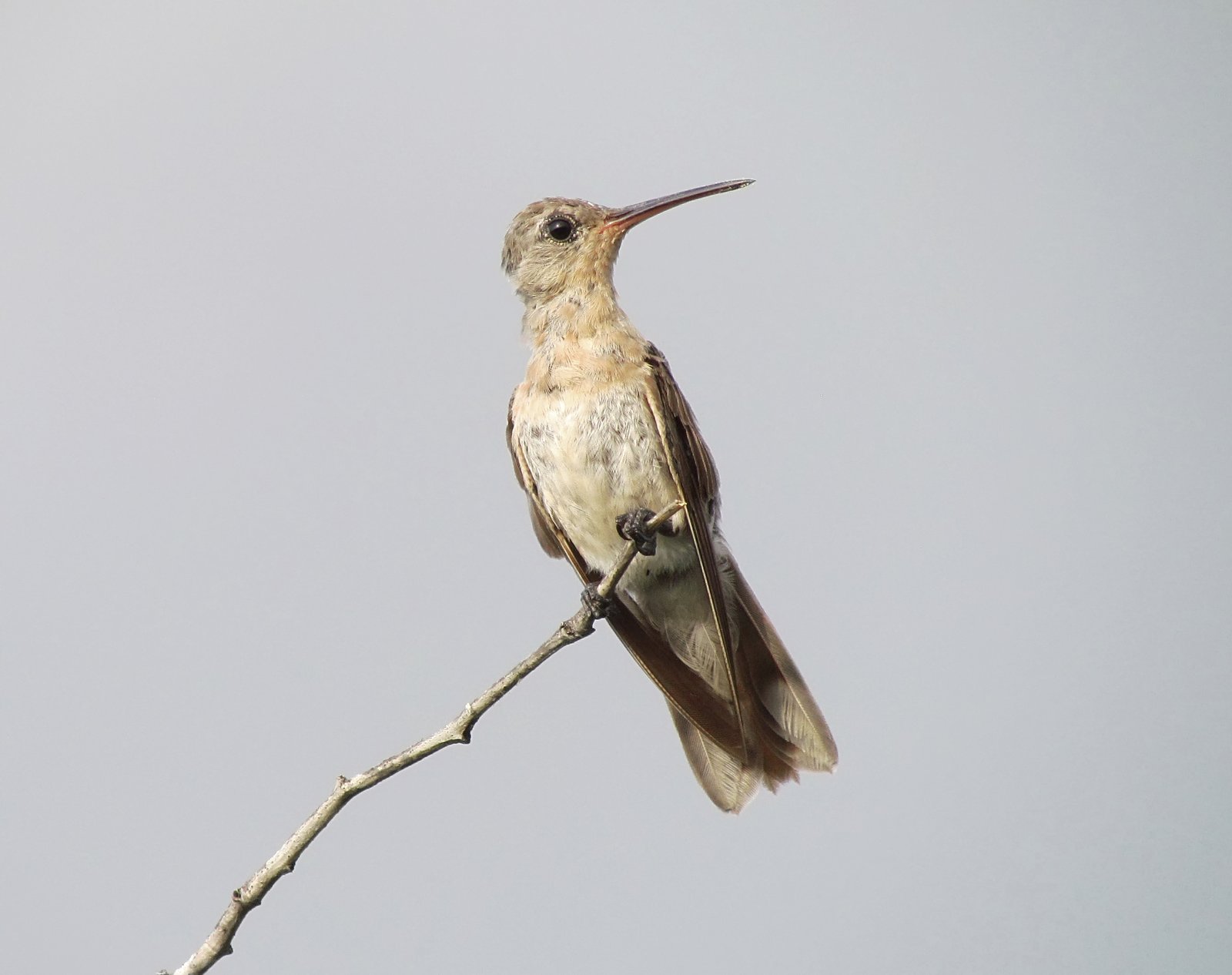
The Buffy Hummingbird is a plain, bronze-green and buff hummingbird of dry scrub along the Caribbean coast. In the guide area it occurs only in the arid north of Colombia. It has no glittering throat and the sexes are alike.
Voice
High, thin tsip calls and a short, dry twitter.
Recording: Nick Athanas — CC BY-NC-SA 3.0 · xeno-canto
Identification
9–10 cm, with a straight, black bill. The upperparts are dull bronze-green, with a small white spot behind the eye. The underparts are plain buff to cinnamon, slightly paler on the throat. The tail is greyish green, with a dark subterminal band and pale tips to the outer feathers. The sexes are alike; young birds are somewhat duller.
Confusion species
The female Ruby-topaz Hummingbird Chrysolampis mosquitus is pale grey below and has a rufous tail with white tips. Shining-green Hummingbird Chrysuronia goudoti is green below and has a pink lower mandible. Red-billed Emerald Chlorostilbon gibsoni is smaller; the male is all green and the female grey below with a dark eye mask.
Habitat
Dry thorn scrub, cactus scrub, dry woodland, mangrove edges and gardens in arid areas, from sea level to about 500 m. It visits flowers of shrubs, cacti and trees and catches small insects. The nest is a cup of plant down on a twig.
Where the bird is most at home, classified by the vegetation units of the Andes and the west coast.


Range and movements
In Colombia only in the arid north, along the Caribbean coast and mainly on the Guajira Peninsula. Absent from Ecuador, Peru, Bolivia and the Galápagos. Outside the guide area along the dry coast of Venezuela and on the Venezuelan offshore islands.
- Resident
- dark = core range, pale = thinly spread
How and when to look
Search on the Guajira Peninsula at flowering shrubs and cacti in dry scrub, especially in the early morning.
Conservation status
Least Concern. Its habitat is limited to the dry coastal belt, but the species tolerates disturbed scrub.
Scientific name
Leucippus fallax | (Bourcier, 1843)
Bourcier described the species in 1843 as Trochilus fallax; because it was later moved to another genus, the author and year stand in brackets. The genus Leucippus was introduced in 1850 by Bonaparte. The genus name refers to Leucippus of Greek mythology, a son of Oenomaus, who disguised himself as a woman to be near Daphne; when the deception was revealed, he was torn to pieces by the attendants of the goddess. The species name is Latin fallax, 'false, deceptive', from fallere, 'to deceive'. This epithet was often given to forms that were first misidentified, placed in the wrong genus, or of uncertain relationships. The specimen the first description was based on came from Caracas, Venezuela.