All species › Swifts › Hummingbirds › Scaly-breasted Hummingbird
Scaly-breasted Hummingbird | Phaeochroa cuvierii
Schubborstkolibrie | Fandanguero pecho escamoso | Beija-flor-de-peito-escamoso
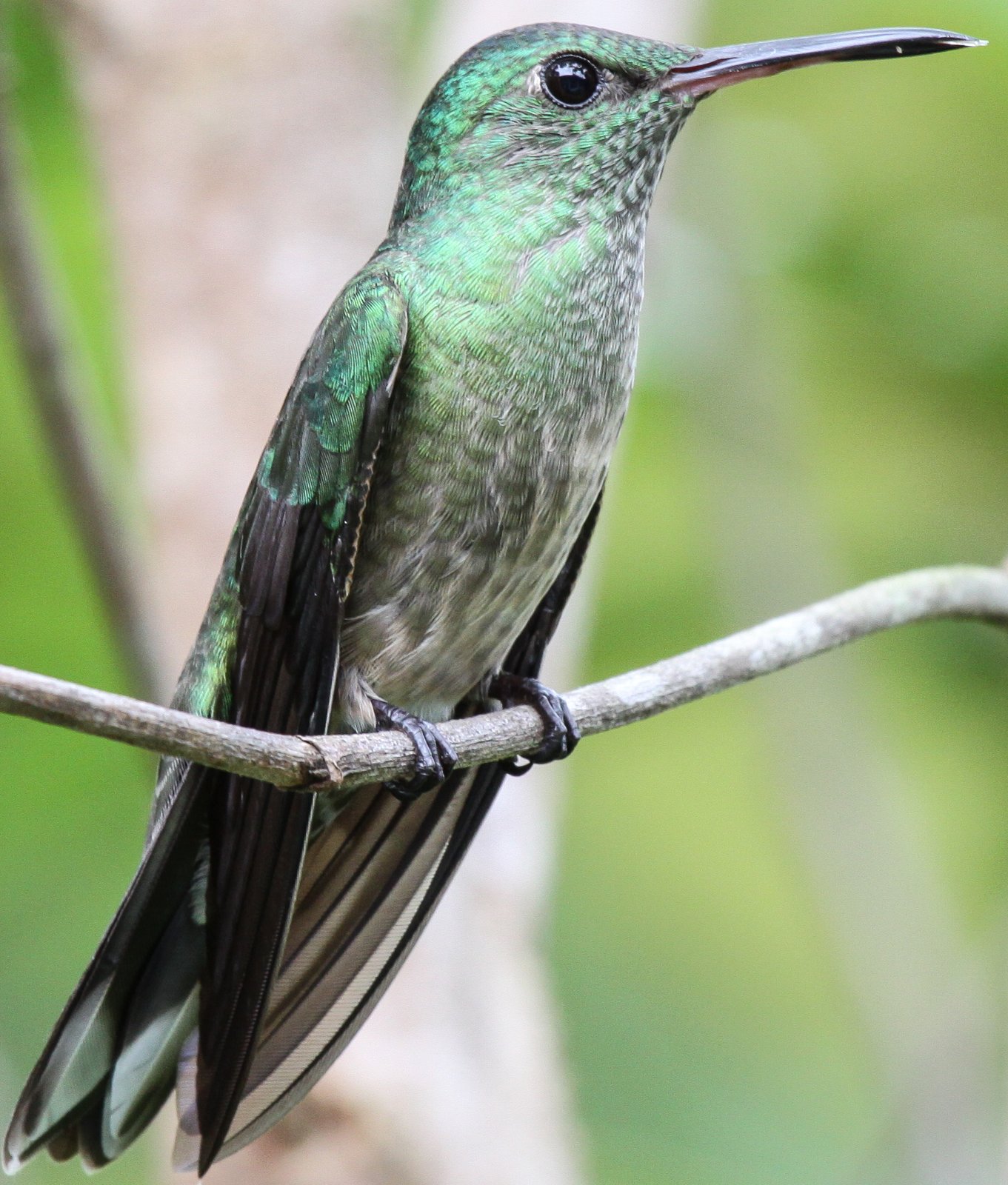
The Scaly-breasted Hummingbird is a large, dull hummingbird of forest edges and semi-open country in northern Colombia. It lacks glittering colours but shows a scaly breast and white tail corners. Males sing for long periods from a regular perch.
Voice
A loud, sustained song of sharp, dry chips and squeaky notes, repeated from a perch. The call is a hard tchip.
Recording: GABRIEL LEITE — CC BY-NC-SA 4.0 · xeno-canto
Identification
12–13 cm, with a rather stout, slightly decurved black bill. The upperparts are dull bronze-green, with a small white spot behind the eye. The throat and breast are greyish with green scaling, and the belly is paler, grey to pale buff. The tail is green, with broad white tips to the outer three pairs of feathers. The sexes are alike.
Confusion species
The female White-necked Jacobin Florisuga mellivora also has a scaly throat, but a white belly and a dark tail with narrow white edges. Lazuline Sabrewing Campylopterus falcatus lives higher in the mountains and has a rufous tail. Rufous-tailed Hummingbird Amazilia tzacatl is smaller, with a green throat and a rufous tail.
Habitat
Forest edges, gallery forest, secondary forest, semi-open country with trees, plantations and gardens in the lowlands, from sea level to about 1000 m. It visits flowering trees and shrubs and catches insects. The nest is a cup of plant down on a twig.
Where the bird is most at home, classified by the vegetation units of the Andes and the west coast.


Range and movements
In Colombia in the north: in the Caribbean lowlands and at the foot of the Sierra Nevada de Santa Marta, south into the Magdalena valley. Absent from Ecuador, Peru, Bolivia and the Galápagos. Outside the guide area from southern Mexico through Central America to Panama.
- Resident
- dark = core range, pale = thinly spread
How and when to look
Listen along forest edges and in gallery forest in the Caribbean lowlands for the sustained, dry song; the singer often sits on a bare twig at mid-level.
Conservation status
Least Concern. The species tolerates secondary forest and man-made landscapes.
Scientific name
Phaeochroa cuvierii | (Delattre & Bourcier, 1846)
Delattre & Bourcier described the species in 1846 as Trochilus Cuvierii; because it was later moved to another genus, the author and year stand in brackets. The genus Phaeochroa was introduced in 1861 by Gould. The genus name combines Greek phaios, 'dusky', with khroa, 'colour'. The species name honours Georges Cuvier (1769–1832), a French zoologist and founder of comparative anatomy. The specimen the first description was based on came from Isthmus of Panama.