All species › Swifts › Hummingbirds › Spot-throated Hummingbird
Spot-throated Hummingbird | Thaumasius taczanowskii
Vlekkeelkolibrie | Colibrí de Taczanowski | Beija-flor-de-garganta-pintada
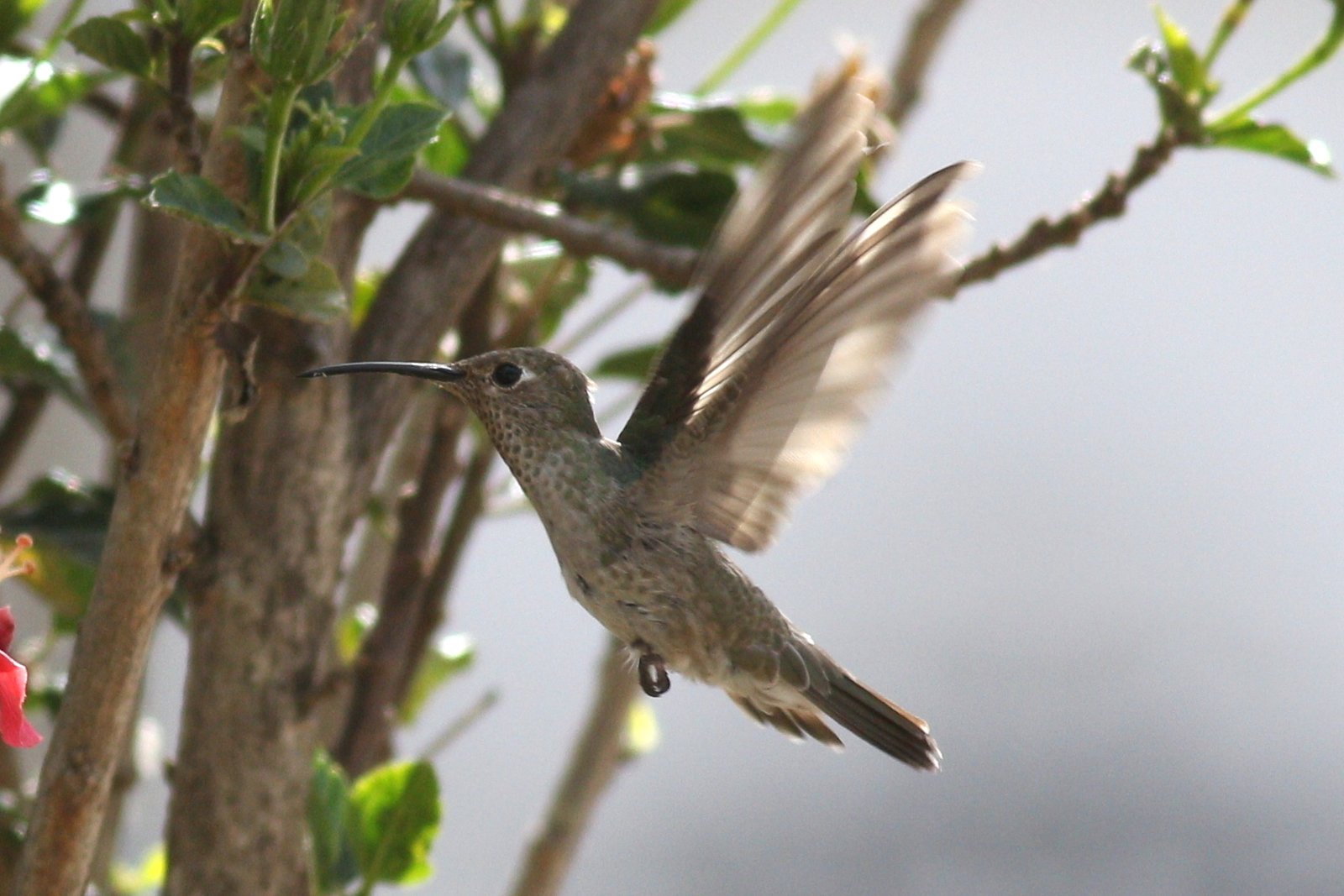
The Spot-throated Hummingbird is a plainly marked, green and grey hummingbird found only in Peru. It lives in dry scrub and dry forest on the western slope of the Andes and in the dry Marañón valley. The feature that gives it its name is the green spotting on a pale grey throat.
Voice
Dry, hard chip calls and high, squeaky series, often during chases around flowering shrubs.
Recording: Paul van Els — CC BY-NC-SA 3.0 · xeno-canto
Identification
11 cm, with a fairly long, slightly decurved, black bill. The upperparts are dull green to bronze-green. There is a small white spot behind the eye. The underparts are pale grey, with green spots on the throat and a green wash on the sides of the breast and belly. The tail is bronze-green with a dark subterminal band and greyish tips to the outer feathers. The sexes are nearly alike; young birds are duller, with pale feather edges on the head and back.
Confusion species
Tumbes Hummingbird Thaumasius baeri is smaller, has unspotted, greyish-buff underparts and lives mainly in the lowlands of the far northwest. Oasis Hummingbird Rhodopis vesper has a cinnamon rump and a more clearly decurved bill. Amazilia Hummingbird Amazilis amazilia has a reddish bill with a dark tip and rufous flanks or belly. Many-spotted Hummingbird Taphrospilus hypostictus is more densely spotted with green on the throat and breast and lives on the eastern slope of the Andes.
Habitat
Dry scrub, dry forest, cactus vegetation, shrubby river valleys, hedges and gardens on the western slope of the Andes and in the dry Marañón valley, roughly between 500 and 3000 m. It feeds at the flowers of shrubs, cacti and garden plants and catches small insects. The nest is a cup of plant down on a branch or vine.
Where the bird is most at home, classified by the vegetation units of the Andes and the west coast.


Range and movements
In Peru on the western slope of the Andes in the north and centre of the country and in the dry Marañón valley. Absent from Colombia, Ecuador, Bolivia and the Galápagos. Does not occur outside the guide area.
- Resident
- dark = core range, pale = thinly spread
How and when to look
Search flowering shrubs and gardens in the dry valleys of the western slope, for example along roads that climb from the coast into the Andes, and in the Marañón valley. Watch for the pale grey underparts with the green throat spots.
Conservation status
Least Concern. The species has a limited range, but tolerates scrub, hedges and gardens in farmland.
Scientific name
Thaumasius taczanowskii | Sclater, 1879
Sclater described the species in 1879 and placed it straight away in the genus where it still stands. He introduced the genus Thaumasius in that same work. The genus name comes from Greek thaumasios, 'wonderful, marvellous'. The specific name honours Władysław Taczanowski (1819–1890), a Polish zoologist who published widely on the birds of Peru. The specimen the first description was based on came from Guajungo, Cajamarca, Peru.