All species › Swifts › Hummingbirds › Tumbes Hummingbird
Tumbes Hummingbird | Thaumasius baeri
Tumbeskolibrie | Colibrí de Tumbes | Beija-flor-de-tumbes
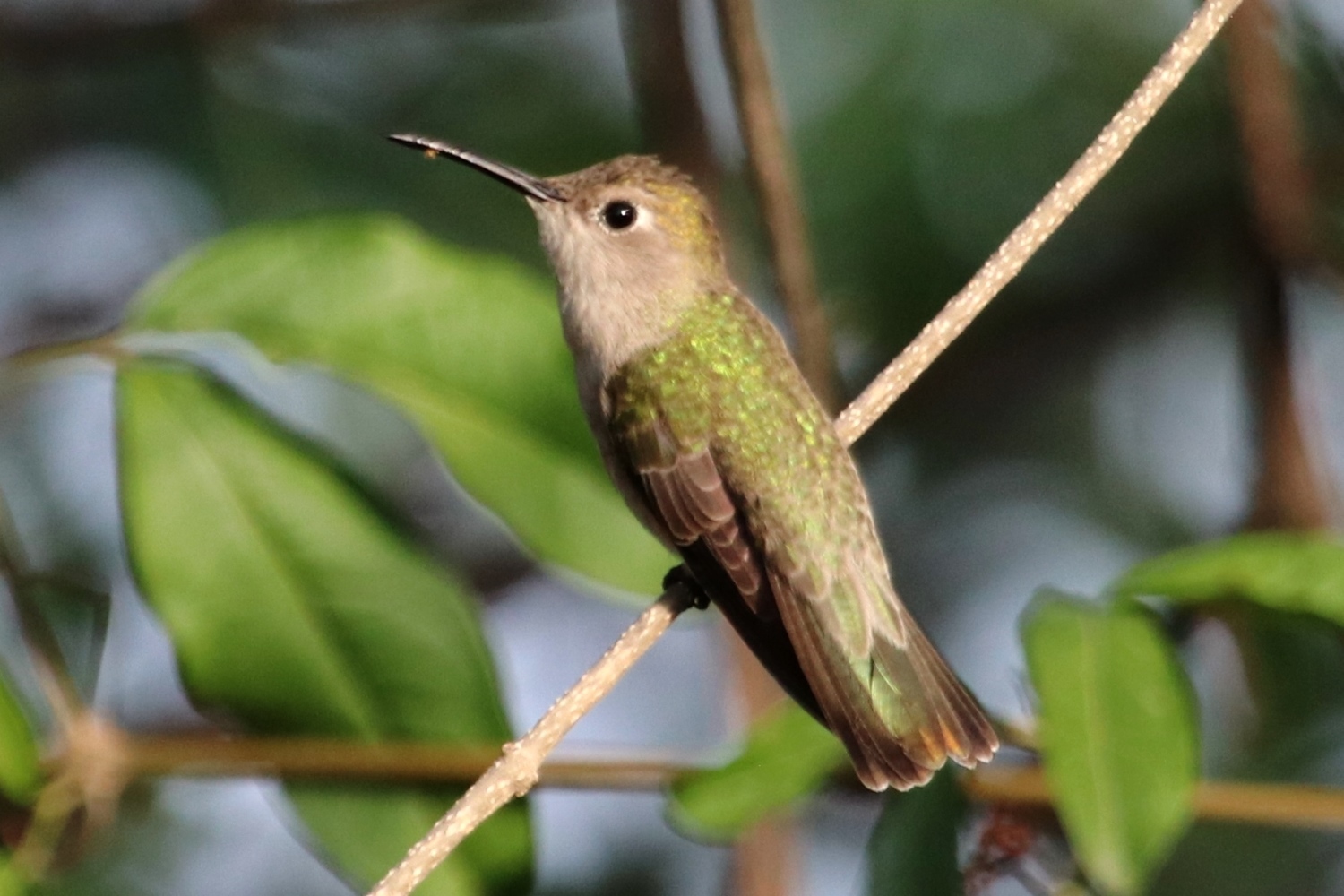
The Tumbes Hummingbird is a small, uniform-looking hummingbird of the dry Tumbesian region of south-western Ecuador and north-western Peru. It lacks glittering patches of colour and is identified mainly by the combination of bronze-green upperparts, greyish-buff underparts and a white spot behind the eye.
Voice
Dry chik calls and a fast, squeaky chatter during chases.
Recording: Leonardo Ordóñez-Delgado — CC BY-NC-SA 4.0 · xeno-canto
Identification
9–10 cm, with a medium-length, nearly straight to slightly decurved, black bill. The upperparts are bronze-green to olive-green, the crown somewhat duller. There is a small white spot behind the eye. The underparts are plain greyish-buff to dull buff, without spots. The tail is bronze-green with a dark subterminal band and pale buffy tips to the outer feathers. The sexes are nearly alike.
Confusion species
Spot-throated Hummingbird Thaumasius taczanowskii is larger, with green spots on a pale grey throat, and lives higher on the western slope and in the Marañón valley. Amazilia Hummingbird Amazilis amazilia has a reddish bill with a dark tip, a glittering green throat and a rufous belly. Buffy Hummingbird Leucippus fallax is warmer cinnamon-buff below; it lives in northern Colombia and does not overlap with Tumbes Hummingbird. Female woodstars, such as Little Woodstar Chaetocercus bombus, are smaller, with a short bill and cinnamon flanks.
Habitat
Dry forest, thorn scrub, shrubby riverbanks, irrigated farmland, orchards and gardens in the dry Tumbesian region, from sea level to roughly 1500 m, locally higher. It feeds at the flowers of shrubs, trees and garden plants and catches small insects. The nest is a cup of plant down on a low branch.
Where the bird is most at home, classified by the vegetation units of the Andes and the west coast.


Range and movements
In Ecuador in the dry southwest, from the coast into the lower valleys of Loja province. In Peru in the dry northwest, south to about Lambayeque. Absent from Colombia, Bolivia and the Galápagos. Does not occur outside the guide area.
- Resident
- dark = core range, pale = thinly spread
How and when to look
Search flowering shrubs, riverside vegetation and gardens in the dry coastal region of south-western Ecuador and north-western Peru. The birds also occur in villages and along fields.
Conservation status
Least Concern. The species has a limited range, but also occurs in farmland and gardens; the dry forest of the region is, however, highly fragmented.
Scientific name
Thaumasius baeri | (Simon, 1901)
Simon described the species in 1901 as Leucippus Baeri; because it was later moved to another genus, the author and year stand in brackets. The genus Thaumasius was introduced in 1879 by Sclater. The genus name comes from Greek thaumasios, 'wonderful, marvellous'. The specific name honours Gustave Adolphe Baer (1838–1918), French natural history dealer and collector in Peru, Chile and Brazil. The specimen the first description was based on came from Tumbes, Peru.