All species › Swifts › Hummingbirds › Many-spotted Hummingbird
Many-spotted Hummingbird | Taphrospilus hypostictus
Druppelkolibrie | Colibrí moteado | Beija-flor-de-muitas-pintas
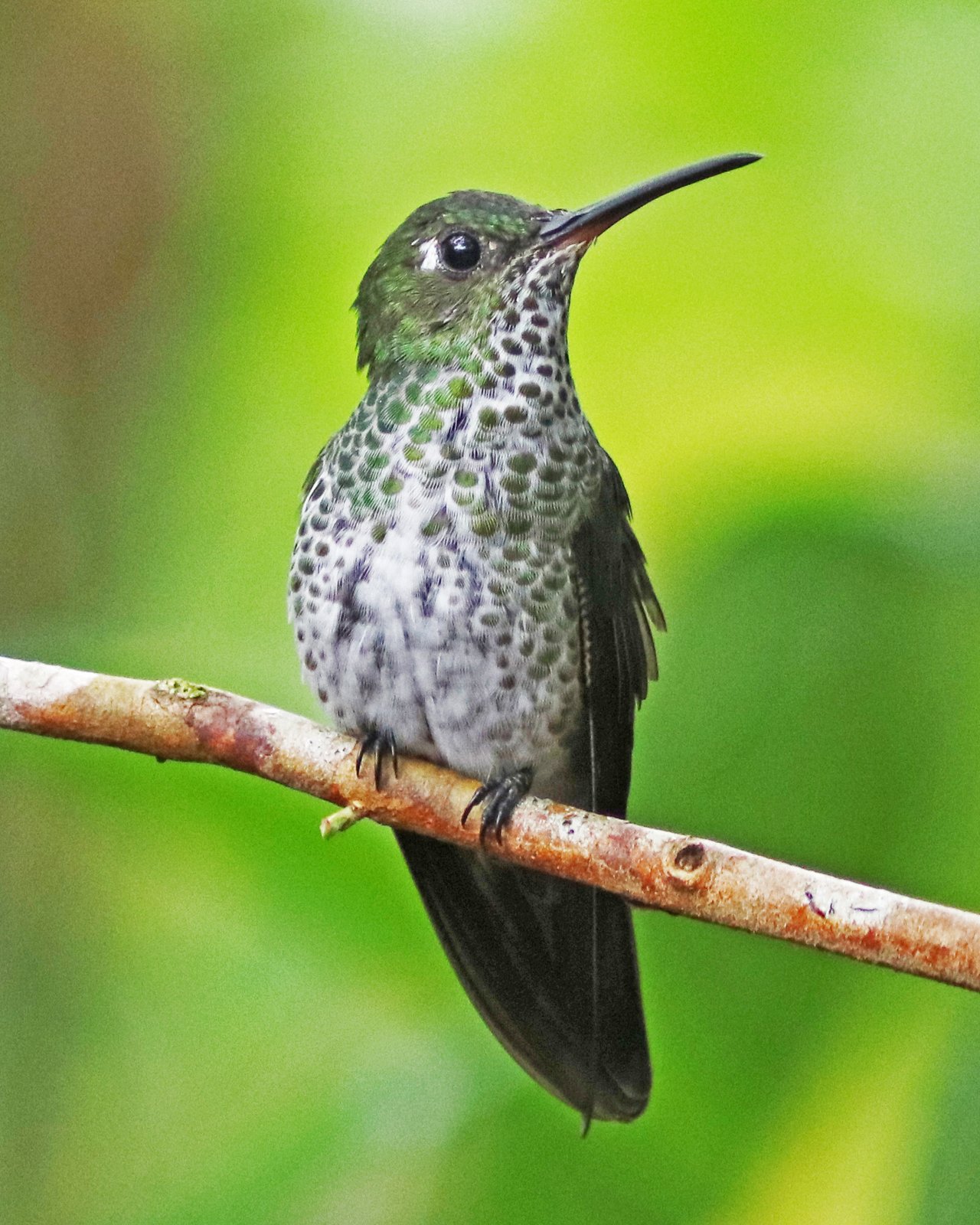
The Many-spotted Hummingbird is a medium-sized hummingbird of the foothills on the eastern slope of the Andes. Its white underparts are densely covered with round green spots, which give it its name. It is usually solitary and feeds in the interior and at the edges of humid forest, often in small ravines.
Voice
A thin, sharp chit and a wheezy, repeated dew-dew-dew. The song is a quiet series of wheezy, buzzing notes mixed with gravelly chatters.
Recording: Jonas Nilsson — CC BY-NC-SA 4.0 · xeno-canto
Identification
11 cm, with a fairly long (just over 2 cm), slightly decurved, black bill. The upperparts are grass-green to coppery bronze-green. There is a small white spot behind the eye. The underparts are white, densely covered with round green spots on the throat, breast and flanks; only the centre of the belly is unspotted. The tail is blue-green with grey tips. The sexes are nearly alike; the female is slightly less densely spotted. Young birds have buffy feather edges on the head.
Confusion species
Spot-throated Hummingbird Thaumasius taczanowskii has only small spots on the throat, grey underparts and lives on the western slope and in the Marañón valley. Olive-spotted Hummingbird Talaphorus chlorocercus is smaller and paler, with an olive, weakly spotted throat, and lives on river islands in the Amazonian lowlands. Sapphire-spangled Emerald Chionomesa lactea has a blue throat and breast. Glittering-throated Emerald Chionomesa fimbriata has a glittering green throat and breast without separate spots and a white central stripe on the belly. Female White-necked Jacobins Florisuga mellivora are scaled rather than spotted and lack the white spot behind the eye.
Habitat
The interior and edges of humid foothill and lower montane forest, especially in small ravines and along streams, also riverine woodland and semi-open country with flowering trees. Mostly between 400 and 1500 m, in Peru locally up to about 2800 m. It feeds at flowers in all levels of the forest, including flowering trees such as Inga, and catches small insects. The nest is a cup of plant down on a branch.
Where the bird is most at home, classified by the vegetation units of the Andes and the west coast.


Range and movements
In Colombia only in the far south. In Ecuador on the eastern slope of the Andes, mainly in the foothills. In Peru along the entire eastern slope. In Bolivia on the eastern slope and in the Yungas of the centre of the country. Absent from the Galápagos. Outside the guide area there are unconfirmed reports from north-western Argentina.
- Resident
- dark = core range, pale = thinly spread
How and when to look
Search forest edges and ravines in the foothills of the eastern slope, for example around lodges with flowering trees or hummingbird feeders. The bird often feeds alone and can sit still for long periods on a shaded branch.
Conservation status
Least Concern. The species has a large range, but is scarce locally and can be affected by deforestation in the foothills.
Scientific name
Taphrospilus hypostictus | (Gould, 1862)
Gould described the species in 1862 as Aphantochroa hyposticta; because it was later moved to another genus, the author and year stand in brackets. The genus Taphrospilus was introduced in 1910 by Simon. The genus name comes from Greek tarphus, 'close, dense', and spilos, 'spot'. The spelling is almost certainly an error, for Tarphospilus or Tephrospilus; the author gave no explanation. The specific name comes from Greek hupo, 'below', and stiktos, 'spotted': spotted underneath. The specimen the first description was based on came from Ecuador.