All species › Swifts › Hummingbirds › Swallow-tailed Hummingbird
Swallow-tailed Hummingbird | Eupetomena macroura
Zwaluwstaartkolibrie | Colibrí golondrina | Beija-flor-tesoura
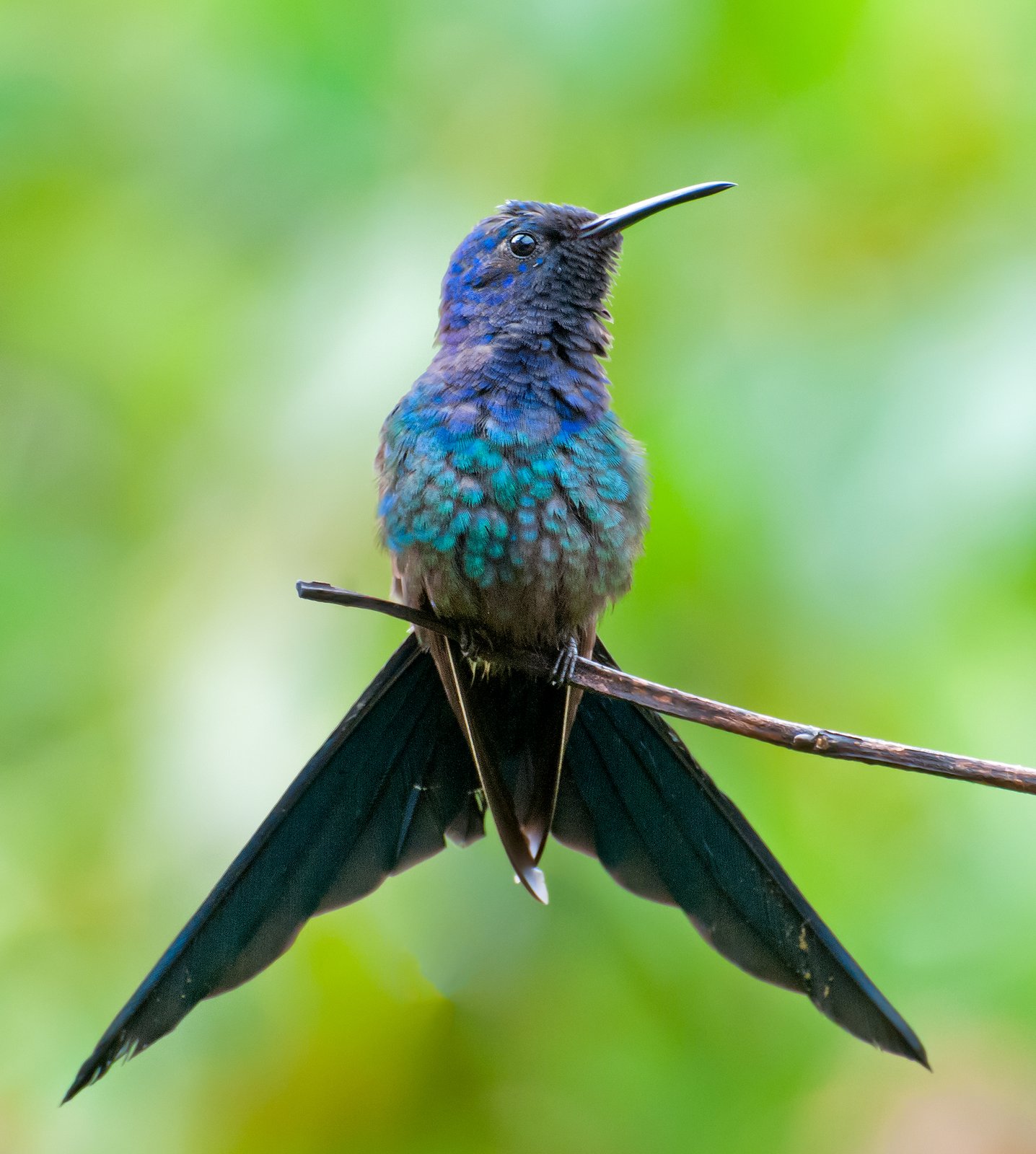
The Swallow-tailed Hummingbird is a large hummingbird of savannas and semi-open country, with a long, deeply forked tail. The head, breast and tail are dark blue, the rest of the body is green. It vigorously defends flowering trees and shrubs against other hummingbirds. In the guide area it lives mainly in the lowlands of Bolivia.
Voice
Fairly loud psek calls and weaker twitters; when excited or alarmed a dry tik.
Recording: Ricardo José Mitidieri — CC BY-NC-SA 4.0 · xeno-canto
Identification
15–17 cm, almost half of which is tail, with a medium-length, slightly decurved, black bill. The male has a glittering dark blue head, throat and upper breast; the back, belly and flanks are glittering green. The tail is long, deeply forked and steel-blue to dark violet-blue, and the undertail coverts are blue. The flight feathers are blackish brown; there are white leg puffs. The female is duller and about a quarter smaller, with a shorter tail; young birds have a dull, brownish-tinged head. The Bolivian subspecies is greener, the Peruvian one has duller blue and a less deeply forked tail.
Confusion species
Fork-tailed Woodnymph Thalurania furcata is smaller, with a violet belly and back band in the male, and lives in the interior of humid forest. Blue-tailed Emerald Chlorostilbon mellisugus is much smaller, with a short tail. The male Blue-tufted Starthroat Heliomaster furcifer has a long, straight bill and a blue breast with a violet throat, but a green back and a less forked tail. The female White-necked Jacobin Florisuga mellivora has scaled underparts and a short tail.
Habitat
Savanna, cerrado, semi-open woodland, gallery forest, forest edges, clearings, parks and gardens in the lowlands, up to about 1000 m, locally to 1500 m. It avoids the interior of humid forest. It feeds at flowering trees, shrubs and garden plants, chasing other hummingbirds away, and also catches insects in flight. The nest is a cup of plant down on a horizontal branch.
Where the bird is most at home, classified by the vegetation units of the Andes and the west coast.


Range and movements
In Peru only in the southeast, in isolated savannas and semi-open enclaves within Amazonia, such as the Pampas del Heath and the upper Urubamba. In Bolivia widespread in the lowlands of the north and east. Absent from Colombia, Ecuador and the Galápagos. Outside the guide area in much of Brazil, the Guianas, northern Paraguay and north-eastern Argentina.
- Resident
- dark = core range, pale = thinly spread
How and when to look
In Bolivia, search flowering trees in savannas, villages and town parks in the lowlands; identify the bird by its size and long, forked tail when it chases other hummingbirds.
Conservation status
Least Concern. The species has a very large range, also occurs in towns and gardens, and is expanding in southern Brazil.
Scientific name
Eupetomena macroura | (Gmelin, 1788)
Gmelin described the species in 1788 as Trochilus macrourus; because it was later moved to another genus, the author and year stand in brackets. The genus Eupetomena was introduced in 1853 by Gould. The genus name combines Greek eu, 'good', with petomenos, 'flying' or 'always on the wing'. The species name comes from Greek makros, 'long', and -ouros, '-tailed', referring to the long forked tail. The specimen the first description was based on came from Cayenne, French Guiana.