All species › Swifts › Hummingbirds › Olive-spotted Hummingbird
Olive-spotted Hummingbird | Talaphorus chlorocercus
Olijfvlekkolibrie | Colibrí blanquioliva | Beija-flor-de-pintas-oliva
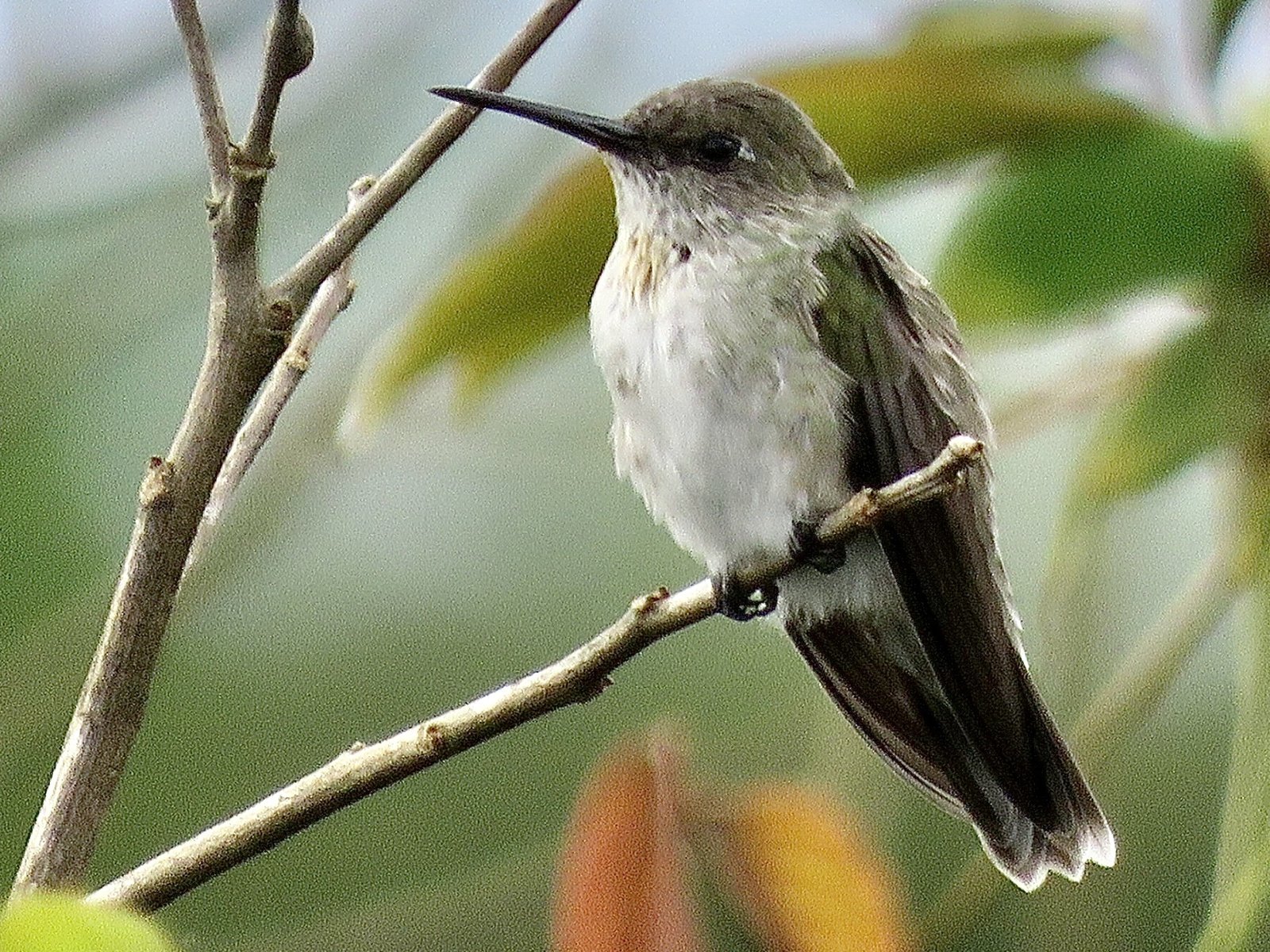
The Olive-spotted Hummingbird is a dull green and white hummingbird that lives almost exclusively on young river islands in the western Amazon basin. It is tied to the pioneer scrub that grows on newly formed sandbars. This places it in a small group of birds specialised in this dynamic river habitat.
Voice
A monotonous series of multisyllabic notes as song; calls are a sharp seek, a wiry seeuee, a rich chatter and a hard tcht.
Recording: Robert S. Ridgely — CC BY-NC-SA 4.0 · xeno-canto
Identification
11–12 cm, with a straight, blackish bill; the female has a slightly longer bill. The crown and neck are bronze, the upperparts greyish green to bronze-green. There is a small white spot behind the eye. The throat is olive-green, sometimes with golden-green spots; the rest of the underparts are whitish. The tail is pale greyish green to olive, with grey tips to the inner feathers and a dark subterminal band on the outer feathers. The sexes are nearly alike; young birds are greyer brown below.
Confusion species
Many-spotted Hummingbird Taphrospilus hypostictus is more densely and sharply spotted with green on white underparts and lives in the Andean foothills. Glittering-throated Emerald Chionomesa fimbriata has a glittering green throat and breast, a pink lower mandible and a dark tail. The female Fork-tailed Woodnymph Thalurania furcata is grey below, with a dark blue, forked tail, and lives inside the forest. Spot-throated Hummingbird Thaumasius taczanowskii is very similar to this species, but lives far away, on the western slope of the Andes in Peru.
Habitat
Pioneer scrub, young Tessaria and willow thickets, rank growth and open woodland on young river islands and sandbars, sometimes also on the adjacent bank, up to about 400 m. It feeds at the flowers of shrubs and vines in the scrub and catches small insects. The nest is a cup of plant down on a branch above the ground.
Where the bird is most at home, classified by the vegetation units of the Andes and the west coast.


Range and movements
In Colombia in the far southeast, along the Amazon. In Ecuador in the east, along the large rivers such as the Napo. In Peru in the northeast, along the Amazon and the lower reaches of its large tributaries. Absent from Bolivia and the Galápagos. Outside the guide area in north-western Brazil, along the upper Amazon and its major tributaries.
- Resident
- dark = core range, pale = thinly spread
How and when to look
Take a boat to young river islands in the Amazon or the Napo, for example near Iquitos or Leticia, and search the low, dense scrub with flowering shrubs and vines.
Conservation status
Least Concern. Its habitat is constantly renewed by river dynamics; the species therefore depends mainly on free-flowing rivers with natural deposition of sediment.
Scientific name
Talaphorus chlorocercus | (Gould, 1866)
Gould described the species in 1866 as Leucippus chlorocercus; because it was later moved to another genus, the author and year stand in brackets. The genus Talaphorus was introduced in 1874 by Mulsant & Verreaux. The origin of the genus name is unclear; the second part may come from Greek -phoros, 'bearing'. The specific name comes from Greek khlōros, 'green', and kerkos, 'tail'. The specimen the first description was based on came from Upper Ucayali River, Peru.