All species › Swifts › Hummingbirds › Steely-vented Hummingbird
Steely-vented Hummingbird | Saucerottia saucerottei
Blauwbuikamazilia | Amazilia coliazul | Beija-flor-de-crisso-azul
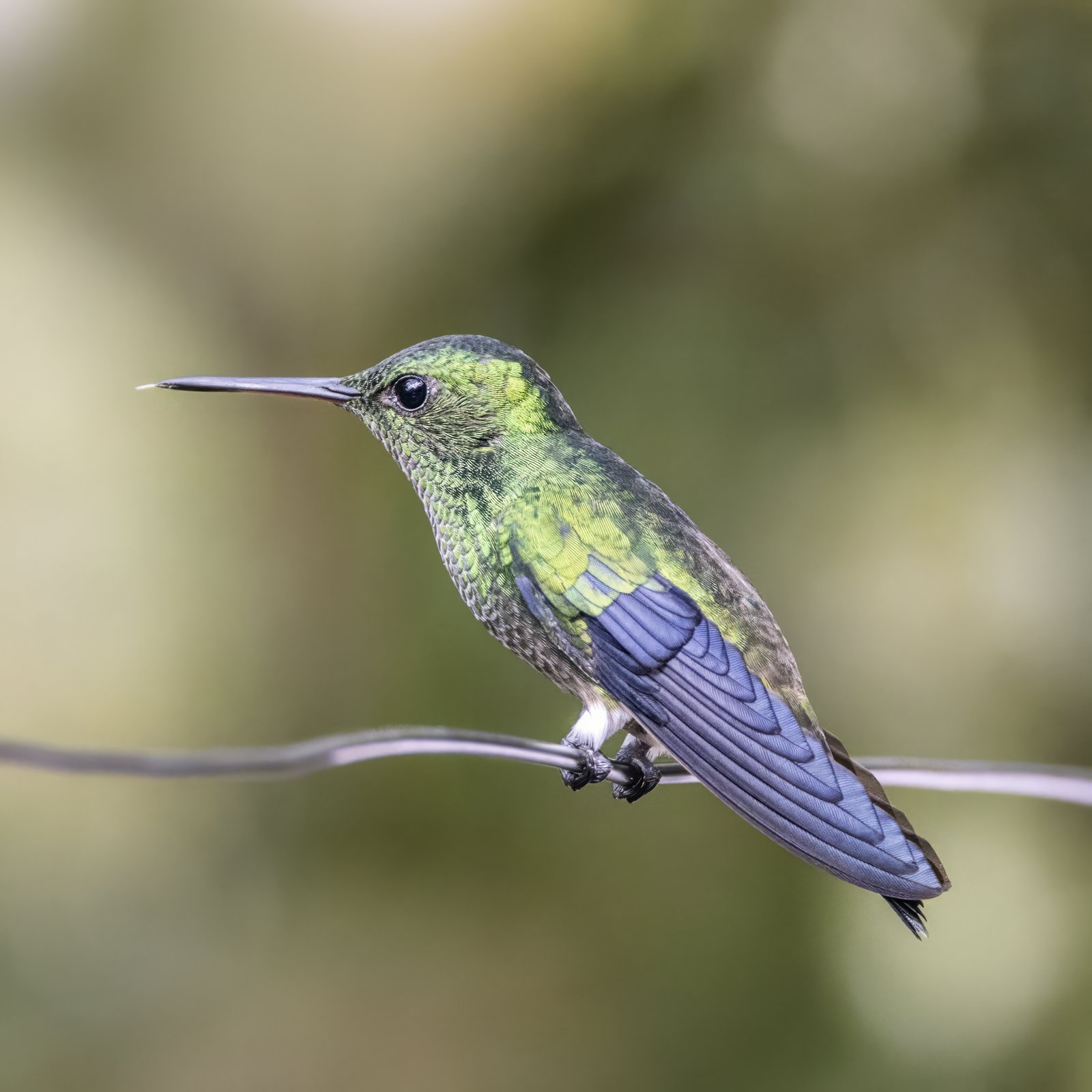
The Steely-vented Hummingbird is a small, entirely green hummingbird of dry and semi-open areas in northern and western Colombia and north-western Venezuela. It is characterised by its blue-black tail and steel-blue undertail coverts. It is common in gardens, plantations and scrub.
Voice
A high, sharp tsit or dry chit, sometimes in sputtering series. The song has not been well described.
Recording: Carolina Bravo B — CC BY-NC-SA 4.0 · xeno-canto
Identification
9–10 cm, with a straight, black bill with a pink to reddish base to the lower mandible. The male is golden-green above and dark glittering golden-green below; the tail and uppertail coverts are blue-black, the undertail coverts greenish to steel-blue. There are white leg puffs. The female has some white in the throat feathers and greyish-brown undertail coverts. Young birds are duller, with a partly grey throat, a greyish-brown belly and brown feather edges on the back and rump. The northern subspecies has purplish- to blue-tinged uppertail coverts.
Confusion species
Green-bellied Hummingbird Saucerottia viridigaster has a purplish-brown to coppery tail and lives mainly on the eastern slope of the Eastern Andes. Indigo-capped Hummingbird Saucerottia cyanifrons has a blue crown. Blue-tailed Emerald Chlorostilbon mellisugus is smaller, with an all-black bill and a steely blue, slightly forked tail. Red-billed Emerald Chlorostilbon gibsoni has a largely red bill and a slightly forked tail. Glittering-throated Emerald Chionomesa fimbriata has a white central stripe on the belly and a bronzy tail.
Habitat
Semi-open to open country, often somewhat dry: scrub, savanna, forest edges, secondary woodland, plantations, coffee-growing areas and gardens, from sea level to about 1500 m, locally higher. It feeds at the flowers of shrubs, trees and garden plants, also at feeders, and catches small insects. The nest is a cup of plant down on a thin branch.
Where the bird is most at home, classified by the vegetation units of the Andes and the west coast.


Range and movements
In Colombia in the Caribbean lowlands from Sucre eastward, in the Cauca valley and on the western slope of the Western Andes, and locally in the Magdalena valley. Absent from Ecuador, Peru, Bolivia and the Galápagos. Outside the guide area in north-western Venezuela and the Venezuelan Andes.
- Resident
- dark = core range, pale = thinly spread
How and when to look
Search gardens, coffee plantations and flowering hedges in the Cauca valley and the Caribbean lowlands of Colombia; the bird also visits feeders at lodges and houses.
Conservation status
Not Evaluated. The species has recently been treated in a narrower sense, separate from the Central American Blue-vented Hummingbird Saucerottia hoffmanni, and has no assessment of its own as a separate species yet. It is common in farmland and does not appear to be threatened.
Scientific name
Saucerottia saucerottei | (Delattre & Bourcier, 1846)
Delattre & Bourcier described the species in 1846 as Trochilus Saucerrottei; because it was later moved to another genus, the author and year stand in brackets. The genus Saucerottia was introduced in 1850 by Bonaparte. The genus name is taken from the specific epithet saucerrottei of the Steely-vented Hummingbird, honouring the French physician and ornithologist Antoine Constant Saucerotte. The specific name honours the French physician and ornithologist Antoine Constant Saucerotte; Delattre and Bourcier coined it in 1846. The specimen the first description was based on came from Cali, Colombia.