All species › Swifts › Hummingbirds › Indigo-capped Hummingbird
Indigo-capped Hummingbird | Saucerottia cyanifrons
Blauwkapamazilia | Amazilia capiazul | Beija-flor-de-coroa-índigo
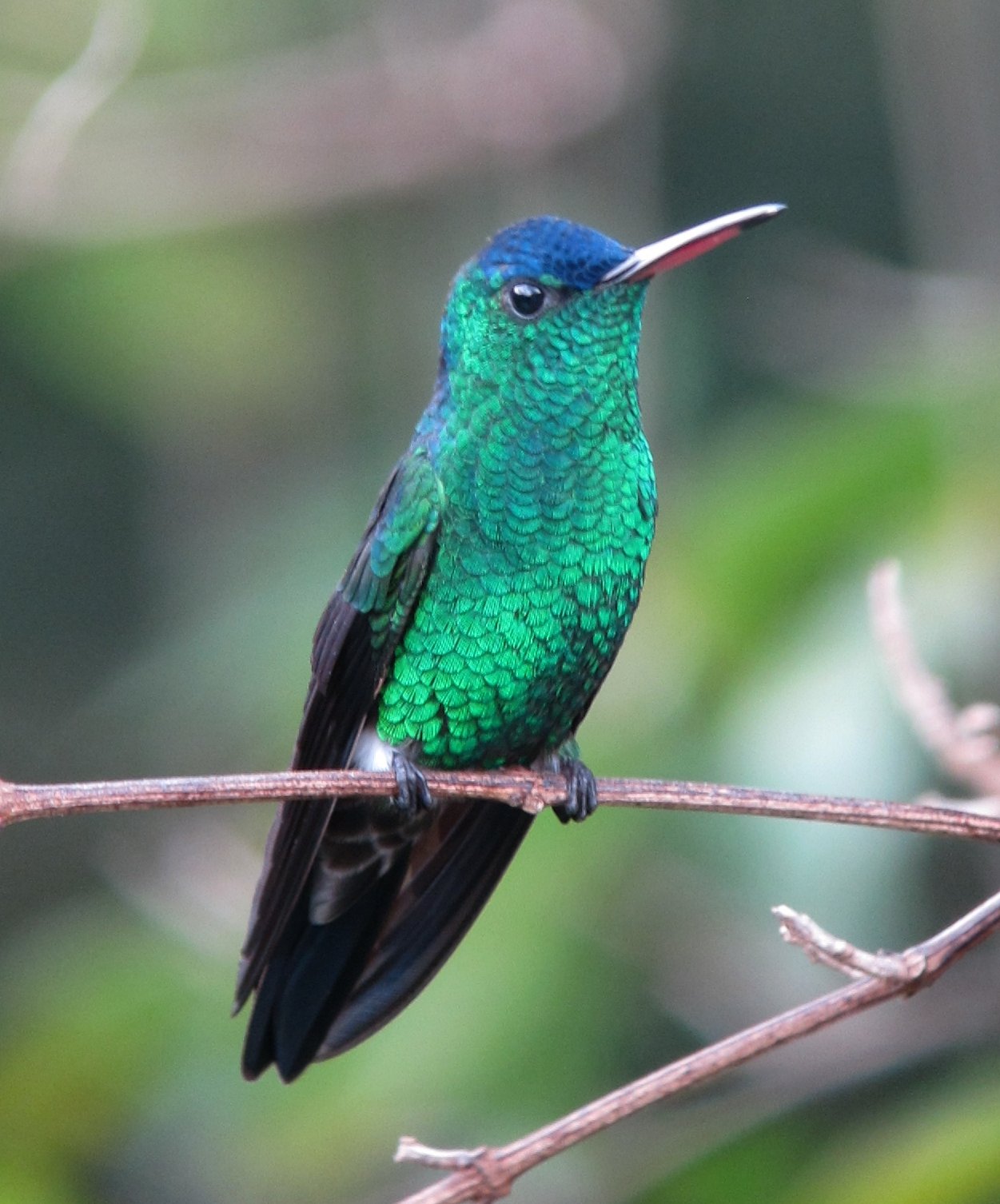
The Indigo-capped Hummingbird is a medium-sized hummingbird found only in Colombia. The male has an indigo-blue crown above a glittering golden-green body and a steel-blue tail. It lives mainly in semi-open, fairly dry country in the Magdalena and Cauca valleys and also visits gardens and coffee plantations.
Voice
The song is a repeated, buzzy, squeaky phrase, rendered as tzuk-keee … tsrp. The call is a high, sharp tsit, sometimes in series.
Recording: Jerome Fischer — CC BY-NC-SA 4.0 · xeno-canto
Identification
9–10 cm, with a straight, medium-length bill that is black with a red base to the lower mandible. The male has an indigo-blue crown, green upperparts with a bronze to coppery rump, glittering golden-green underparts and a dark steel-blue tail; the undertail coverts are bronze-green to dark blue with pale edges. The female has a less blue crown, turquoise mainly towards the rear, and greyish bars on the throat feathers. Young birds resemble the female, with a greyer belly.
Confusion species
Green-bellied Hummingbird Saucerottia viridigaster has a green crown, a brownish rump and a greyish-brown vent, and lives on the eastern slope of the Eastern Andes. Steely-vented Hummingbird Saucerottia saucerottei has a green crown and steel-blue undertail coverts. Andean Emerald Uranomitra franciae also has a blue crown in the male, but a white belly and a bronze-green tail. Rufous-tailed Hummingbird Amazilia tzacatl has a grey belly and a rufous tail.
Habitat
Semi-open to open country: forest edges, scrub, savanna with trees, plantations, shade coffee and gardens, mostly in fairly dry areas. Most numerous between 1000 and 2000 m, regularly down to 400 m in the breeding season and rarely up to 3000 m; it moves with the flowering of its food plants. It takes nectar from flowers and catches small insects. The cup nest is made of moss, cobweb and lichen; the clutch is two eggs.
Where the bird is most at home, classified by the vegetation units of the Andes and the west coast.


Range and movements
Endemic to Colombia: in the north and centre of the country, mainly in Norte de Santander, on the slopes of the Magdalena valley (Santander, Cundinamarca, Tolima, Huila) and in the upper Cauca valley. Absent from Ecuador, Peru, Bolivia and the Galápagos.
- Resident
- dark = core range, pale = thinly spread
How and when to look
Look at flowering shrubs and feeders in gardens and coffee farms on the slopes above the Magdalena valley, for example in Cundinamarca and Tolima.
Conservation status
Least Concern. The species tolerates man-made habitats and occurs in gardens and plantations.
Scientific name
Saucerottia cyanifrons | (Bourcier, 1843)
Bourcier described the species in 1843 as Trochilus cyanifrons; because it was later moved to another genus, the author and year stand in brackets. The genus Saucerottia was introduced in 1850 by Bonaparte. The genus name is taken from the specific epithet saucerrottei of the Steely-vented Hummingbird, honouring the French physician and ornithologist Antoine Constant Saucerotte. The specific name comes from Greek kuanos, 'dark blue', and Latin frons, 'forehead'. The specimen the first description was based on came from Ibagué, Colombia.