All species › Passerines › Ovenbirds and woodcreepers › Narrow-billed Woodcreeper
Narrow-billed Woodcreeper | Lepidocolaptes angustirostris
Wenkbrauwmuisspecht | Trepatroncos chico | Arapaçu-de-cerrado
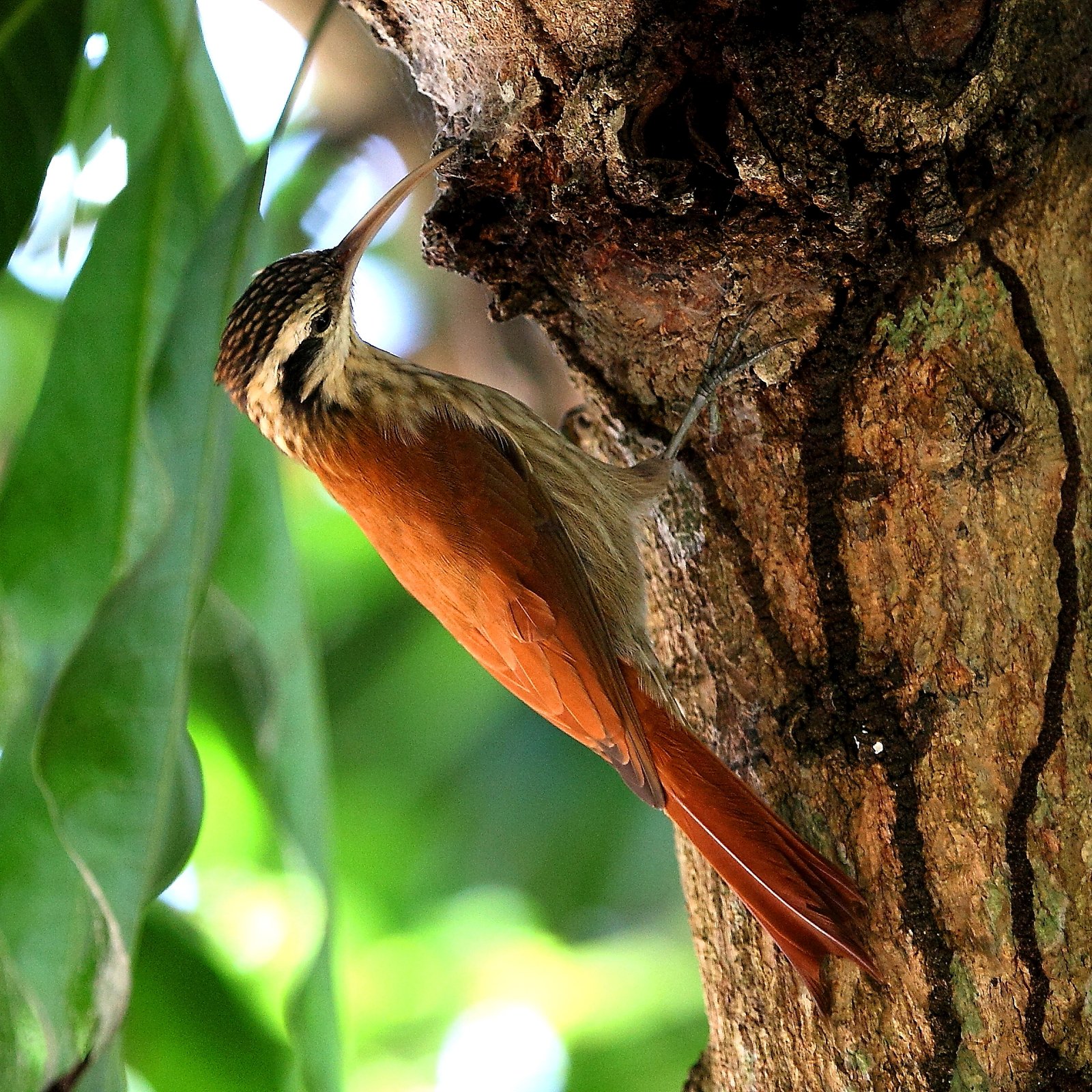
The Narrow-billed Woodcreeper is the woodcreeper of open, dry woodland and savanna in the interior of South America. A broad white supercilium and pale underparts set it apart from almost all other woodcreepers. It lives in pairs and is often seen in open country with scattered trees.
Voice
The song is a loud series of clear whistles, first rising and accelerating, then falling and slowing. The call is a sharp, descending chew.
Recording: JAYRSON ARAUJO DE OLIVEIRA — CC BY-NC-SA 4.0 · xeno-canto
Identification
19–22 cm, slender, with a long, thin, slightly decurved, pale bill. The upperparts are warm rufous-brown, with a dark, finely streaked crown. A broad white supercilium extends to the nape, with a dark eyestripe below it. The throat and underparts are whitish to pale buff with narrow brown streaks. Birds from Bolivia are on average darker and more heavily streaked below. The sexes are alike.
Confusion species
Scimitar-billed Woodcreeper Drymornis bridgesii also has a white supercilium, but is much larger, with a very long, dark bill, and often walks on the ground. Streak-headed Woodcreeper Lepidocolaptes souleyetii lacks the white supercilium and has darker underparts, but does not share its range in the guide area. Olivaceous Woodcreeper Sittasomus griseicapillus is smaller, with a short, straight bill and an unstreaked, greyish-olive head and breast.
Habitat
Open dry woodland, Chaco, cerrado, savanna with scattered trees, gallery forest, parks and trees in farmland, in Bolivia also dry Andean valleys up to about 2500 m. It climbs trunks and branches and searches bark and crevices for insects and spiders. The nest is in a tree cavity or behind loose bark.
Where the bird is most at home, classified by the vegetation units of the Andes and the west coast.


Range and movements
Bolivia: widespread in the lowlands of the north, centre and east, in the Chaco and in dry valleys on the eastern slope of the Andes. Peru: only in the far south-east, in the savanna of the Pampas del Heath. Absent from Colombia, Ecuador and the Galápagos. Outside the guide area in Brazil, Paraguay, Argentina and Uruguay.
- Resident
- dark = core range, pale = thinly spread
How and when to look
In open woodland, savanna and Chaco in Bolivia, look for a pale woodcreeper with a broad white supercilium, usually in pairs. In the early morning the clear whistled series carry a long way.
Conservation status
Least Concern. The species has a very large range and tolerates open, partly agricultural country with trees.
Scientific name
Lepidocolaptes angustirostris | (Vieillot, 1818)
Vieillot described the species in 1818 as Dendrocopus angustirostris; because it was later moved to another genus, the author and year stand in brackets. The genus Lepidocolaptes was introduced in 1853 by Reichenbach. The genus name combines Greek lepis, 'scale', with kolaptēs, 'pecker', after the scaly plumage. The species name comes from Latin angustus, 'narrow', and rostrum, 'bill': 'narrow-billed'. The specimen the first description was based on came from Paraguay.