All species › Passerines › Ovenbirds and woodcreepers › Streak-headed Woodcreeper
Streak-headed Woodcreeper | Lepidocolaptes souleyetii
Streepkopmuisspecht | Trepatroncos corona rayada | Arapaçu-listrado
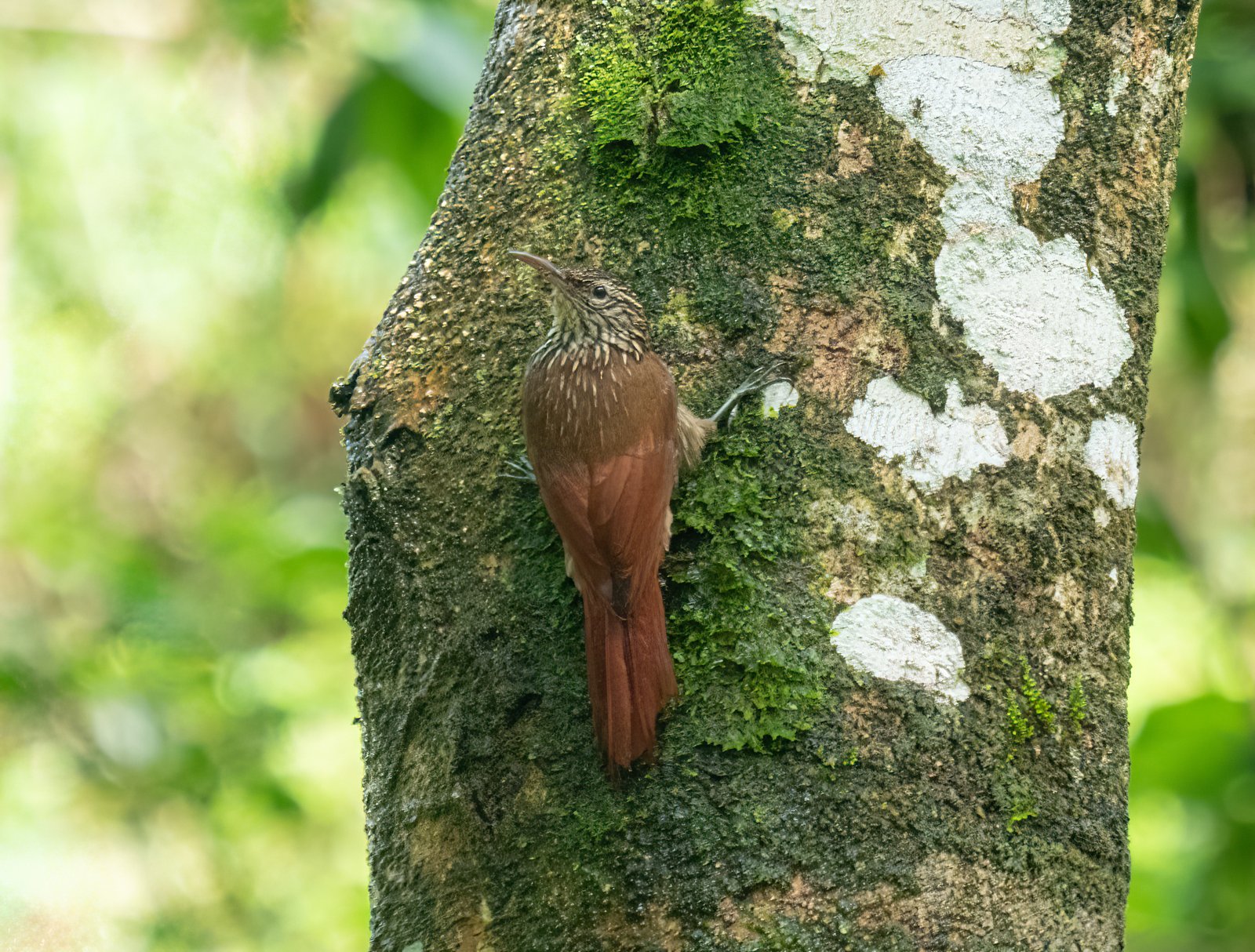
The Streak-headed Woodcreeper is a medium-sized, slender woodcreeper of dry and semi-open lowland woodland, with a thin, decurved, pale bill. It lives in pairs or joins mixed-species flocks and tolerates forest edge, plantations and wooded gardens. In the guide area it is the woodcreeper of the lowlands west and north of the Andes.
Voice
The song is a high, fast, slightly descending trill, tee-ee-ee-ee-ee-ee, slowing a little towards the end. The call is a short, sharp cheet.
Recording: Juan Freile — CC BY-NC-SA 4.0 · xeno-canto
Identification
19–21 cm, slender, with a thin, slightly decurved, pinkish-horn bill and a rufous tail. The crown and nape are dark brown with fine pale streaks; the back is almost unstreaked brown, the wings and rump rufous. The face shows a faint pale supercilium. The throat is pale buff, and the breast and belly brown with narrow, pale, dark-edged streaks. The sexes are alike.
Confusion species
Montane Woodcreeper Lepidocolaptes lacrymiger has a spotted rather than streaked crown and broader, drop-shaped streaks below, and lives higher in the Andes. Straight-billed Woodcreeper Dendroplex picus has a straight, dagger-shaped, pale bill and a whiter throat. Cocoa Woodcreeper Xiphorhynchus susurrans is larger, with a heavier, straighter bill and a buff throat. Wedge-billed Woodcreeper Glyphorynchus spirurus is much smaller, with a short, wedge-shaped bill.
Habitat
Dry and humid lowland forest, forest edge, gallery forest, open woodland with scattered trees, shade coffee and cacao, mangroves and wooded gardens, from sea level to about 1500 m. It climbs trunks and larger branches, also high in the trees, and searches bark and crevices for insects and spiders. The nest is in a tree cavity or crevice.
Where the bird is most at home, classified by the vegetation units of the Andes and the west coast.


Range and movements
Colombia: in the Caribbean lowlands, in the Magdalena and Cauca valleys, along the Pacific coast and in the north-east, including the edge of the Llanos. Ecuador: in the lowlands and foothills west of the Andes. Peru: in the north-west, in the dry forest of Tumbes, Piura and adjacent areas. Absent from Bolivia and the Galápagos. Outside the guide area from southern Mexico to Venezuela, the Guianas, northern Brazil and Trinidad.
- Resident
- dark = core range, pale = thinly spread
How and when to look
In dry forest and forest edge in western Ecuador and north-western Peru, look for a slender brown woodcreeper with a streaked head, often in pairs or with mixed flocks. The high, descending trill is often the first clue.
Conservation status
Least Concern. The species has a very large range, is locally common and tolerates semi-open country with trees.
Scientific name
Lepidocolaptes souleyetii | (des Murs, 1849)
Des Murs described the species in 1849 as Dendrocolaptes Souleyetii; because it was later moved to another genus, the author and year stand in brackets. The genus Lepidocolaptes was introduced in 1853 by Reichenbach. The genus name combines Greek lepis, 'scale', with kolaptēs, 'pecker', after the scaly plumage. The species name honours Louis François Auguste Souleyet (1811–1852), French naval surgeon and naturalist on the round-the-world voyage of La Bonite (1836–1837). The specimen the first description was based on came from Paita, Piura, Peru.