All species › Passerines › Ovenbirds and woodcreepers › Spotted Barbtail
Spotted Barbtail | Premnoplex brunnescens
Vlekborstboomloper | Subepalo moteado | Rabo-de-espinho-pintado
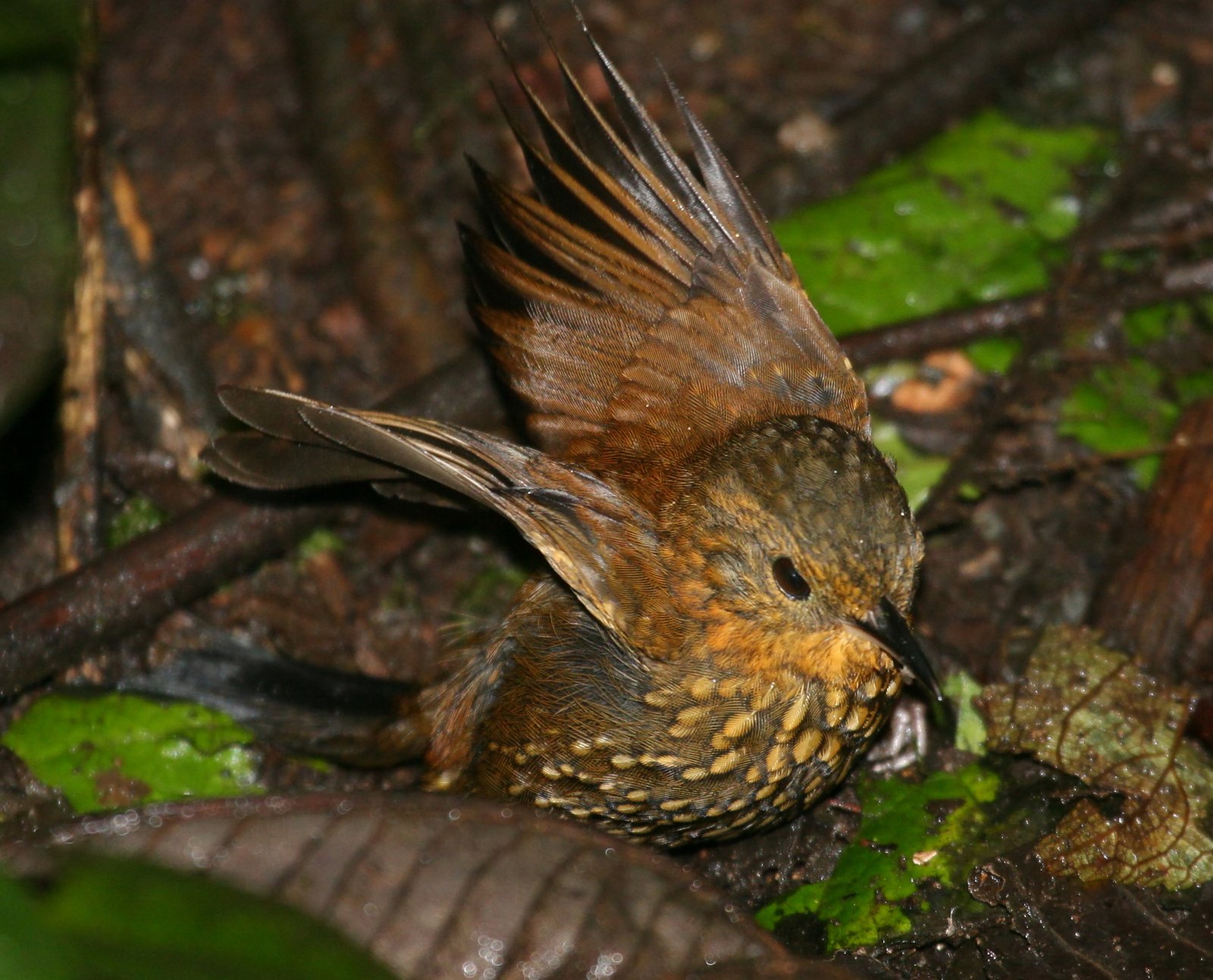
The Spotted Barbtail is a small, dark brown ovenbird of the lower levels of humid montane forest. It climbs mossy trunks and branches, bracing itself on its tail, whose shafts project as short spines. The pale droplet spots on the throat and breast are characteristic.
Voice
The song is a high, thin, fast trill lasting a few seconds. The call is a sharp, high tseet.
Recording: Juan Freile — CC BY-NC-SA 4.0 · xeno-canto
Identification
13–14 cm, with a short, straight bill. The upperparts are dark rufous-brown, the tail dark and stiff, with projecting shaft tips. A narrow buff supercilium. The throat is buff with fine dark scaling; the breast and belly are dark brown with numerous round, buff, dark-edged spots. The sexes are alike. Juveniles are duller, with less distinct spots.
Confusion species
Rusty-winged Barbtail Premnornis guttuliger has rufous wings and tail, pale streaks instead of round spots and climbs trunks less. Pearled Treerunner Margarornis squamiger is bright rufous above, with a white throat and white droplets on the underparts, and lives higher. Star-chested Treerunner Margarornis stellatus is more rufous, with a white throat and only a few spots on the breast.
Habitat
Humid montane forest and cloud forest, especially in dark ravines and along streams, mostly between 900 and 2800 m. It forages alone or in pairs, often in mixed flocks, on trunks, mossy branches and epiphytes for insects and spiders, usually low down. The nest is a ball of moss with a side entrance, hanging under an overhanging bank, a rock or a fallen log.
Where the bird is most at home, classified by the vegetation units of the Andes and the west coast.


Range and movements
Colombia: in all three Andean ranges, the Sierra de Perijá and the Sierra Nevada de Santa Marta. Ecuador: on both slopes of the Andes. Peru: along the eastern slope of the Andes the length of the country. Bolivia: on the eastern slope in La Paz and Cochabamba. Absent from the Galápagos. Outside the guide area in Costa Rica, Panama and Venezuela.
- Resident
- dark = core range, pale = thinly spread
How and when to look
Search along streams and in ravines in cloud forest and look for small dark birds climbing low on mossy trunks. They often join mixed flocks of tanagers and ovenbirds.
Conservation status
Least Concern. The species is widespread over a large area, but depends on forest and disappears where montane forest is cleared.
Scientific name
Premnoplex brunnescens | (Sclater, 1856)
Sclater described the species in 1856 as Margarornis brunnescens; because it was later moved to another genus, the author and year stand in brackets. The genus Premnoplex was introduced in 1891 by Cherrie. The genus name combines Greek premnon, 'tree trunk', and plēssō, 'to strike'. The species name brunnescens is Late Latin for 'brownish'. The specimen the first description was based on came from Bogotá, Colombia.