All species › Passerines › Ovenbirds and woodcreepers › Rufous-tailed Xenops
Rufous-tailed Xenops | Microxenops milleri
Roodstaartxenops | Xenops colirrufo | Bico-virado-da-copa
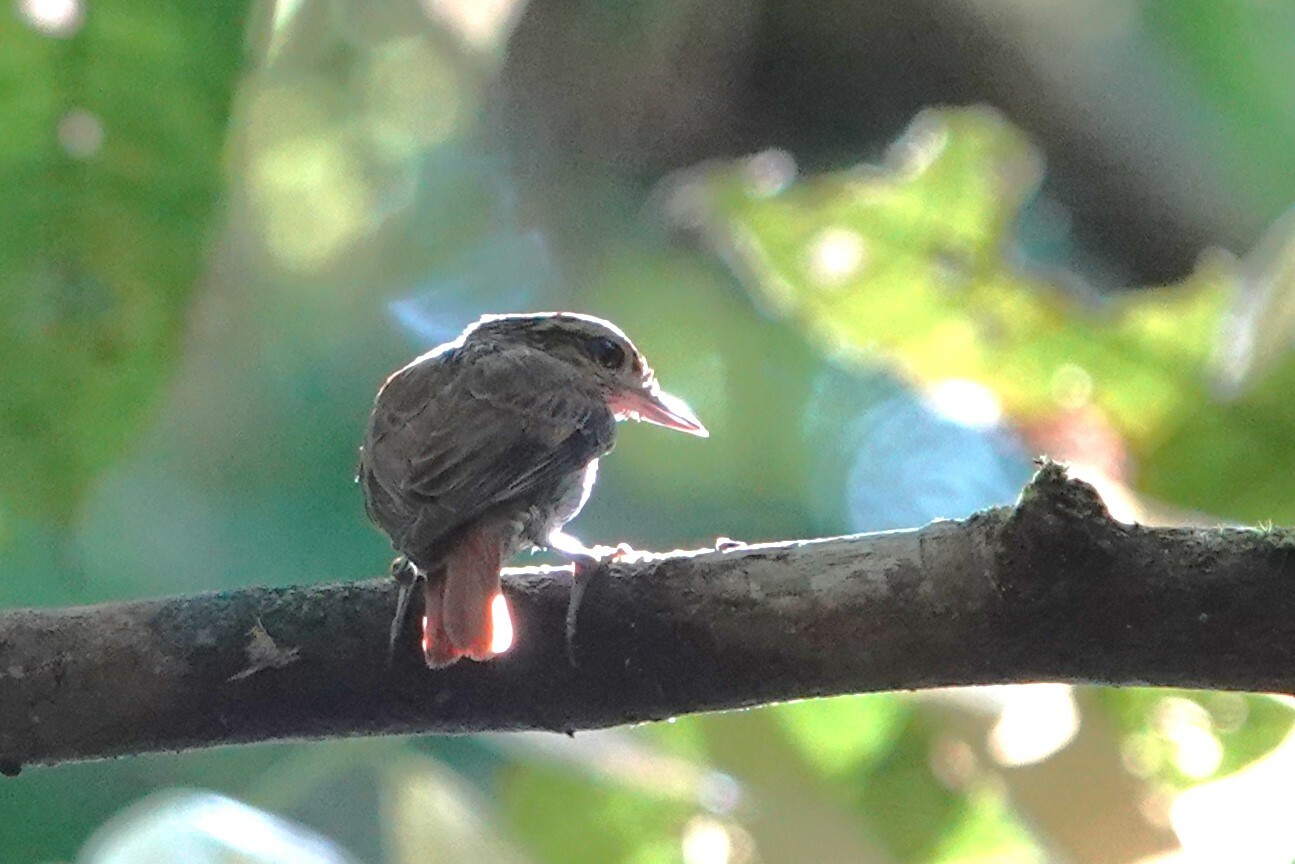
The Rufous-tailed Xenops is a small, streaked ovenbird of the high canopy of Amazonian forest. Despite its name, it lacks the upturned bill of the true xenops and is placed in its own genus. It forages along branches and vines high in the crowns, usually in mixed flocks.
Voice
The song is a fast, high, dry trill or rattle, a few seconds long. The call is a short, sharp tseet.
Recording: Jerome Fischer — CC BY-NC-SA 4.0 · xeno-canto
Identification
10–11 cm, small, with a short, straight, pointed bill. The upperparts are brown with pale buff streaks on the crown and mantle; the rump and tail are entirely rufous, without black. A narrow pale supercilium; no white cheek stripe. The underparts are olive-brown with pale buff streaks. In flight a cinnamon band across the wing. The sexes are alike.
Confusion species
Slender-billed Xenops Xenops tenuirostris and Streaked Xenops Xenops rutilans have an upturned bill, a white cheek stripe and black in the tail. Small foliage-gleaners and leaftossers are larger and rarely stay this high in the crowns.
Habitat
The canopy of tall, humid lowland forest on terra firme, less in várzea and at forest edges, mostly below 900 m. It searches branches, vines and dead leaves for insects and spiders, often in canopy mixed flocks. The nest is in a cavity in a tree.
Where the bird is most at home, classified by the vegetation units of the Andes and the west coast.


Range and movements
Colombia: in the Amazonian lowlands in the south-east. Ecuador: in the eastern lowlands. Peru: in the Amazonian lowlands. Bolivia: in the lowlands of the north. Absent from the Galápagos. Outside the guide area in southern Venezuela, the Guianas and Brazilian Amazonia.
- Resident
- dark = core range, pale = thinly spread
How and when to look
Watch mixed flocks from a canopy tower or a clearing with a view of the canopy; the xenops forages along the outer branches. The dry trill gives it away.
Conservation status
Least Concern. The species has a large range, but depends on tall forest and disappears with deforestation.
Scientific name
Microxenops milleri | Chapman, 1914 (GBIF: Xenops milleri)
Chapman described the species in 1914 and placed it straight away in the genus where it still stands. He introduced the genus Microxenops in that same work. The genus name combines Greek mikros, 'little', with the genus Xenops: 'little xenops'. The species name milleri honours Leo Edward Miller (1887–1952), an American collector who worked in tropical America from 1910 to 1917. The specimen the first description was based on came from Cerro Duida, Amazonas, Venezuela.