All species › Passerines › Antbirds › Natterer's Slaty Antshrike
Natterer's Slaty Antshrike | Thamnophilus stictocephalus
Natterers mierklauwier | Batará pizarroso de Natterer | Choca-de-natterer
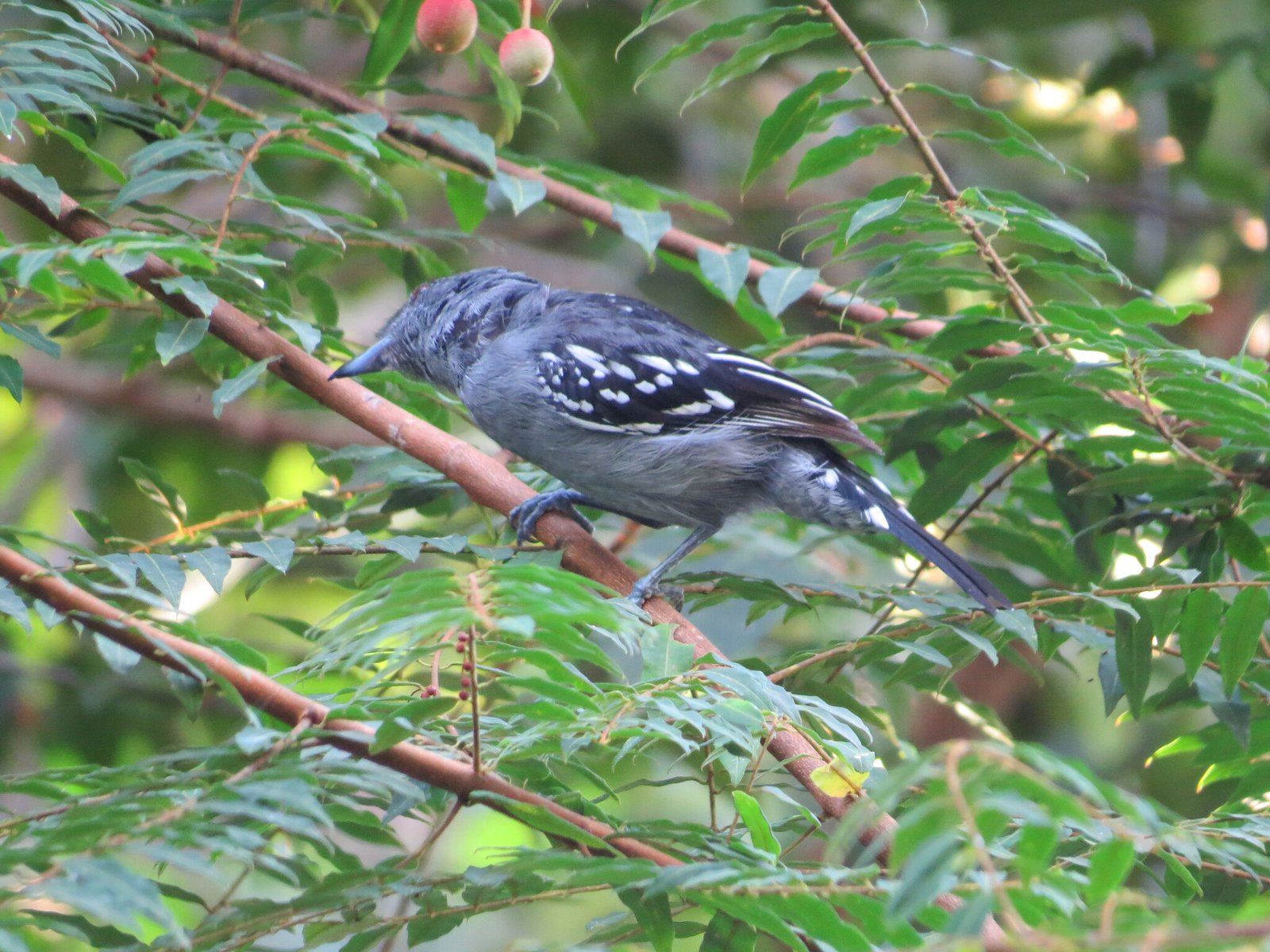
Natterer's Slaty Antshrike is a small grey antshrike with white wing spots, one of the six species into which the former Slaty Antshrike has been split. It is named after the Austrian collector Johann Natterer. In the guide area it lives only in northern and north-eastern Bolivia; the main range lies in Brazil south of the Amazon.
Voice
The song is a series of level, nasal notes that starts slowly and accelerates into a bouncing rattle of 3–4 seconds. Calls are a short and a long kaw and an abrupt growl.
Recording: JAYRSON ARAUJO DE OLIVEIRA — CC BY-NC-SA 4.0 · xeno-canto
Identification
14–15 cm. The male has a black forehead with grey spots and a black crown, a mixed black-and-grey back with a concealed white patch, black wings with white spots and edges, a black tail with white tips and grey underparts with a whitish belly. The female has a rufous crown, reddish yellow-brown upperparts, dark brown wings with white spots and a mix of pale buff and grey on the underparts, paler on the throat and belly. In the Serranía de Huanchaca the male is greyer on the back and paler below.
Confusion species
Bolivian Slaty Antshrike Thamnophilus sticturus is almost identical; the male is paler grey with more white on the belly, and the song rises towards the end. Amazonian Antshrike Thamnophilus amazonicus has a female with an orange-brown head and breast. Variable Antshrike Thamnophilus caerulescens lives higher in the Andes. Plain-winged Antshrike Thamnophilus schistaceus lacks the white wing spots.
Habitat
Edges of humid evergreen forest, treefall gaps, woodland on white sand, semi-deciduous forest and gallery forest; in the Serranía de Huanchaca edges of evergreen forest within grassland and cerrado. From sea level to 700 m. It forages in pairs in the understorey and mid-storey and searches foliage for insects.
Where the bird is most at home, classified by the vegetation units of the Andes and the west coast.


Range and movements
Bolivia: in northern Beni and in the Serranía de Huanchaca in extreme north-eastern Santa Cruz. Absent from Colombia, Ecuador, Peru and the Galápagos. Outside the guide area in Brazil south of the Amazon, between the Madeira and the Tocantins, south to Rondônia and northern and western Mato Grosso.
- Resident
- dark = core range, pale = thinly spread
How and when to look
Look for the species at forest edges in Noel Kempff Mercado National Park. Listen for the accelerating, bouncing rattle; compare the song with that of Bolivian Slaty Antshrike, which lives farther south.
Conservation status
Least Concern. The range is large; the species tolerates forest edges and secondary forest.
Scientific name
Thamnophilus stictocephalus | Pelzeln, 1868
Pelzeln described the species in 1868 and placed it straight away in the genus where it still stands. The genus Thamnophilus was introduced in 1816 by Vieillot. The genus name comes from Greek thamnos, 'bush', and philos, 'loving': bush-lover. The species name comes from Greek stiktos, 'spotted', and kephalē, 'head'. The specimen the first description was based on came from São Vicente, Mato Grosso, Brazil.