All species › Passerines › Antbirds › Northern Slaty Antshrike
Northern Slaty Antshrike | Thamnophilus punctatus
Noordelijke gevlekte mierklauwier | Batará pizarroso norteño | Choca-bate-cabo
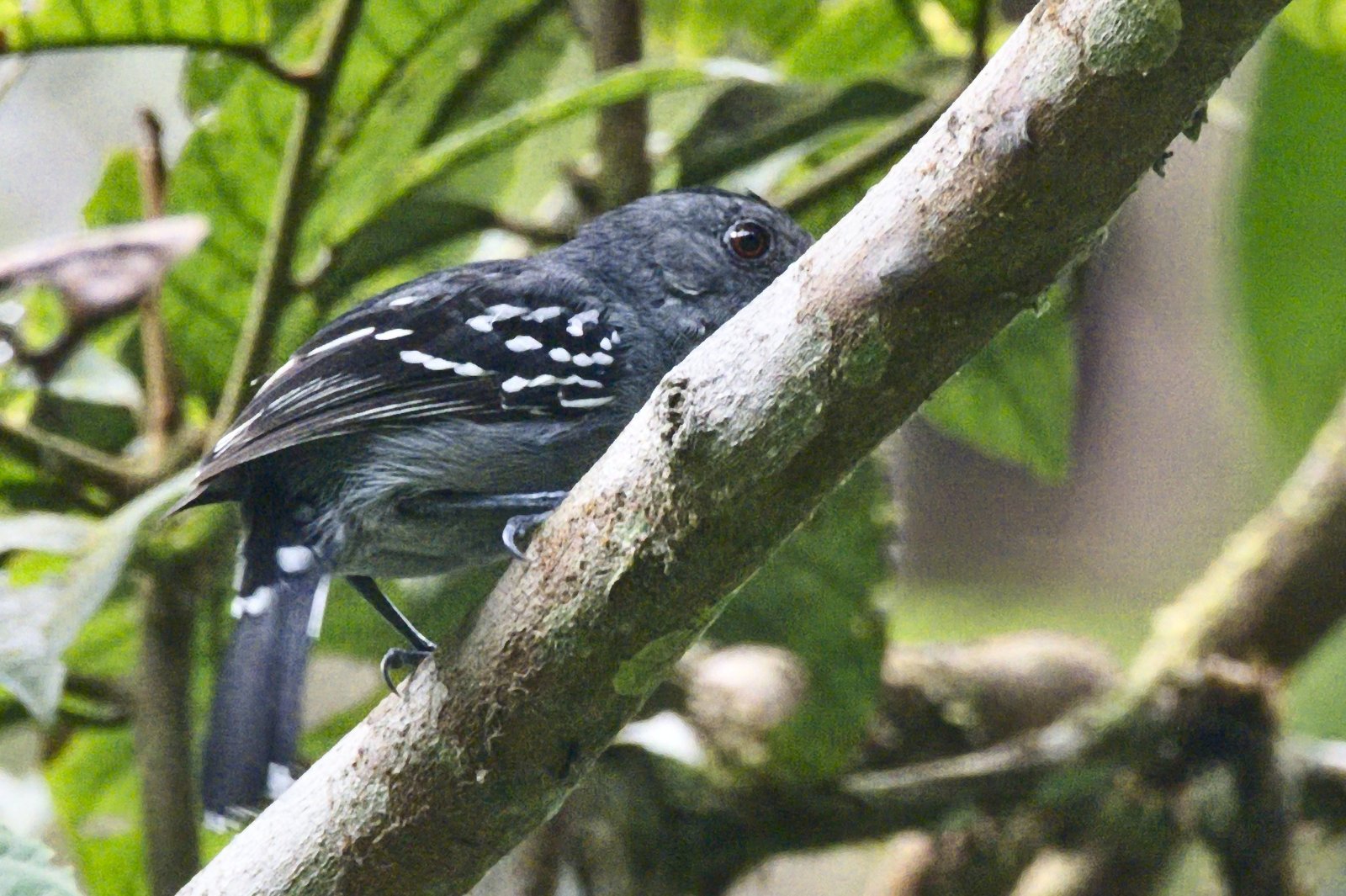
Northern Slaty Antshrike is a small grey-and-black antshrike with white wing spots, the remainder of a former species that has been split into six species. In the guide area it lives in two separate areas: in forest edges east of the Andes in Colombia, and in the dry valleys of the Marañón, the Chinchipe and the Huallaga in Peru and extreme southern Ecuador.
Voice
The song is an accelerating series of 10–15 notes that starts slow and countable and ends in a fast trill, often slightly higher. Birds from the Marañón sing fastest. Calls are a short and a longer kaw and an abrupt, raspy note.
Recording: Tristan Guillebot de Nerville — CC BY-NC-SA 4.0 · xeno-canto
Identification
14 cm (13–15 cm), with a fairly heavy, hooked bill. The male has a black crown (with many white spots in birds from the Marañón and the Huallaga), a grey to blackish back with a concealed white patch, black wings with white spots and edges, a black tail with white tips and grey underparts, sometimes with a white belly. The female has a rufous crown, olive-brown upperparts, dark brown wings with pale spots and pale buffy-olive underparts; females from the Marañón are largely white below.
Confusion species
Amazonian Antshrike Thamnophilus amazonicus is very similar, but the female has an orange-brown head and breast; that species lives in humid lowland forest. The male Plain-winged Antshrike Thamnophilus schistaceus lacks white wing spots and has a red eye. Natterer's Slaty Antshrike Thamnophilus stictocephalus and Bolivian Slaty Antshrike Thamnophilus sticturus are almost identical in plumage, but live in Bolivia and Brazil and differ mainly in song.
Habitat
Edges of forest and woodland, gallery forest and older secondary forest; in the Marañón and the Huallaga dry deciduous woodland. It forages in the understorey and mid-storey, in pairs, and searches leaves and twigs for insects. In Colombia below 600 m, in Ecuador around 650 m, in Peru up to 1200 m.
Where the bird is most at home, classified by the vegetation units of the Andes and the west coast.


Range and movements
Colombia: east of the Andes, south to Caquetá; sight records from the extreme east. Ecuador: only in the Chinchipe drainage in Zamora-Chinchipe. Peru: in the dry valleys of the Marañón (Cajamarca, Amazonas) and the Huallaga (San Martín). Absent from Bolivia and the Galápagos. Outside the guide area in Venezuela, the Guianas and Brazil north of the Amazon.
- Resident
- dark = core range, pale = thinly spread
How and when to look
In Peru the species can be found in dry woodland in the Marañón valley near Jaén and in the Huallaga valley near Tarapoto. Listen for the accelerating song that ends in a trill.
Conservation status
Least Concern. The Marañón and Huallaga forms have a small range in heavily fragmented dry forest under pressure from agriculture.
Scientific name
Thamnophilus punctatus | (Shaw, 1809)
Shaw described the species in 1809 as Lanius punctatus; because it was later moved to another genus, the author and year stand in brackets. The genus Thamnophilus was introduced in 1816 by Vieillot. The genus name comes from Greek thamnos, 'bush', and philos, 'loving': bush-lover. The species name comes from Latin punctatus, 'spotted'. The specimen the first description was based on came from Cayenne, French Guiana.