All species › Waders, gulls and terns › Sandpipers and allies › Noble Snipe
Noble Snipe | Gallinago nobilis
Páramosnip | Becasina noble | Narceja-nobre
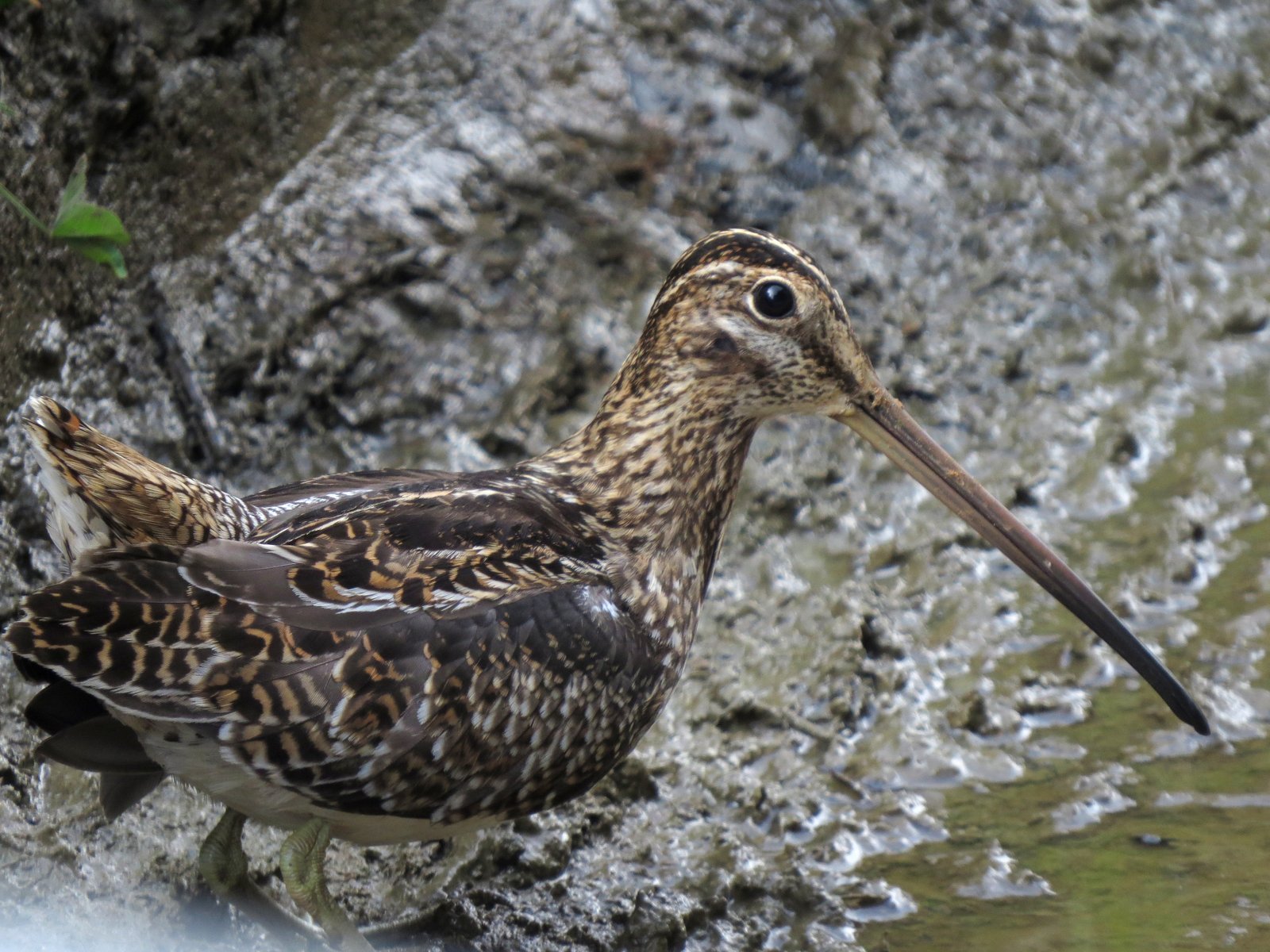
The Noble Snipe is the largest snipe of the páramos of the northern Andes: a heavy, dark snipe with a very long bill. It lives in boggy grassland and mires above the treeline and flushes only when almost stepped on. Its range is small and follows the páramo of Colombia and Ecuador.
Voice
When flushed a hoarse, rasping kretch. In display flight, mainly at dusk, a rapidly repeated series of notes and a humming sound produced by the tail and wings.
Recording: Lelis Navarrete — CC BY-NC-SA 4.0 · xeno-canto
Identification
30–32 cm, a large, stocky snipe with a bill of about 10–12 cm. The upperparts are dark blackish brown, with broad creamy stripes on the back and scapulars and fine brown barring. The head has a pale crown stripe, a dark eyestripe and pale supercilia. The neck and breast are buff with dark streaks, the flanks are densely barred and the centre of the belly is white. The wings are rather broad and rounded, with a narrow white trailing edge. The sexes are alike.
Confusion species
Jameson's Snipe Gallinago jamesoni lives in the same altitudinal zone, but more in damp scrub and at the treeline; it is more uniformly dark, without clear creamy back stripes, and has a barred, not white, belly. Imperial Snipe Gallinago imperialis is warm rufous-brown and barred and lives at the edge of cloud forest. Wilson's Snipe Gallinago delicata is smaller, with a shorter bill, and occurs in the Andes only as a rare winter visitor.
Habitat
Boggy páramo, mires, bofedales and wet grassland, also damp pastures and marshy lake edges, roughly between 2800 and 4100 m. It probes the soft ground for earthworms, insect larvae and other invertebrates. The nest is a scrape in a grass tussock on the ground.
Where the bird is most at home, classified by the vegetation units of the Andes and the west coast.


Range and movements
In Colombia in the páramos of all three Andean ranges. In Ecuador on both slopes and in the páramos between the ranges along the whole length of the Andes. In Peru only in the far north, in the páramos near the border with Ecuador. Absent from Bolivia and the Galápagos. Outside the guide area in the Andes of western Venezuela.
- Resident
- dark = core range, pale = thinly spread
How and when to look
Walk slowly through boggy parts of the páramo or along the edges of mires; the bird crouches and flushes only right in front of you. At dusk displaying birds can be heard over the marshes.
Conservation status
Near Threatened. The population is declining through burning, drainage and grazing of the páramo and through the conversion of wet grassland to cropland.
Scientific name
Gallinago nobilis | Sclater, 1856
Sclater described the species in 1856 and placed it straight away in the genus where it still stands. The genus Gallinago was introduced in 1760 by Brisson. The genus name is New Latin for a woodcock or snipe, from Latin gallina, 'hen', with the suffix -ago, 'resembling'. The species name is Latin nobilis, 'noble'. The specimen the first description was based on came from Bogotá, Colombia.