All species › Waders, gulls and terns › Sandpipers and allies › Puna Snipe
Puna Snipe | Gallinago andina
Punasnip | Becasina de la puna | Narceja-da-puna
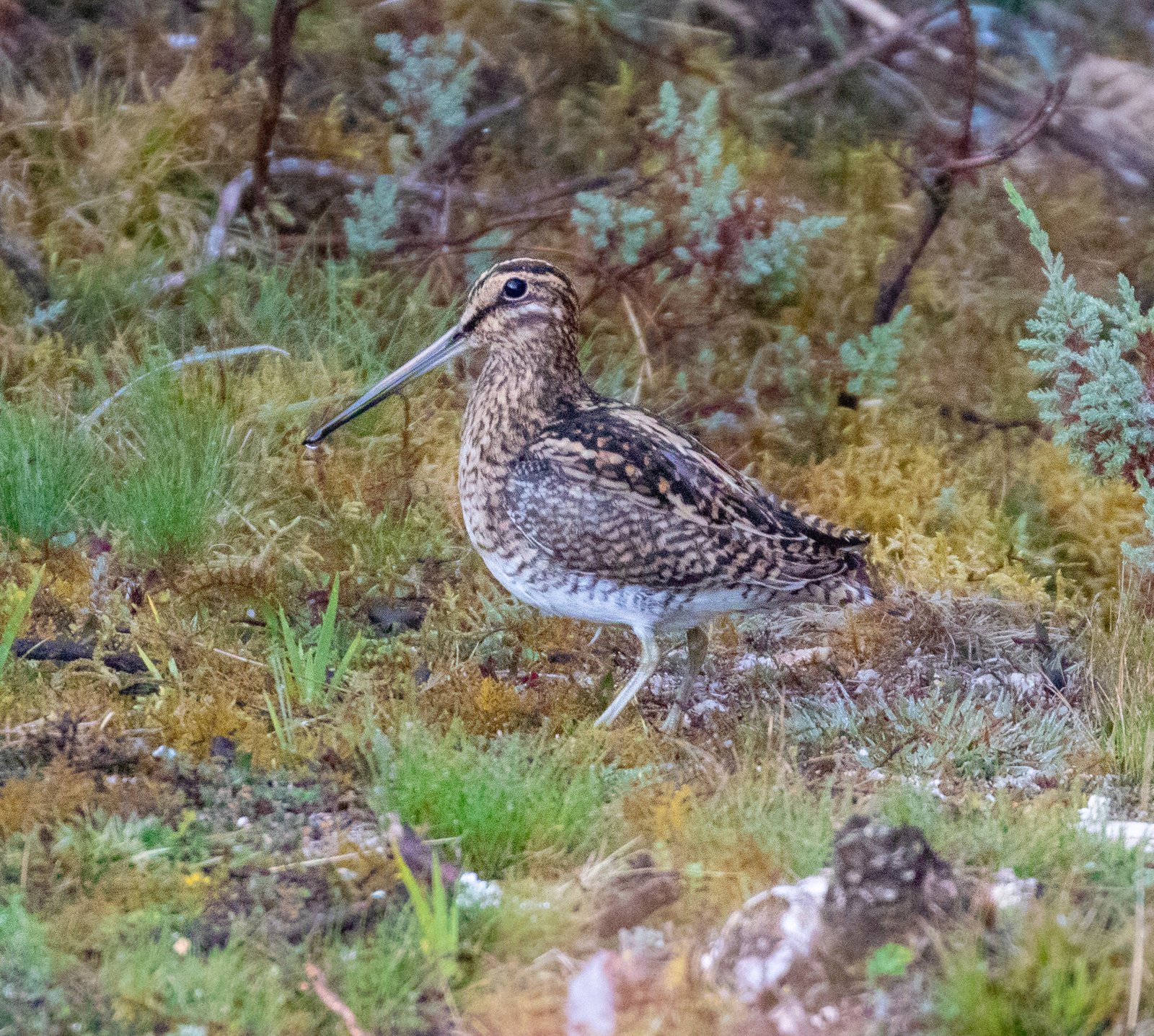
The Puna Snipe is a small, pale snipe of the bofedales and boggy shores of the puna in the central Andes. It was long treated as a subspecies of the Pantanal Snipe, but differs in size, colour and voice. At dusk its display flight can be heard over the mires.
Voice
When flushed a short, rasping krek. In display flight, mainly at dusk and by moonlight, an undulating humming sound made by the outer tail feathers during dives, and on the ground a repeated chee-chee-chee.
Recording: Niels Krabbe — CC BY-NC-SA 3.0 · xeno-canto
Identification
23–25 cm, a small, compact snipe with a relatively short bill for a snipe. The upperparts are dark brown with broad, pale buff stripes; the overall impression is paler and yellower than in other snipes. The head has a pale crown stripe and a dark eyestripe. The neck and breast are buff with fine streaks, and the belly is white. The legs are conspicuously yellowish. The sexes are alike.
Confusion species
Jameson's Snipe Gallinago jamesoni is much larger and darker, with a longer bill and a barred belly, and lives more in damp scrub and at the treeline. Pantanal Snipe Gallinago paraguaiae is larger and darker, with greyish legs and a longer bill, and lives in the lowlands. Wilson's Snipe Gallinago delicata is larger and darker and occurs in the Andes only as a rare winter visitor.
Habitat
Bofedales, boggy grassland, peaty shores of lakes and streams and wet parts of the puna, roughly between 3000 and 4600 m. It probes the soft ground for insect larvae, worms and other invertebrates. The nest is well hidden in a grass tussock on the ground.
Where the bird is most at home, classified by the vegetation units of the Andes and the west coast.


Range and movements
In Peru in the Andes of the centre and south of the country. In Bolivia on the altiplano and in the high Andes of the west. Absent from Colombia, Ecuador and the Galápagos. Outside the guide area in northern Chile and north-western Argentina.
- Resident
- dark = core range, pale = thinly spread
How and when to look
Search the edges of bofedales and boggy shores on the puna, for instance around Lake Titicaca; birds that crouch flush right in front of you. At dusk the display flight can be heard over the mires.
Conservation status
Least Concern. Locally the species loses habitat through drainage, overgrazing and water extraction for mining in the bofedales.
Scientific name
Gallinago andina | Taczanowski, 1875
Taczanowski described the species in 1875 and placed it straight away in the genus where it still stands. The genus Gallinago was introduced in 1760 by Brisson. The genus name is New Latin for a woodcock or snipe, from Latin gallina, 'hen', with the suffix -ago, 'resembling'. The species name refers to the Andes. The specimen the first description was based on came from Lake Junín, Peru.