All species › Waders, gulls and terns › Sandpipers and allies › Pantanal Snipe
Pantanal Snipe | Gallinago paraguaiae
Zuid-Amerikaanse snip | Becasina sudamericana | Narceja
The Pantanal Snipe is the snipe of the wet grasslands and marshes of the lowlands east of the Andes. It lives hidden in low, boggy grass and is noticed mainly when it flushes with a rasping call or displays at dusk. Since the split of Magellanic Snipe in the south of the continent, the species comprises only the birds of the tropical and subtropical lowlands.
Voice
When flushed a rasping kretch. In display flight, mainly at dusk and at night, an undulating hoo-hoo-hoo-hoo produced by the outer tail feathers during dives; on the ground or on a post a repeated chik-a, chik-a.
Recording: Paul Lenrumé — CC BY-NC-SA 4.0 · xeno-canto
Identification
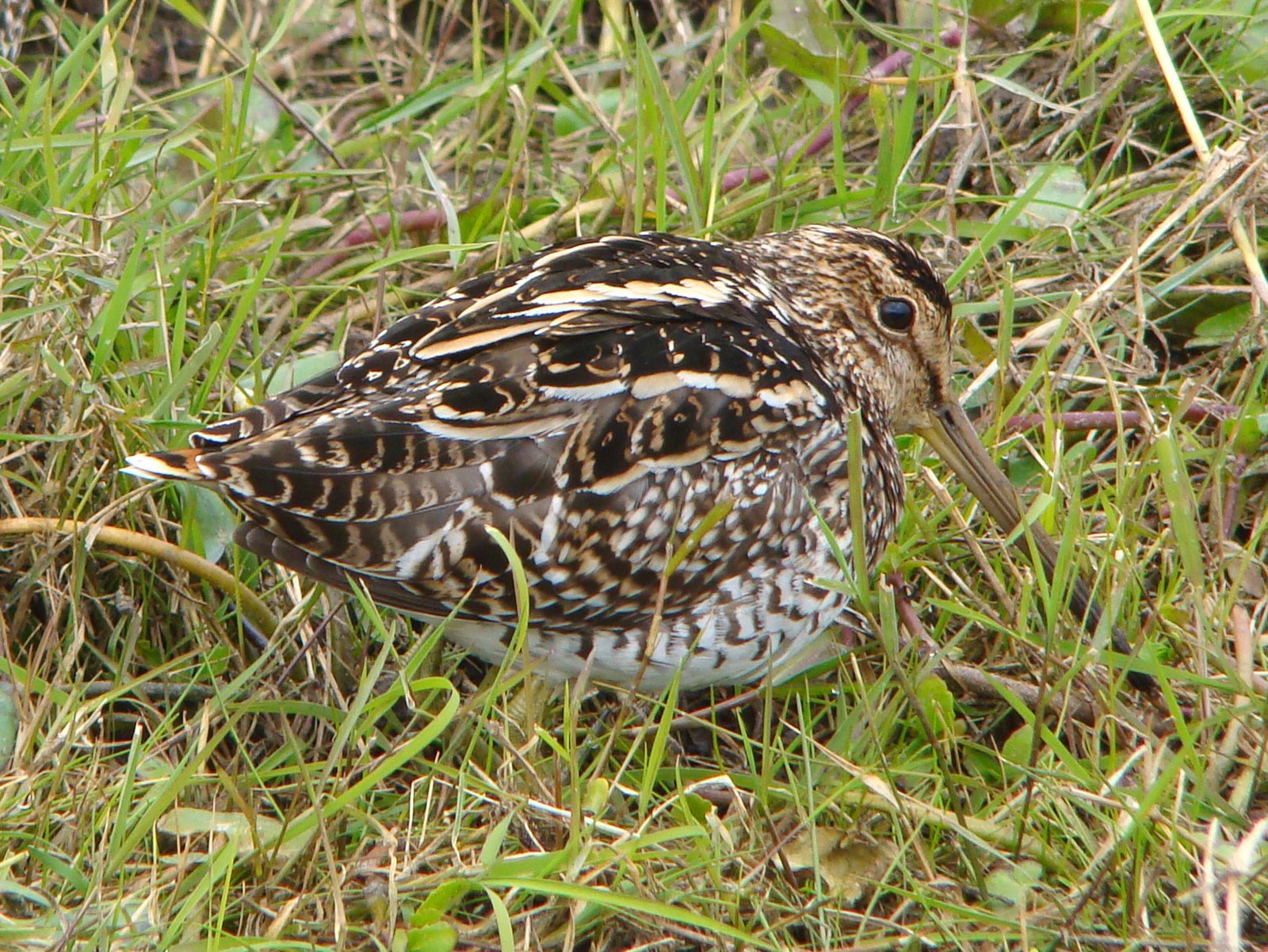
26–29 cm, a medium-sized snipe with a long, straight bill of about 7 cm. The upperparts are dark brown with broad buff stripes on the back and scapulars. The head has a pale crown stripe, a dark eyestripe and pale supercilia. The neck and breast are buff with dark streaks, the flanks are barred and the belly is white. In flight a narrow white trailing edge to the wing and a rufous tail. The legs are greyish green. The sexes are alike.
Confusion species
Wilson's Snipe Gallinago delicata is very similar and occurs as a rare winter visitor, mainly in Colombia; it has a darker, more heavily barred underwing and a different display call, and often cannot be safely separated in the field. Giant Snipe Gallinago undulata is much larger, with a heavy bill and densely barred wings, and lives in taller, drier grassland. Puna Snipe Gallinago andina is smaller and paler, with yellow legs, and lives high in the Andes.
Habitat
Wet grassland, marshy savanna, flooded pastures, edges of lakes and lagoons and rice fields in the lowlands, locally into the lower valleys. It probes the soft mud for worms, insect larvae and other invertebrates. The nest is a scrape in a grass tussock on the ground.
Where the bird is most at home, classified by the vegetation units of the Andes and the west coast.


Range and movements
In Colombia in the lowlands east of the Andes, mainly in the llanos. In Ecuador a scarce and local bird of the Amazonian lowlands. In Peru local in the Amazonian lowlands, mainly in the south-east. In Bolivia widespread in the savannas of the Beni and the eastern lowlands. Absent from the Galápagos. Outside the guide area from Venezuela and the Guianas to Paraguay, Uruguay and northern Argentina.
- Resident
- dark = core range, pale = thinly spread
How and when to look
Walk along the edges of wet grassland and flooded savanna, especially when the water is falling and muddy margins appear. At dusk displaying birds can be heard over the marshes.
Conservation status
Least Concern. The species benefits locally from rice fields and flooded pastures, but loses habitat elsewhere through drainage.
Scientific name
Gallinago paraguaiae | (Vieillot, 1816)
Vieillot described the species in 1816 as Scolopax Paraguaiae; because it was later moved to another genus, the author and year stand in brackets. The genus Gallinago was introduced in 1760 by Brisson. The genus name is New Latin for a woodcock or snipe, from Latin gallina, 'hen', with the suffix -ago, 'resembling'. The species name refers to Paraguay. The specimen the first description was based on came from Paraguay.