All species › Waders, gulls and terns › Sandpipers and allies › Spotted Sandpiper
Spotted Sandpiper | Actitis macularius
Amerikaanse oeverloper | Andarríos maculado | Maçarico-pintado
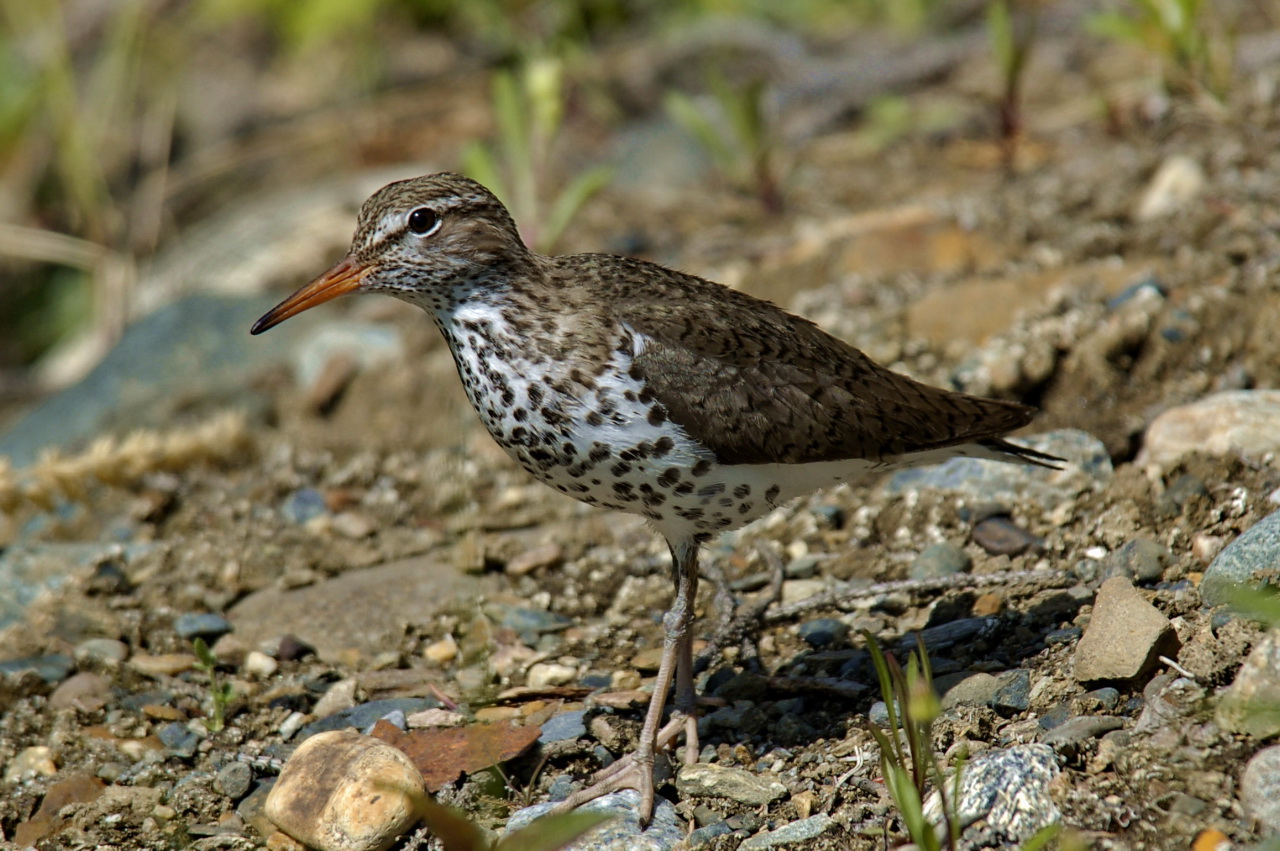
The Spotted Sandpiper is the small shorebird found singly along almost every shoreline in the guide area, from the coast and the Galápagos to streams high in the Andes. It constantly bobs its rear end and flies low over the water with short, stiff, flickering wingbeats. In breeding plumage it has round black spots on the underparts, which give it its English name.
Voice
A high, clear peet-weet or a series of weet-weet-weet, often when flushed; also a single sharp peet.
Recording: Manuel Grosselet — CC BY-NC-SA 4.0 · xeno-canto
Identification
18–20 cm, a small, stocky sandpiper with a horizontal stance, a rather short tail and a medium-length, straight bill. In non-breeding plumage, the plumage in which it is usually seen here, plain greyish brown above, with a white supercilium and a dark eyestripe, white below and with a greyish brown patch on the breast sides, in front of which a white wedge runs up to the shoulder. The bill is then dark with a pale base, and the legs are yellowish to flesh-coloured. In breeding plumage, which may already be seen in March and April, the underparts are white with round black spots and the bill is orange with a black tip. Juveniles have fine barring on the wing coverts. In flight a narrow white wing bar. The sexes are alike.
Confusion species
Solitary Sandpiper Tringa solitaria is longer-legged, darker above with white spots, has a white eye-ring, a dark rump with barred tail sides and no wing bar, and bobs its whole body rather than its rear end. Wandering Tattler Tringa incana, mainly on rocky coasts and the Galápagos, is larger and plain slate grey, without a white wedge in front of the wing. Least Sandpiper Calidris minutilla is smaller, browner, with a streaked breast and a thin, decurved bill, and does not bob.
Habitat
Shores of rivers, streams, lakes and lagoons, sandbars, rocky coasts, mangrove edges, harbours and irrigation canals, from sea level to above 4000 m. It feeds by walking and pecking, taking insects, crustaceans and other small invertebrates at the water's edge. It does not breed in the guide area.
Where the bird is most at home, classified by the vegetation units of the Andes and the west coast.


Range and movements
In Colombia, Ecuador, Peru and Bolivia a widespread winter visitor along almost all waters, from the coast and the Amazonian lowlands to high in the Andes. In the Galápagos a common winter visitor along the coasts. Breeds over much of North America and winters from the southern United States to northern Argentina and Chile.
- Resident
- Winter visitor (c. Oct–Mar)
- Passage (Mar–Apr, Oct–Nov)
- dark = core range, pale = thinly spread
How and when to look
Look for a small shorebird walking alone along the water's edge and constantly bobbing its rear end; when disturbed it flies off low over the water with its characteristic stiff wingbeats and a clear peet-weet.
Conservation status
Least Concern. The species has a large range and a large population, which appears to be declining slightly in North America.
Scientific name
Actitis macularius | (Linnaeus, 1766)
Linnaeus described the species in 1766 as Tringa macularia; because it was later moved to another genus, the author and year stand in brackets. The genus Actitis was introduced in 1811 by Illiger. The genus name comes from Greek aktitēs, 'coast-dweller', from aktē, 'coast'. The specific name comes from Latin macularius, 'spotted'. The specimen the first description was based on came from Pennsylvania, United States.