All species › Waders, gulls and terns › Sandpipers and allies › Wilson's Phalarope
Wilson's Phalarope | Phalaropus tricolor
Grote franjepoot | Falaropo tricolor | Pisa-n'água
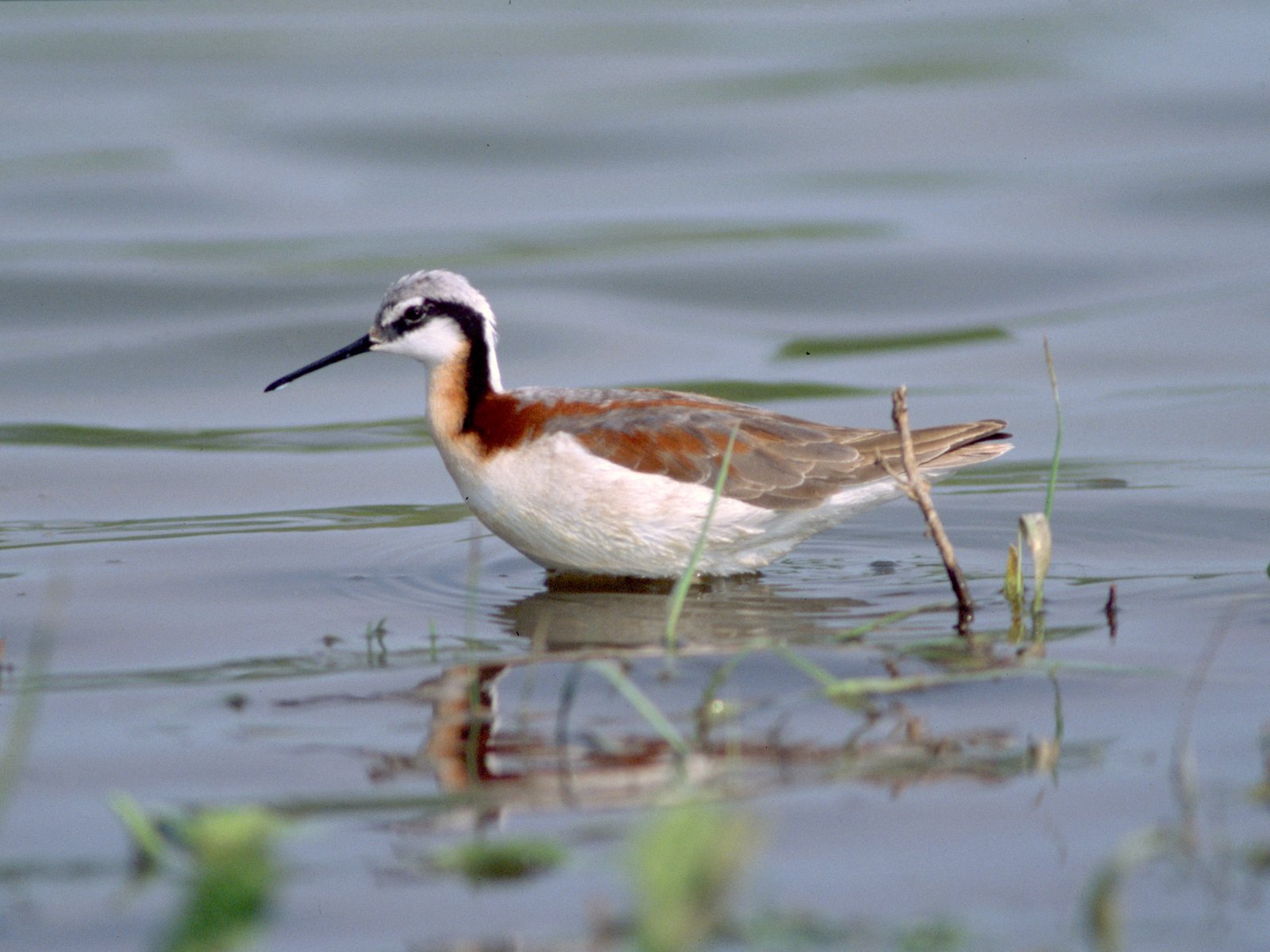
Wilson's Phalarope is the inland phalarope: it breeds on the prairie lakes of North America and winters mainly on the salt lakes of the altiplano. There large flocks spin on the water to draw small crustaceans and insects to the surface. Unlike most birds, the female is the more brightly coloured and the male incubates the eggs.
Voice
Usually silent in the guide area. In flocks a soft, nasal wurk or wek.
Recording: Paul Marvin — CC BY-NC-SA 4.0 · xeno-canto
Identification
22–24 cm, a slender phalarope with a small head, a long, needle-thin black bill and rather long legs; it also walks a lot on the shore. In non-breeding plumage, in which it is usually seen here, pale grey above and white below, with a white rump, a faint grey eyestripe and yellow legs, and no wing bar. In breeding plumage the female has a black stripe running from the eye down the side of the neck to the back, where it turns chestnut, a grey crown and a buff throat; the male is duller. Juveniles have brown, pale-fringed upperparts.
Confusion species
Red-necked Phalarope Phalaropus lobatus is smaller, with a shorter bill, a dark patch behind the eye, a clear white wing bar and dark upperparts with pale stripes, and lives mainly at sea. Red Phalarope Phalaropus fulicarius has a thicker bill, a dark eye patch and a white wing bar, and stays on the open sea. Lesser Yellowlegs Tringa flavipes has longer, bright yellow legs and a darker, spotted back, and does not swim.
Habitat
Saline and brackish lakes and lagoons of the altiplano and puna, up to well over 4500 m, also shallow coastal lagoons, salt pans and sewage ponds on migration. It swims and spins on the water or walks through shallow water, picking brine shrimps, midge larvae and other small invertebrates. It does not breed in the guide area.
Where the bird is most at home, classified by the vegetation units of the Andes and the west coast.


Range and movements
In Colombia and Ecuador a scarce passage migrant, mainly on the coast and on lakes in the Andes. In Peru a passage migrant along the coast and a winter visitor on the puna lakes of the south. In Bolivia an abundant winter visitor on the salt lakes of the south-western altiplano. A rare visitor to the Galápagos. Breeds in the interior of western North America and winters mainly on the salt lakes of the Andes of Bolivia, Chile and Argentina and on lagoons in the pampas.
- Resident
- Winter visitor (c. Oct–Mar)
- Passage (Mar–Apr, Oct–Nov)
- dark = core range, pale = thinly spread
How and when to look
Search the salt lakes of the altiplano from October to March, where large flocks feed among the flamingos; on the coast of Peru mainly in August–October and March–April on lagoons and salt pans.
Conservation status
Least Concern. The species is vulnerable through its dependence on a small number of salt lakes as staging and wintering sites, where water extraction and mining can lower water levels.
Scientific name
Phalaropus tricolor | (Vieillot, 1819)
Vieillot described the species in 1819 as Steganopus tricolor; because it was later moved to another genus, the author and year stand in brackets. The genus Phalaropus was introduced in 1760 by Brisson. The genus name combines Greek phalaris, 'coot', with pous, 'foot'. Coots and phalaropes both have lobed toes. The species name is Latin tricolor, 'three-coloured', after the grey, black and chestnut of the breeding plumage. The specimen the first description was based on came from Paraguay.