All species › Waders, gulls and terns › Sandpipers and allies › Red Phalarope
Red Phalarope | Phalaropus fulicarius
Rosse franjepoot | Falaropo picogrueso | Falaropo-de-bico-grosso
The Red Phalarope spends most of the year on the open sea and comes ashore only in the short Arctic summer to breed. Off the coasts of Peru and Chile, in the cold water of the Humboldt Current, large numbers winter, often in flocks along current lines and over upwelling water. As in all phalaropes, the female is the more brightly coloured and the male cares for the eggs and young.
Voice
Usually silent in the guide area. In flocks a high, sharp pik or keet, especially when flushed.
Recording: Uku Paal — CC BY-NC-SA 4.0 · xeno-canto
Identification
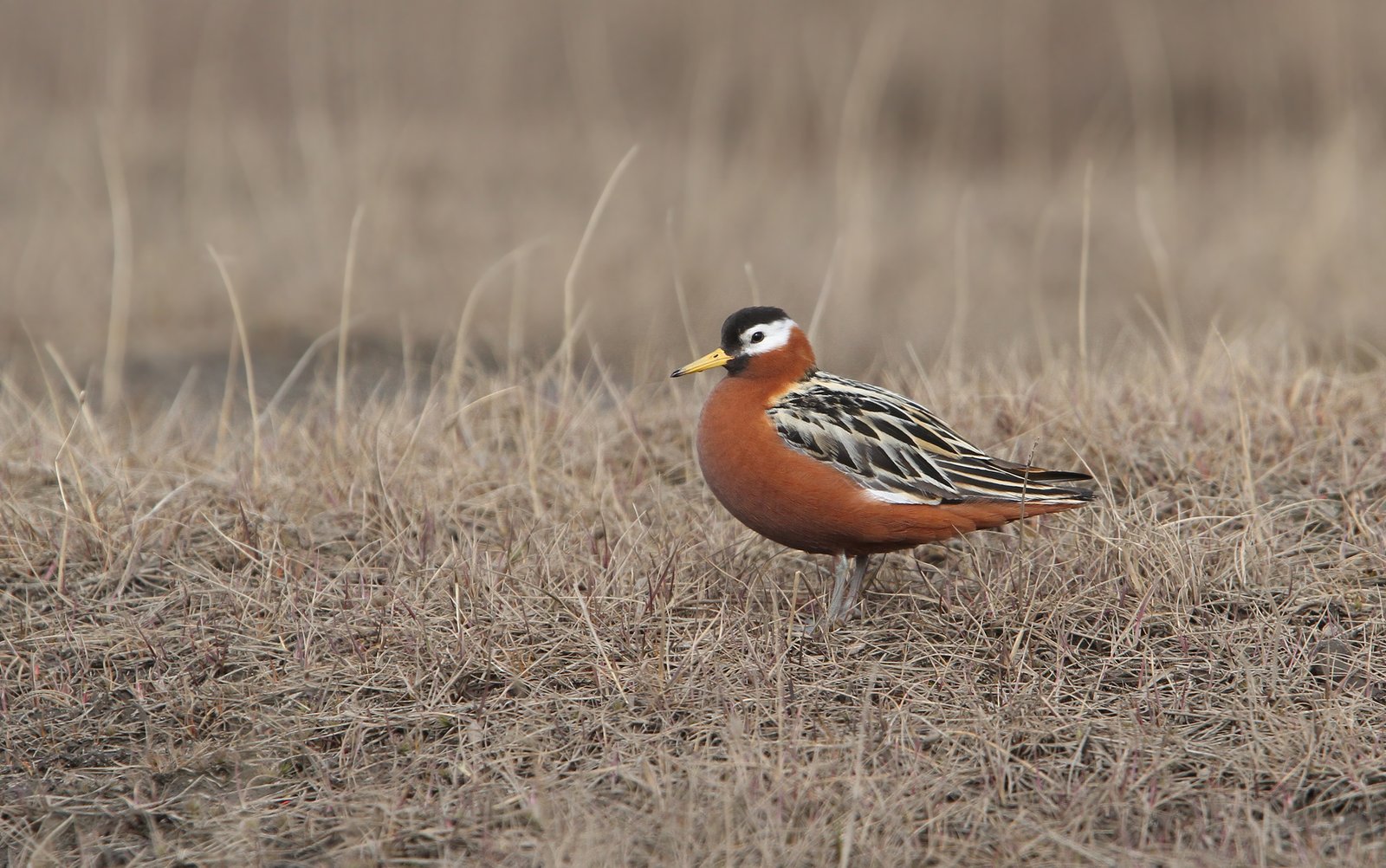
20–22 cm, a stocky phalarope with a rather thick, straight bill. In non-breeding plumage, in which it is almost always seen here, plain pale grey above, white below, with a white head, a black patch around and behind the eye and a dark hindcrown; the bill is black, sometimes with a yellowish base. In flight a broad white wing bar. In breeding plumage, sometimes partly seen by April, the neck and underparts are rufous-red, the cheeks white and the bill yellow with a black tip; the female is brighter than the male. Juveniles have dark, pale-fringed upperparts and a buff breast.
Confusion species
Red-necked Phalarope Phalaropus lobatus is smaller and slimmer, with a needle-thin bill, darker upperparts with pale stripes and a shorter wing bar; both occur together at sea. Wilson's Phalarope Phalaropus tricolor has a long, thin bill, no wing bar and a white rump, and lives on lakes. Sanderling Calidris alba resembles a Red Phalarope in non-breeding plumage, but runs along the beach and does not swim.
Habitat
Open sea, especially over the cold, nutrient-rich water of the Humboldt Current and along fronts and upwelling zones, usually far offshore. It swims and spins on the water, picking copepods, fish eggs and other small animals from the surface. After storms sometimes in bays, coastal lagoons and rarely on inland lakes. It does not breed in the guide area.
Where the bird is most at home, classified by the vegetation units of the Andes and the west coast.


Range and movements
In Peru an abundant winter visitor at sea off the whole coast, especially over the Humboldt Current. Off the Pacific coasts of Ecuador and Colombia scarcer and mainly on passage; rarely at sea near the Galápagos. In Bolivia and on the lakes of the Andes only as an exceptional vagrant. Breeds on the Arctic tundra around the North Pole and winters on the open sea, especially in the cold currents off West Africa and western South America.
- Winter visitor (c. Oct–Mar)
- Passage (Mar–Apr, Oct–Nov)
- dark = core range, pale = thinly spread
How and when to look
Join a pelagic trip off the coast of Peru, for instance from Lima, between November and March; flocks sit on the water along current lines and fly off low as the boat approaches.
Conservation status
Least Concern. At sea the species is sensitive to oil pollution and to changes in food supply during El Niño.
Scientific name
Phalaropus fulicarius | (Linnaeus, 1758)
Linnaeus described the species in 1758 as Tringa fulicaria; because it was later moved to another genus, the author and year stand in brackets. The genus Phalaropus was introduced in 1760 by Brisson. The genus name combines Greek phalaris, 'coot', with pous, 'foot'. Coots and phalaropes both have lobed toes. The species name comes from Latin fulica, 'coot', after the lobed toes. The specimen the first description was based on came from Hudson Bay, Canada.