All species › Gamebirds › Guans, curassows and chachalacas › Nocturnal Curassow
Nocturnal Curassow | Nothocrax urumutum
Nachthokko | Paujil nocturno | Urumutum
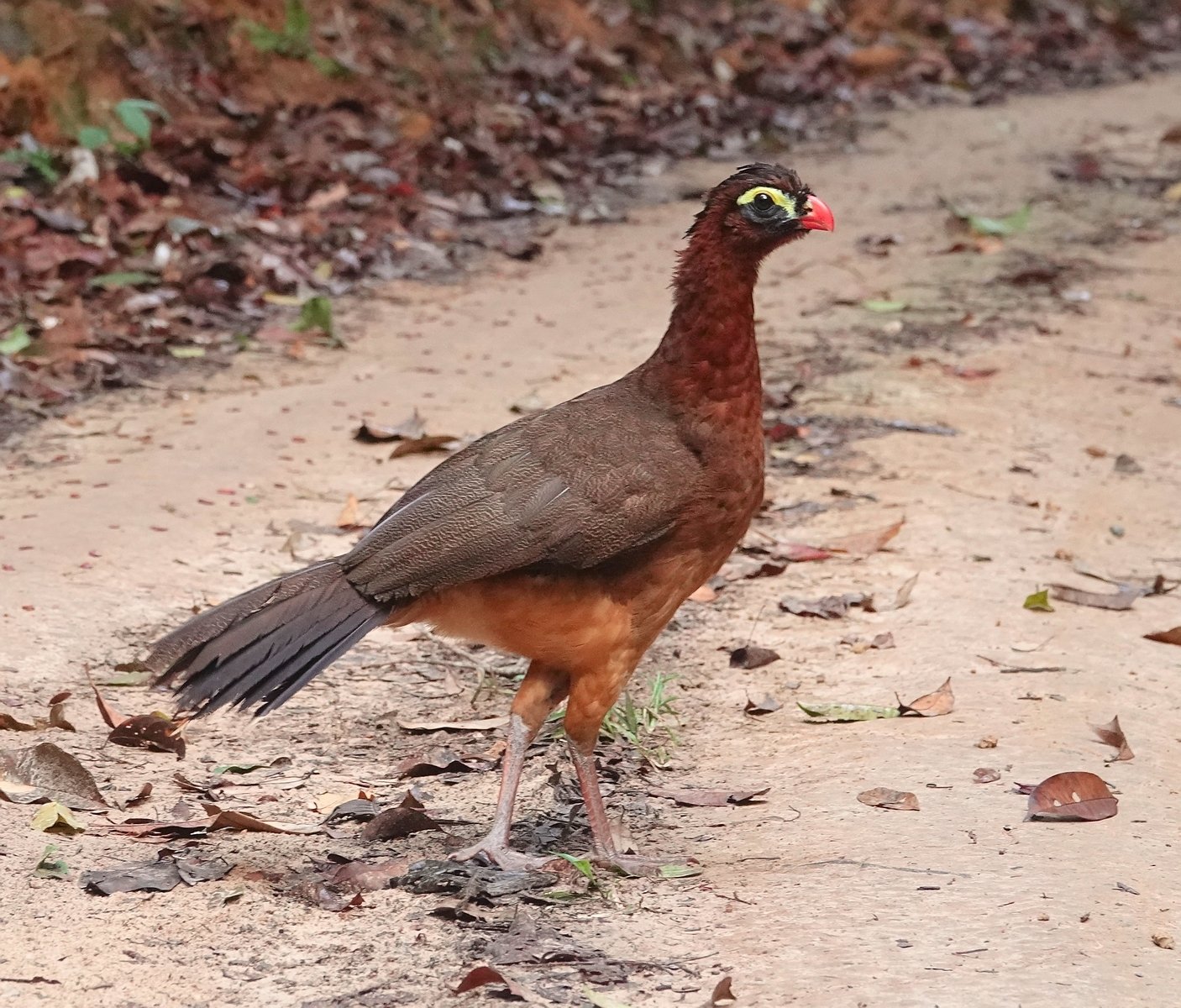
The Nocturnal Curassow is the smallest curassow and the only one that is mainly active at night. By day it hides in dense Amazonian lowland forest; at night it sings from a branch with deep, hollow notes that carry far through the forest. Because of this habit the species is little studied.
Voice
A series of deep, hollow, humming notes, somewhat owl-like, for example oom, oom-oom… oom-hoo, given from a branch in the middle storey of the forest. Sings mainly at night, most often by moonlight and early in the rainy season.
Recording: Felipe Arantes — CC BY-NC-SA 4.0 · xeno-canto
Identification
58–66 cm. A rather slim curassow with a crest of black, forward-curled feathers. Head, neck and underparts are rufous-chestnut, the upperparts darker brown with fine black vermiculation. The tail is blackish with a pale buff terminal band. There is bare skin around the eye, yellow above the eye and bluish below. The bill is orange-red, the legs greyish to pinkish. The sexes are alike.
Confusion species
Razor-billed Curassow Mitu tuberosum and Salvin's Curassow Mitu salvini are much larger, mainly black, with a tall red bill and red legs. Spix's Guan Penelope jacquacu is dark olive-brown with white streaks on the breast and neck and a red dewlap, and is active by day. In the dark the song is the best feature.
Habitat
Tall humid lowland forest on terra firme and in seasonally flooded forest, often near streams, also palm swamp forest; mostly below about 600 m. By day it rests on the ground in dense cover or in cavities under fallen trees. It eats fallen fruit, seeds and leaves. The nest is a platform of sticks in a tree, usually with two eggs.
Where the bird is most at home, classified by the vegetation units of the Andes and the west coast.


Range and movements
In Colombia in the eastern Amazonian lowlands. In Ecuador in the Amazonian lowlands. In Peru in the north-eastern Amazonian lowlands. Absent from Bolivia and west of the Andes. Outside the guide area in southern Venezuela and western Brazilian Amazonia.
- Resident
- dark = core range, pale = thinly spread
How and when to look
Listen at night from forest trails and at lodges in large, undisturbed Amazonian lowland forest, for example along the Napo in Ecuador, for the deep hollow notes. With a torch a singing bird can sometimes be found on a branch; by day it is mostly met by chance when it flushes from the forest floor.
Conservation status
Listed as Least Concern. Numbers are declining locally through hunting and clearance of lowland forest, but the range is large and largely forested.
Scientific name
Nothocrax urumutum | (Spix, 1825)
Spix described the species in 1825 as Crax urumutum; because it was later moved to another genus, the author and year stand in brackets. The genus Nothocrax was introduced in 1856 by Burmeister. The genus name comes from Greek nothos, 'false', and the genus Crax (curassows): a 'false curassow'. The species name comes from the Tupi name urú mutúm, 'night or black curassow', for this species. Spix described it in 1825 as Crax urumutum. The specimen the first description was based on came from Rio Negro, Amazonas, Brazil.