All species › Passerines › Tyrant flycatchers and allies › Ochre-bellied Flycatcher
Ochre-bellied Flycatcher | Mionectes oleagineus
Okerbuikpipratiran | Mosquero ocrillo | Abre-asa
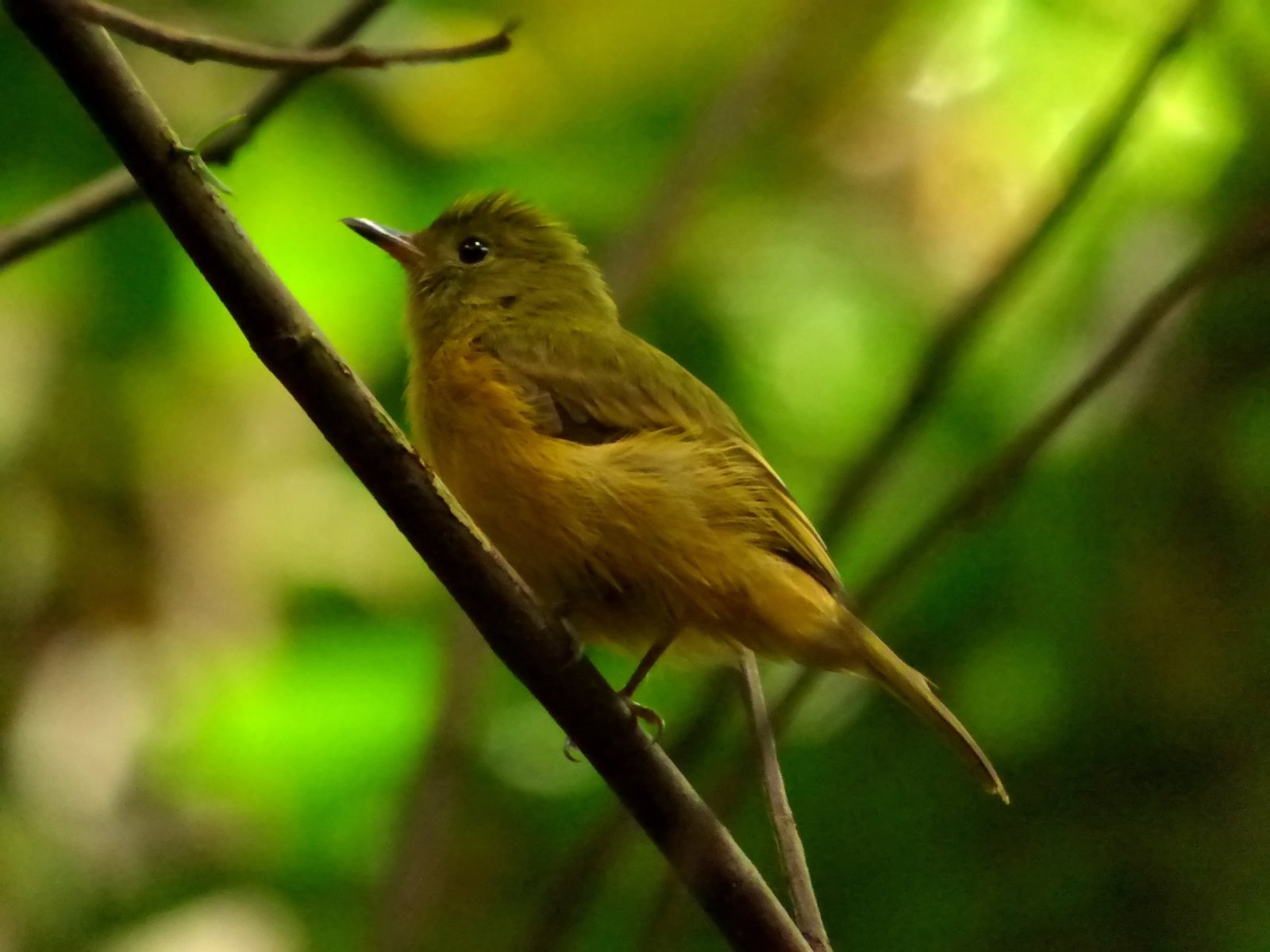
The Ochre-bellied Flycatcher is a small, inconspicuous tyrant flycatcher of humid lowland forest, with an olive-green back and an ochre belly. It lives largely on small berries and constantly lifts one wing, a habit typical of its whole genus. Males sing in loose groups, each at its own site in the understorey.
Voice
A soft tsip or tchip. The displaying male gives a long series of repeated, hoarse and squeaky phrases, accompanied by wing-lifting.
Recording: Mauricio Cuéllar Ramírez — CC BY-NC-SA 4.0 · xeno-canto
Identification
13 cm, with a thin, dark bill with a pale base and a narrow, pale eye-ring. The head, back and breast are olive-green, the throat greyish olive. The belly and undertail-coverts are warm ochre. The wings are dark olive with two faint ochre wing-bars; the edges of the flight feathers are ochre. The sexes are alike.
Confusion species
McConnell's Flycatcher Mionectes macconnelli is very similar, but has plain wing-coverts without wing-bars and is more uniform, darker ochre below; the species also differ in song and display. Olive-striped Flycatcher Mionectes olivaceus is streaked below. Female manakins such as Blue-capped Manakin Lepidothrix coronata are chunkier, with a shorter tail and a shorter, broader bill.
Habitat
The understorey and middle storey of humid lowland forest, also forest edges, secondary forest, várzea and gardens with fruit trees, from sea level to about 1500 m. It eats mainly small berries, including mistletoe, melastomes and Clusia, supplemented with insects and spiders. The nest is a pear-shaped structure of moss and fibres suspended from a root or vine, often over water or along a bank.
Where the bird is most at home, classified by the vegetation units of the Andes and the west coast.


Range and movements
Colombia: widespread in the lowlands and foothills, on the Pacific side, in the Caribbean north, in the Magdalena valley and in Amazonia. Ecuador: in the western lowlands and in Amazonia. Peru: in Amazonia and the eastern foothills, and in the north-west in Tumbes. Bolivia: in the lowlands of Pando, Beni, La Paz, Cochabamba and Santa Cruz. Absent from the Galápagos. Outside the guide area from southern Mexico to Amazonian Brazil.
- Resident
- dark = core range, pale = thinly spread
How and when to look
In lowland forest, watch for a small olive-green bird that lifts one wing at short intervals; it readily visits shrubs and trees with small berries, often together with tanagers and manakins.
Conservation status
Least Concern. The species is very widespread and also occurs in secondary forest and at forest edges.
Scientific name
Mionectes oleagineus | (Lichtenstein, 1823)
Lichtenstein described the species in 1823 as M[uscicapa] oleaginea; because it was later moved to another genus, the author and year stand in brackets. The genus Mionectes was introduced in 1844 by Cabanis. The genus name comes from Greek meionektēs, 'small, having suffered loss', from meionekteō, 'to have too little'. Cabanis (1844) described the species as small birds. The species name comes from Latin oleagineus, 'olive-coloured', referring to the olive-green plumage. The specimen the first description was based on came from Bahia, Brazil.