All species › Passerines › Tyrant flycatchers and allies › McConnell's Flycatcher
McConnell's Flycatcher | Mionectes macconnelli
McConnells pipratiran | Mosquero de McConnell | Abre-asa-da-mata
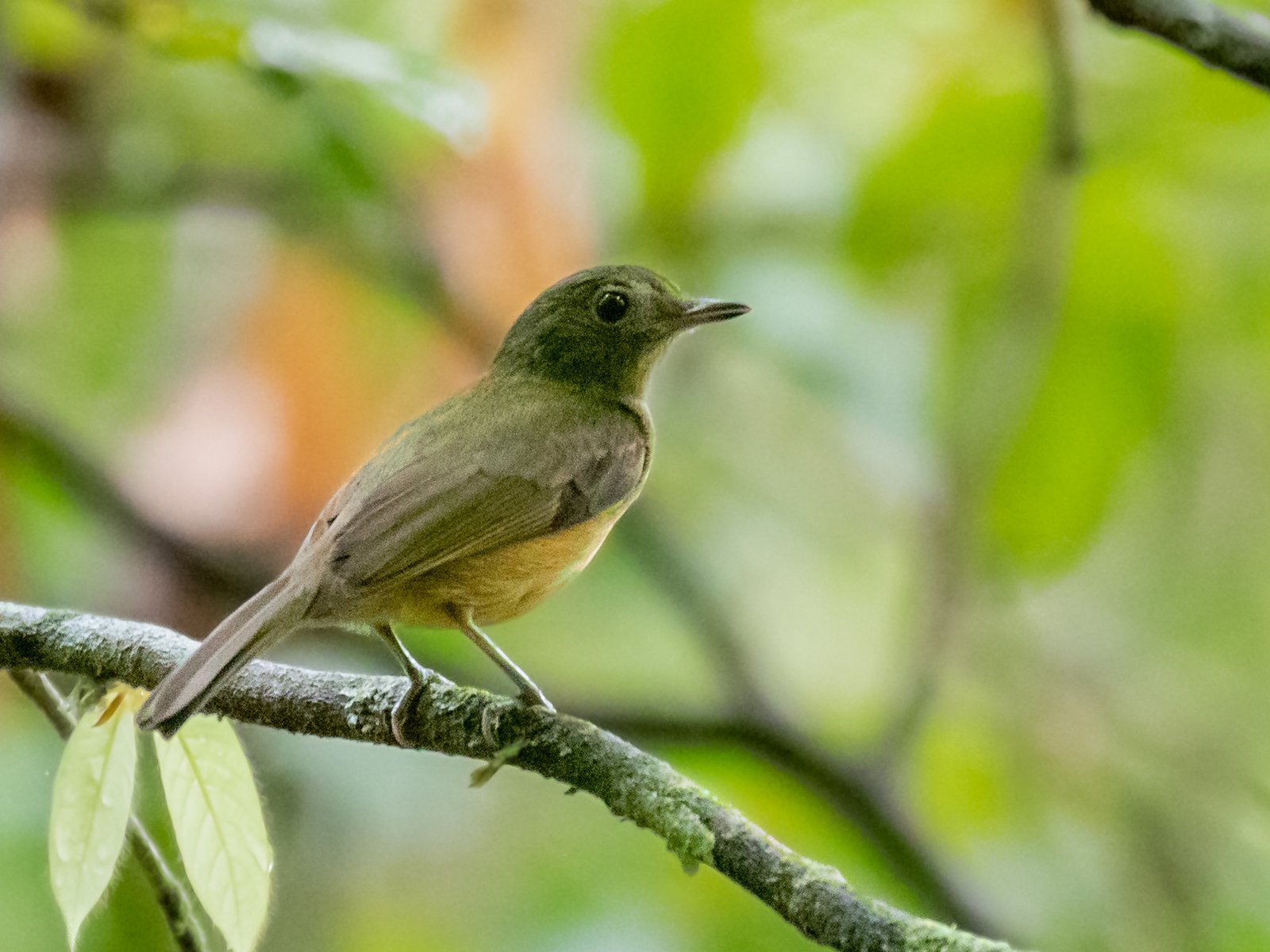
McConnell's Flycatcher is a sibling species of the Ochre-bellied Flycatcher that lives mainly in the interior of tall lowland and foothill forest. The two are almost identical in appearance; song and display differ. The birds of the foothills of Peru and Bolivia are sometimes placed in a separate subspecies, peruanus.
Voice
A soft tsip. The displaying male gives a series of rapid, dry and squeaky notes that sound different from the hoarse phrases of Ochre-bellied Flycatcher, alternately spreading its wings.
Recording: Fernando Igor de Godoy — CC BY-NC-SA 4.0 · xeno-canto
Identification
13 cm, with a thin, dark bill. The head, back and breast are olive-green, the throat greyish olive. The belly and undertail-coverts are uniform ochre, slightly darker than in Ochre-bellied Flycatcher. The wing-coverts are plain olive, without wing-bars. Like its relatives it regularly lifts one wing. The sexes are alike.
Confusion species
Ochre-bellied Flycatcher Mionectes oleagineus has two faint ochre wing-bars and is slightly paler below; it lives more at forest edges, in secondary forest and in várzea. Song and display are the most reliable difference. Olive-striped Flycatcher Mionectes olivaceus is streaked below.
Habitat
The understorey and middle storey of humid terra firme and foothill forest, mainly in the forest interior, from the lowlands to about 1300 m, locally higher. It eats mainly small berries and mistletoe and melastome fruits, supplemented with insects.
Where the bird is most at home, classified by the vegetation units of the Andes and the west coast.


Range and movements
Peru: in the south-east, in the lowlands and foothills of Junín, Ayacucho, Cusco, Puno and Madre de Dios. Bolivia: in the lowlands and foothills of the north and centre, from Pando and La Paz to Cochabamba and Santa Cruz. Colombia: nearly absent; there are a few reports from the north of the country that need confirmation. Absent from Ecuador and the Galápagos. Outside the guide area on the Guiana Shield from Venezuela to the Guianas and in Amazonian Brazil.
- Resident
- dark = core range, pale = thinly spread
How and when to look
Search tall, undisturbed forest in Madre de Dios or in the foothills of Cusco and Puno; where both species occur, the male's song and the lack of wing-bars help with identification.
Conservation status
Least Concern. The species is tied to undisturbed forest, but has a large range.
Scientific name
Mionectes macconnelli | (Chubb, 1919)
Chubb described the species in 1919 as Pipromorpha oleaginea macconnelli; because it was later moved to another genus, the author and year stand in brackets. The genus Mionectes was introduced in 1844 by Cabanis. The genus name comes from Greek meionektēs, 'small, having suffered loss', from meionekteō, 'to have too little'. Cabanis (1844) described the species as small birds. The species name honours Frederick Vavasour McConnell (1868–1914), an English traveller and collector. The specimen the first description was based on came from Kamakabra River, Guyana.