All species › Passerines › Tyrant flycatchers and allies › Suiriri Flycatcher
Suiriri Flycatcher | Suiriri suiriri
Suiriritiran | Suirirí común | Suiriri-cinzento
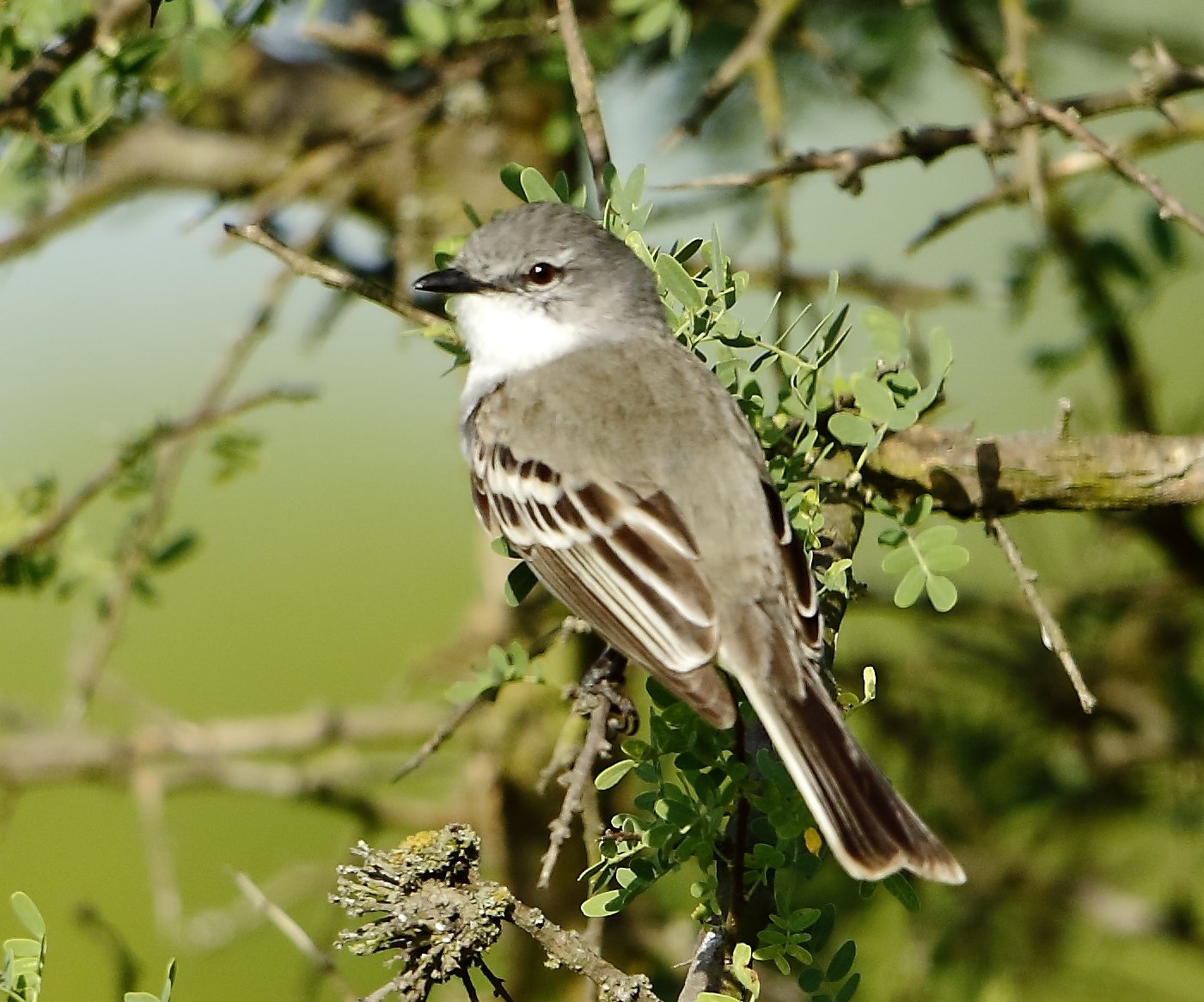
The Suiriri Flycatcher is a grey-and-white tyrant of Chaco woodland and cerrado, which in the guide area occurs only in eastern and southern Bolivia. It forages high in tree crowns, and pairs often call together while raising their wings. Birds from the cerrado and from the Chaco differ in colour and are sometimes treated as separate species.
Voice
A lively, chattering series such as swee-swee-swee or chee-wi-chee-wi, often given by both birds of a pair together, with wing-raising.
Recording: JAYRSON ARAUJO DE OLIVEIRA — CC BY-NC-SA 4.0 · xeno-canto
Identification
15 cm, with a straight, black bill. The crown and back are grey, with a short whitish stripe above the lores. The wings are blackish, with broad white wing bars and white edges to the tertials and secondaries. The tail is dark. The throat is whitish, the breast pale grey. Chaco birds have a white belly; cerrado birds have a pale yellow belly, a paler rump and a pale tail tip. The sexes are alike.
Confusion species
Southern Scrub Flycatcher Sublegatus modestus has a short, black bill, a pale supercilium and a yellower belly. White-crested Tyrannulet Serpophaga subcristata is smaller, with a tiny bill and a small crest with white. Mouse-colored Tyrannulet Nesotriccus murinus is browner, with buffy wing bars and a pale supercilium.
Habitat
Dry forest and thorn woodland of the Chaco, semi-open Chiquitano forest, cerrado and savanna with trees, in the lowlands and on the lower slopes. It forages in tree crowns, gleaning insects from leaves and twigs or catching them in a short sally. The nest is a small, shallow cup on a horizontal branch, covered with lichen.
Where the bird is most at home, classified by the vegetation units of the Andes and the west coast.


Range and movements
Bolivia: in the Chaco in Santa Cruz, Chuquisaca and Tarija and in the cerrado and savannas of eastern Santa Cruz and Beni. Southern birds partly move north in the austral winter. Absent from Colombia, Ecuador, Peru and the Galápagos. Outside the guide area in Paraguay, Argentina, Uruguay and interior Brazil.
- Resident
- dark = core range, pale = thinly spread
How and when to look
Search the Chaco woodland south of Santa Cruz or the cerrado of Noel Kempff Mercado and watch for pairs chattering in the tree crowns and raising their wings.
Conservation status
Least Concern. The species suffers from the conversion of Chaco and cerrado to farmland, but is still widespread.
Scientific name
Suiriri suiriri | (Vieillot, 1818)
Vieillot described the species in 1818 as Muscicapa suiriri; because it was later moved to another genus, the author and year stand in brackets. The genus Suiriri was introduced in 1840 by D'Orbigny, ACVMD. The genus name comes from Guaraní, in which suiriri is a general name for several medium-sized tyrant flycatchers. The species name is the same Guaraní name suiriri, a general name for medium-sized tyrant flycatchers. The specimen the first description was based on came from Puerto Pinasco, Paraguay.