All species › Passerines › Tyrant flycatchers and allies › Southern Beardless Tyrannulet
Southern Beardless Tyrannulet | Camptostoma obsoletum
Geelkeelvliegenpikker | Mosquerito silbador | Risadinha
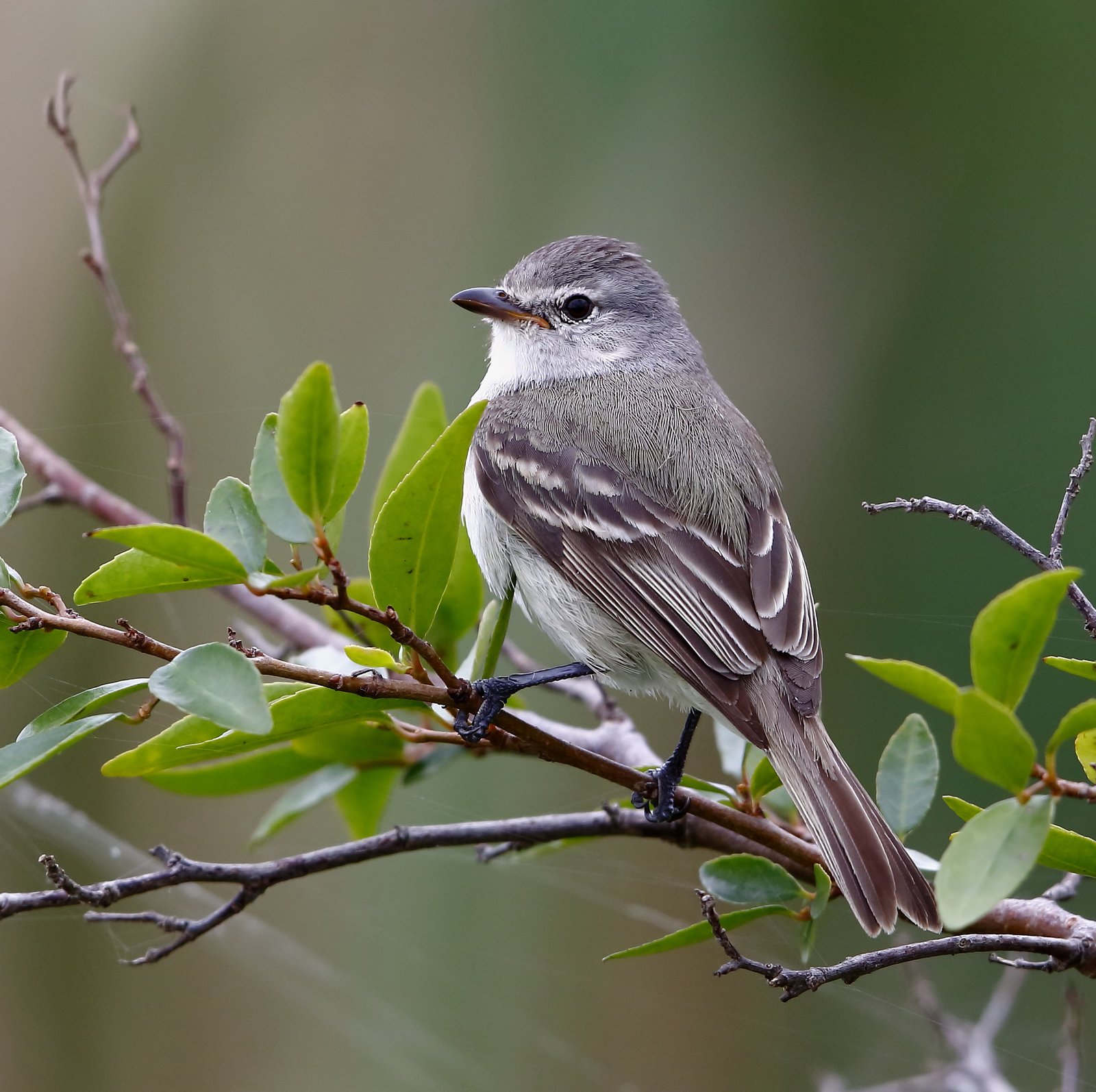
The Southern Beardless Tyrannulet is one of the most widespread small tyrannulets of South America. It lives in almost all semi-open, wooded landscapes, from dry scrub on the Pacific coast to gardens and forest edges in Amazonia. The ragged crest, the often cocked tail and the whistled call are the main features.
Voice
A series of clear, descending whistles, such as tee-tee-tee-tee, and at dawn a repeated, high pir-tee.
Recording: Juan Freile — CC BY-NC-SA 4.0 · xeno-canto
Identification
10 cm, with a short, slightly curved bill with a pale base. The crown is greyish brown and often raised into a ragged crest. The upperparts are greyish olive. The wings are dark, with two buffy to whitish wing bars. The throat and breast are greyish white, the belly pale yellow; birds of the dry Pacific coast are greyer and whiter than those of Amazonia. The sexes are alike.
Confusion species
Mouse-colored Tyrannulet Nesotriccus murinus is larger, with a dark crown without a crest and a pale eyebrow, and does not cock its tail. Pale-tipped Inezia Inezia caudata has white lores and pale tail tips. Yellow-crowned Tyrannulet Tyrannulus elatus has a black bill, a grey face and a yellow crown stripe.
Habitat
Forest edges, secondary forest, dry forest and scrub, mangroves, parks, gardens and plantations, from sea level to about 2500 m in Andean valleys. It searches for small insects and berries among the leaves, often with its tail cocked. The nest is a globular structure with a side entrance, in a shrub or tree.
Where the bird is most at home, classified by the vegetation units of the Andes and the west coast.


Range and movements
Colombia, Ecuador, Peru and Bolivia: widespread in the lowlands and lower parts of the Andes, including dry western Ecuador, north-western Peru and dry Andean valleys. Absent from the Galápagos. Outside the guide area from Costa Rica to Argentina and Uruguay.
- Resident
- dark = core range, pale = thinly spread
How and when to look
Listen in gardens, parks and forest edges for the descending whistles and look for a small grey tyrannulet with a ragged crest and a cocked tail.
Conservation status
Least Concern. The species benefits from deforestation and secondary growth.
Scientific name
Camptostoma obsoletum | (Temminck, 1824)
Temminck described the species in 1824 as Muscicapa obsoleta; because it was later moved to another genus, the author and year stand in brackets. The genus Camptostoma was introduced in 1857 by Sclater. The genus name comes from Greek kamptos, 'curved', and stoma, 'mouth'. The species name comes from Latin obsoletus, 'worn out, indistinct', referring to the plain plumage. The specimen the first description was based on came from Curitiba, Paraná, Brazil.