All species › Passerines › New World sparrows › Ochre-breasted Brushfinch
Ochre-breasted Brushfinch | Atlapetes semirufus
Okerborststruikgors | Atlapetes ocráceo | Tico-tico-de-peito-ocre
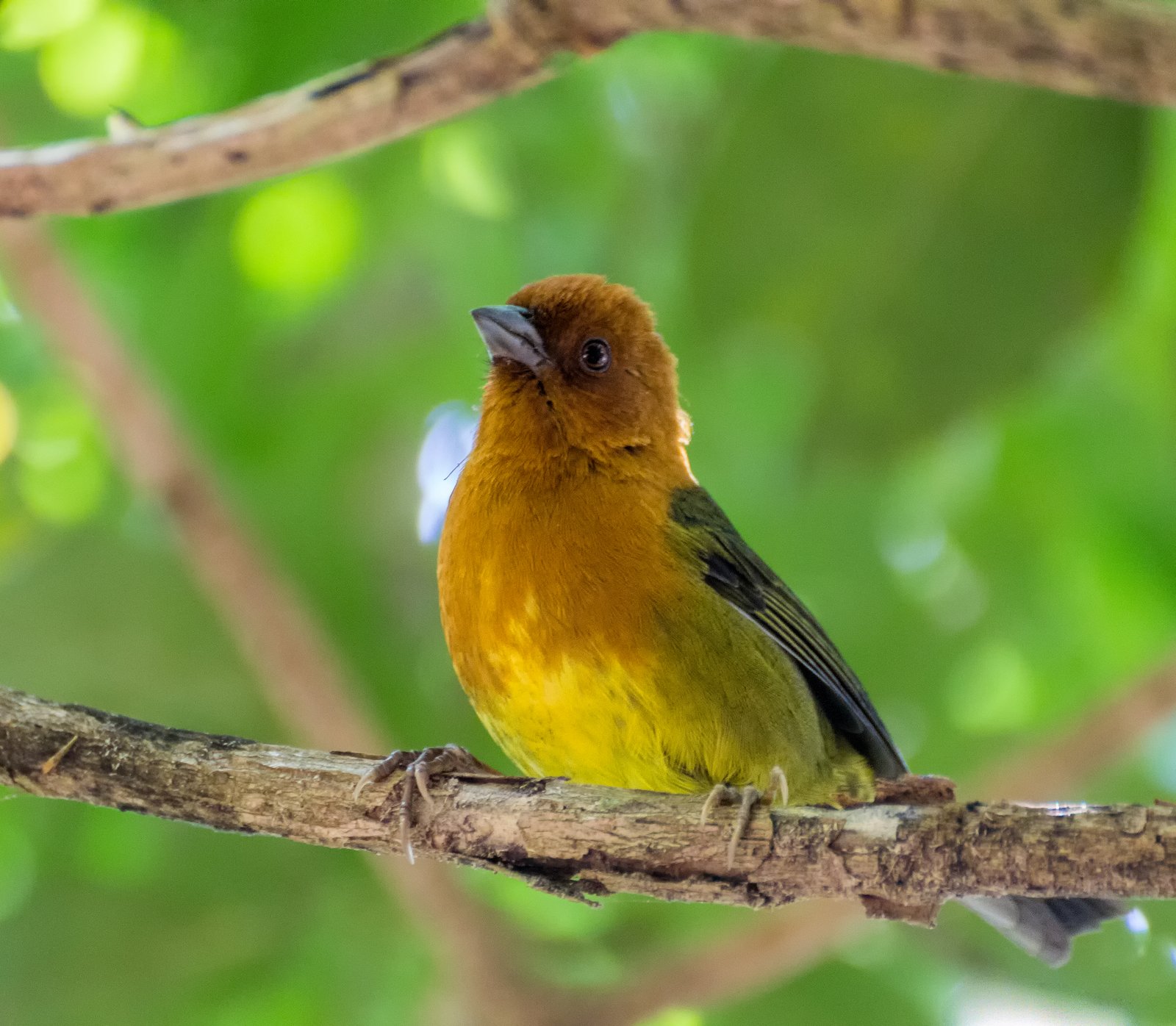
The Ochre-breasted Brushfinch is a brushfinch with an orange-rufous head and breast, of scrub and forest edges in the Eastern Andes of Colombia and the mountains of Venezuela. It is less tied to closed forest than many relatives and also occurs in hedgerows and overgrown farmland. It is usually seen in pairs, low in scrub.
Voice
High, thin calls, roughly tsip, and a song of a few high, thin whistles followed by a short trill.
Recording: Iván Lau — CC BY-NC-SA 4.0 · xeno-canto
Identification
17–18 cm, with a stout, dark bill. The head, throat and breast are warm orange-rufous to ochre, without black markings. The belly is yellow to yellowish olive, and the flanks olive. The upperparts are olive-green. The sexes are alike; juveniles are duller, with faint streaks on the underparts.
Confusion species
Moustached Brushfinch Atlapetes albofrenatus has only a rufous crown, a black face with a white moustache and yellow underparts. Yellow-breasted Brushfinch Atlapetes latinuchus has a rufous crown, a black face and a yellow throat. Tanager Finch Oreothraupis arremonops is also orange-rufous, but has a black head with grey stripes and lives only on the Pacific slope.
Habitat
Scrub, forest edges, secondary forest, hedgerows, overgrown slopes and field edges, roughly between 1000 and 3000 m. It searches low in the vegetation and on the ground for insects, seeds and berries. The nest is a cup low in a shrub.
Where the bird is most at home, classified by the vegetation units of the Andes and the west coast.


Range and movements
In Colombia in the Eastern Andes, from Norte de Santander and Santander south to Boyacá and Cundinamarca. Absent from Ecuador, Peru, Bolivia and the Galápagos. Outside the guide area in the Andes and coastal mountains of Venezuela.
- Resident
- dark = core range, pale = thinly spread
How and when to look
Search shrubby forest edges and hedgerows around villages in the Eastern Andes, for example in Boyacá and Santander. The orange-rufous head and breast stand out when a bird perches on top of a shrub.
Conservation status
Least Concern. The species tolerates small-scale farmland with scrub well.
Scientific name
Atlapetes semirufus | (Boissonneau, 1840)
Boissonneau described the species in 1840 as Tanagra (Arremon) semirufus; because it was later moved to another genus, the author and year stand in brackets. The genus Atlapetes was introduced in 1831 by Wagler. The genus name comes from Greek: the mythical titan Atlas and petēs, 'flyer'. The species name comes from Latin semi-, 'half', and rufus, 'rufous', for the partly ochre-rufous head and underparts. The specimen the first description was based on came from Bogotá, Colombia.