All species › Passerines › Cardinals and allies › Ochre-breasted Tanager
Ochre-breasted Tanager | Chlorothraupis stolzmanni
Okerborsttangare | Tangara pechiocrácea | Tiê-de-peito-ocre
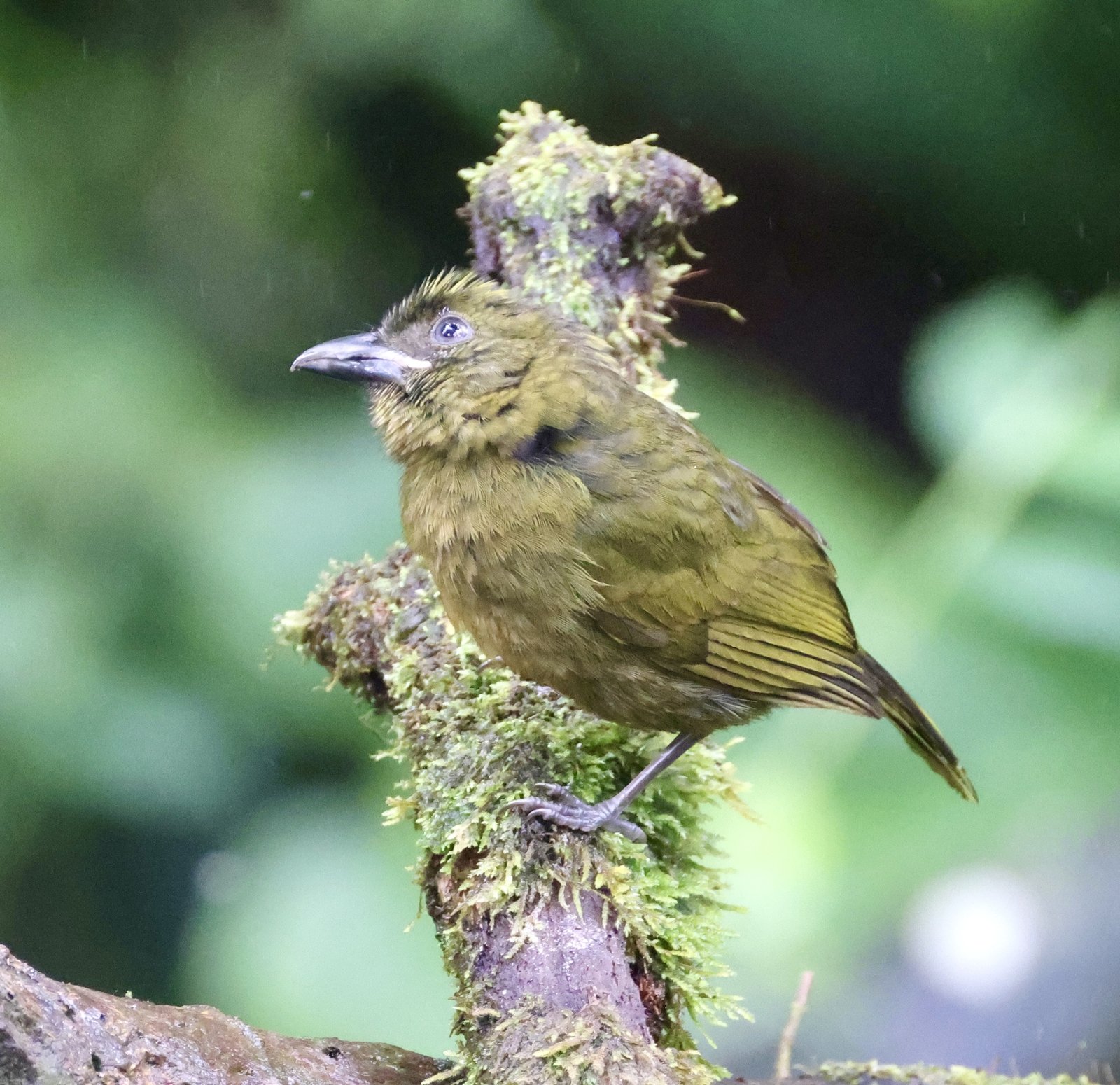
The Ochre-breasted Tanager is a stocky, olive cardinal of humid forest on the west slope of the Andes in Colombia and Ecuador. It lives higher than the related Lemon-spectacled Tanager, in the foothills and on the lower mountain slopes. Noisy groups travel through the undergrowth with mixed flocks.
Voice
Groups give a harsh, nasal chatter, with repeated loud calls. At dawn the male sings a fast series of clear, whistled phrases.
Recording: Juan Freile — CC BY-NC-SA 4.0 · xeno-canto
Identification
17–18 cm, stocky, with a heavy, blackish bill. Olive-green above, the head a greyer olive. Throat and breast are warm ochre-brown to ochre-yellow, the belly olive-yellow. There are no yellow spectacles. The sexes are similar. Young birds are duller, with less ochre on the breast.
Confusion species
Lemon-spectacled Tanager Chlorothraupis olivacea has yellow spectacles and lores and a yellow throat, and lives lower, mainly in the Chocó lowlands. Carmiol's Tanager Chlorothraupis carmioli is a more uniform olive, without ochre on the breast, and occurs only near the border with Panama. Female Summer Tanagers Piranga rubra are yellower, with a pale bill, and live higher in the trees.
Habitat
Undergrowth and mid-levels of humid foothill and lower montane forest on the Pacific slope, also at forest edges and in older secondary forest, roughly between 300 and 1500 m. It lives in groups that travel with mixed flocks. It eats insects and fruit. The nest is a cup low in the vegetation.
Where the bird is most at home, classified by the vegetation units of the Andes and the west coast.


Range and movements
In Colombia on the Pacific slope of the Western Andes, from the centre of the country south to Nariño. In Ecuador on the west slope of the Andes, south to about El Oro. Absent from Peru, Bolivia and the Galápagos. It does not occur outside the guide area.
- Resident
- dark = core range, pale = thinly spread
How and when to look
In foothill forest on the west slope, for example in north-western Ecuador, look for a group moving noisily through the undergrowth; the ochre breast is often the first feature seen.
Conservation status
Least Concern. The species has a limited range and depends on forest, which has been heavily cleared in places on the west slope of the Andes.
Scientific name
Chlorothraupis stolzmanni | (Berlepsch & Taczanowski, 1884)
Berlepsch & Taczanowski described the species in 1884 as Phoenicothraupis stolzmanni; because it was later moved to another genus, the author and year stand in brackets. The genus Chlorothraupis was introduced in 1883 by Salvin & Godman. The genus name comes from Greek khlōros, 'green', and thraupis, an unidentified small bird mentioned by Aristotle, used for tanagers. The species name honours the Polish zoologist Jan Sztolcman (Stolzmann, 1854–1928), who collected birds in Peru and Ecuador. The specimen the first description was based on came from Chimbo, Bolívar, Ecuador.