All species › Passerines › Cardinals and allies › Yellow-green Grosbeak
Yellow-green Grosbeak | Caryothraustes canadensis
Geelgroene kardinaal | Picogordo de antifaz | Furriel
The Yellow-green Grosbeak is a yellow-green cardinal with a black face and a heavy bill, which moves in small groups through the canopy of humid lowland forest. Most of its range lies in Amazonia, the Guianas and the Atlantic Forest of Brazil. In the guide area it occurs only on the margins of Colombia.
Voice
Groups give a constant, harsh and buzzy chatter. The song is a short series of clear, whistled notes, often from the treetops.
Recording: Wim Jacobs — CC BY-NC-SA 4.0 · xeno-canto
Identification
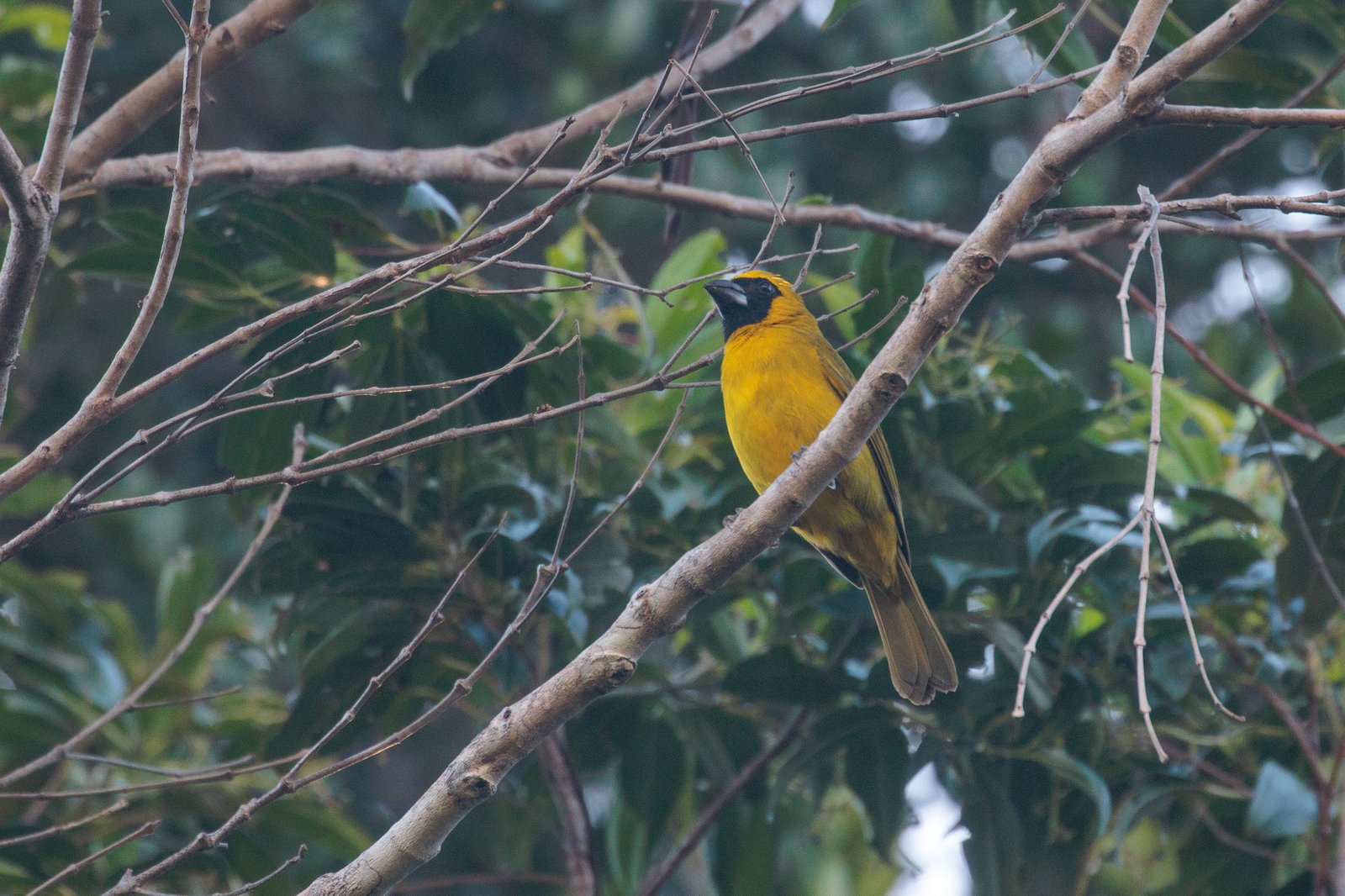
17 cm, with a heavy, conical, dark grey bill. The forehead, lores, skin around the eye and chin are black and form a narrow mask. The rest of the head, the back and the wings are olive-yellow to yellow-green; the underparts are brighter yellow, sometimes greyer on the belly. The sexes are similar. Young birds are duller, with a less sharply defined mask.
Confusion species
Yellow-shouldered Grosbeak Parkerthraustes humeralis has a grey head with a black-and-white face pattern and a grey belly. Lemon-spectacled Tanager Chlorothraupis olivacea has no black mask but yellow spectacles, and lives in the undergrowth. Females of tanagers of the genus Piranga have a paler bill and no black face.
Habitat
Canopy and mid-levels of humid lowland forest and forest edge, also in tall secondary forest, mainly below 800 m. It lives in noisy groups, often with mixed flocks in the treetops. It eats seeds, fruit and insects. The nest is a cup in a tree.
Where the bird is most at home, classified by the vegetation units of the Andes and the west coast.


Range and movements
In Colombia only locally on the margins of the country: in the extreme north-west near the border with Panama and in the extreme east in the lowlands near the borders with Venezuela and Brazil. Absent from Ecuador, Peru, Bolivia and the Galápagos. Outside the guide area in eastern Panama, southern and eastern Venezuela, the Guianas and Brazil, in Amazonia and the Atlantic Forest.
- Resident
- dark = core range, pale = thinly spread
How and when to look
In the canopy of lowland forest on the borders of Colombia, look for a group of yellow-green birds with a black face travelling with a mixed flock; the harsh chatter gives the group away.
Conservation status
Least Concern. The species tolerates some disturbance and also occurs in secondary forest, but disappears with large-scale deforestation.
Scientific name
Caryothraustes canadensis | (Linnaeus, 1766)
Linnaeus described the species in 1766 as Loxia canadensis; because it was later moved to another genus, the author and year stand in brackets. The genus Caryothraustes was introduced in 1850 by Reichenbach. The genus name comes from Greek karuon, 'nut', and thraustēs, 'breaker'. The species name means 'of Canada', but is a slip for Cayenne; the species does not occur in Canada. The specimen the first description was based on came from Cayenne, French Guiana.