All species › Passerines › Cardinals and allies › Vermilion Cardinal
Vermilion Cardinal | Cardinalis phoeniceus
Vermiljoenkardinaal | Cardenal guajiro | Cardeal-vermelhão
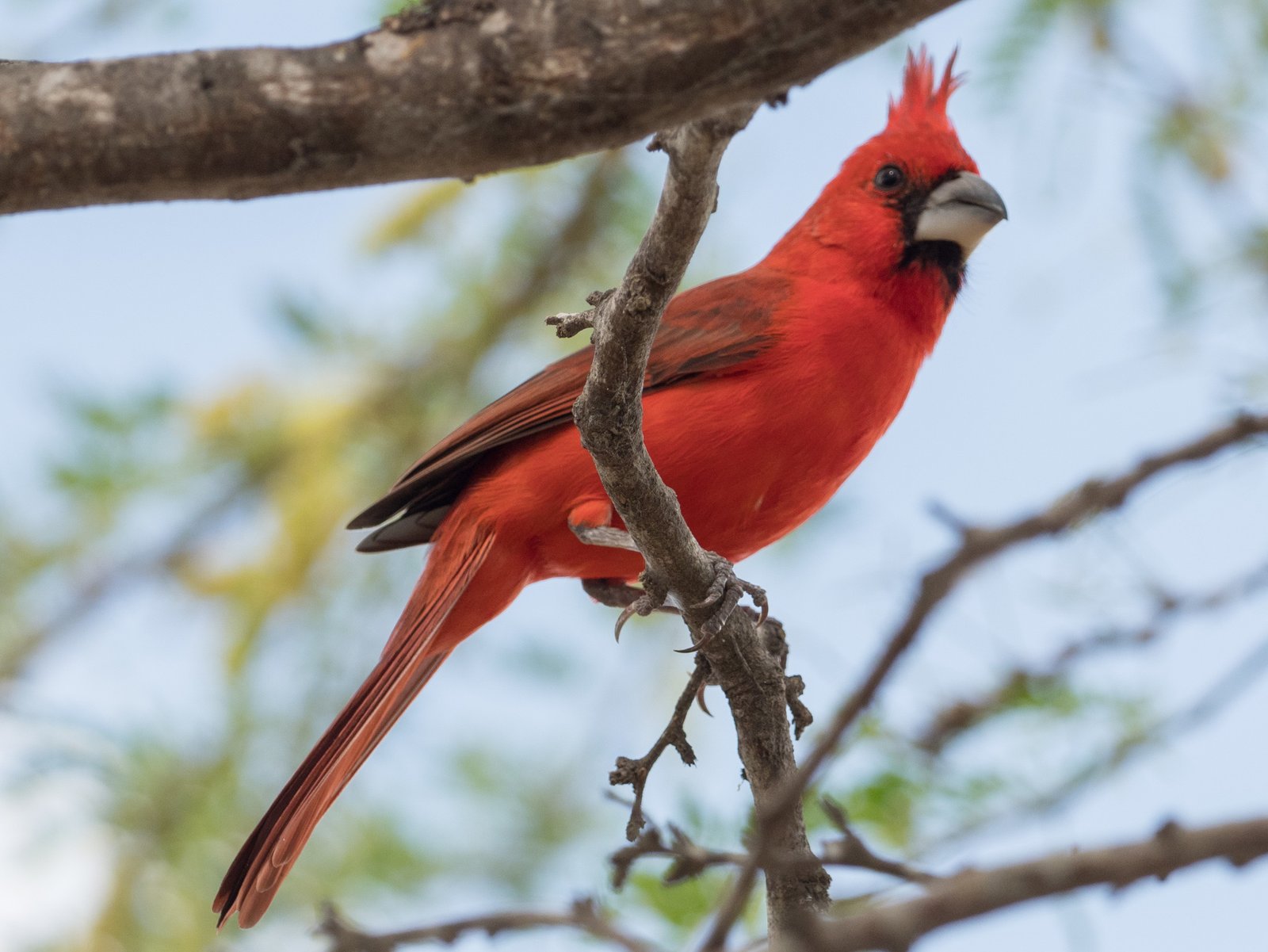
The Vermilion Cardinal is a red cardinal with a long, pointed crest of the dry Caribbean lowlands of Colombia and Venezuela. It is the South American relative of the Northern Cardinal. In the guide area it is restricted to the dry north of Colombia, mainly the Guajira Peninsula.
Voice
The song is a series of loud, clear whistles, often repeated, such as chew chew chew, similar to that of the Northern Cardinal. The call is a sharp, metallic chip.
Recording: Francisco contreras — CC BY-NC-SA 4.0 · xeno-canto
Identification
19–20 cm, with a long, narrow, upright crest and a heavy, pale grey bill. The male is rose-red, darker and greyer red on the back and wings, with a bright red crest. The female is grey-brown above, with a grey head, and warm ochre-brown below; the crest is red. Young birds resemble the female, with a shorter crest and a darker bill.
Confusion species
Grey Pileated Finch Coryphospingus pileatus is smaller, grey, with a slender bill; the male has a red, black-bordered crown stripe and no long crest. Summer Tanager Piranga rubra has no crest and a slimmer, paler bill. Vermilion Flycatcher Pyrocephalus rubinus is a small flycatcher with a black eye mask and a thin bill.
Habitat
Dry thorn scrub, shrubs with cacti and dry, open woodland in the lowlands, mainly below 300 m. It lives in pairs and forages on the ground and low in shrubs. It eats seeds, fruit and insects. The nest is a cup of twigs and grasses in a thorny shrub or cactus.
Where the bird is most at home, classified by the vegetation units of the Andes and the west coast.


Range and movements
In Colombia only in the dry Caribbean north, on the Guajira Peninsula and in adjacent dry lowlands. Absent from Ecuador, Peru, Bolivia and the Galápagos. Outside the guide area in the dry coastal zone of northern Venezuela.
- Resident
- dark = core range, pale = thinly spread
How and when to look
Search thorn scrub and cactus vegetation on the Guajira Peninsula early in the morning, when males sing from a tall shrub.
Conservation status
Least Concern. The species has a limited range; locally it is trapped as a cage bird and scrub is lost to grazing and wood cutting.
Scientific name
Cardinalis phoeniceus | Bonaparte, 1838
Bonaparte described the species in 1838 and placed it straight away in the genus where it still stands. He introduced the genus Cardinalis in that same work. The genus name comes from Latin cardinalis, 'cardinal', after the red robes of cardinals. The species name comes from Greek phoinikeos, 'crimson'. The specimen the first description was based on came from Venezuela.