All species › Passerines › Cardinals and allies › Red-throated Ant Tanager
Red-throated Ant Tanager | Driophlox fuscicauda
Roodkeelmiertangare | Tangara hormiguera garganta roja | Tiê-de-garganta-vermelha
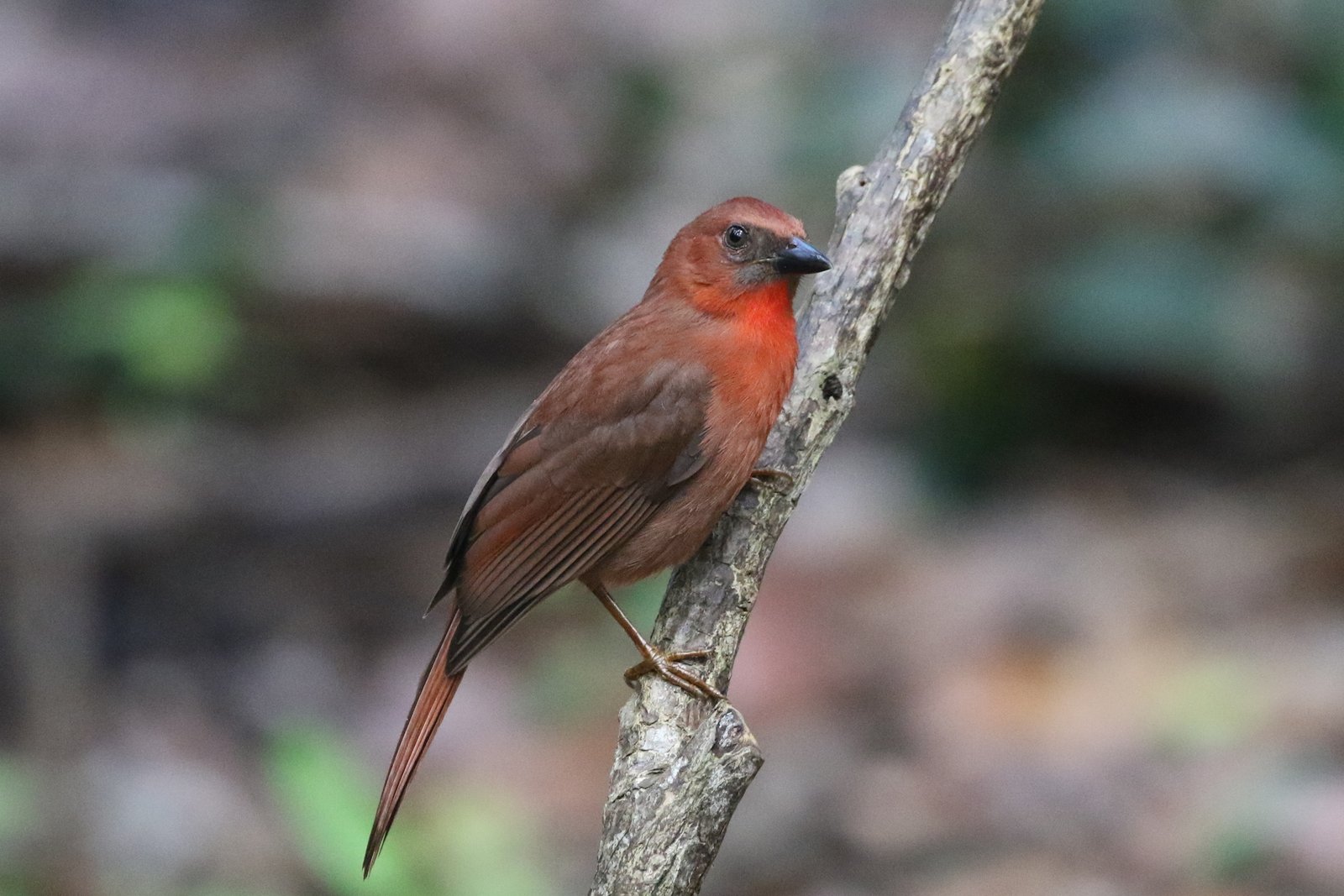
The Red-throated Ant Tanager is a dull red cardinal of the undergrowth of forest and scrub, from Mexico to northern Colombia. In the guide area it reaches only the Caribbean lowlands of Colombia. Groups move noisily through dense thickets and sometimes follow army-ant swarms.
Voice
Groups give a harsh, rasping chatter, like tearing paper, and sharp shek calls. The song is a sweet, rising series of whistles, often repeated.
No recording with a suitable Creative Commons licence is available for this species yet.
Identification
18–19 cm, with a fairly long tail and a stout, dark bill. The male is dull reddish brown, with a sharply defined, bright red throat and a red crown patch without black borders. The female is olive-brown, with an ochre-yellow throat and a faint, yellowish crown patch. Young birds resemble the female, but are duller.
Confusion species
Red-crowned Ant Tanager Habia rubica has a narrow, black-bordered crown stripe and a less sharply defined throat. Sooty Ant Tanager Driophlox gutturalis is dark grey, with a red crest and a rosy-red throat. Summer Tanager Piranga rubra is a more uniform red, with a pale bill, and lives higher in the trees.
Habitat
Undergrowth of evergreen and semi-deciduous forest, secondary forest, forest edges and dense scrub, in the guide area in the lowlands up to about 200 m. It lives in pairs or family groups. It eats mainly insects and other invertebrates, as well as fruit. The nest is a cup low in a shrub.
Where the bird is most at home, classified by the vegetation units of the Andes and the west coast.


Range and movements
In Colombia only in the Caribbean lowlands of the north, from northern Córdoba to Atlántico. Absent from Ecuador, Peru, Bolivia and the Galápagos. Outside the guide area from Mexico to Panama.
How and when to look
In dense scrub and forest edges in northern Córdoba and Sucre, listen for the harsh, rasping chatter of a group moving low through the vegetation.
Conservation status
Least Concern. The species tolerates secondary forest and scrub, but the Caribbean lowlands of Colombia have been largely deforested.
Scientific name
Driophlox fuscicauda | (Cabanis, 1861)
Cabanis described the species in 1861 as Phoenicothraupis fuscicauda; because it was later moved to another genus, the author and year stand in brackets. The genus Driophlox was introduced in 2024 by Scott, Chesser, Unitt & Burns. The genus name (2024) combines Greek drios, 'thicket', with phlox, 'flame'. The species name comes from Latin fuscus, 'dusky', and cauda, 'tail'. The specimen the first description was based on came from Costa Rica.