All species › Passerines › Cardinals and allies › Sooty Ant Tanager
Sooty Ant Tanager | Driophlox gutturalis
Roetmiertangare | Tangara hormiguera ahumada | Tiê-fuliginoso
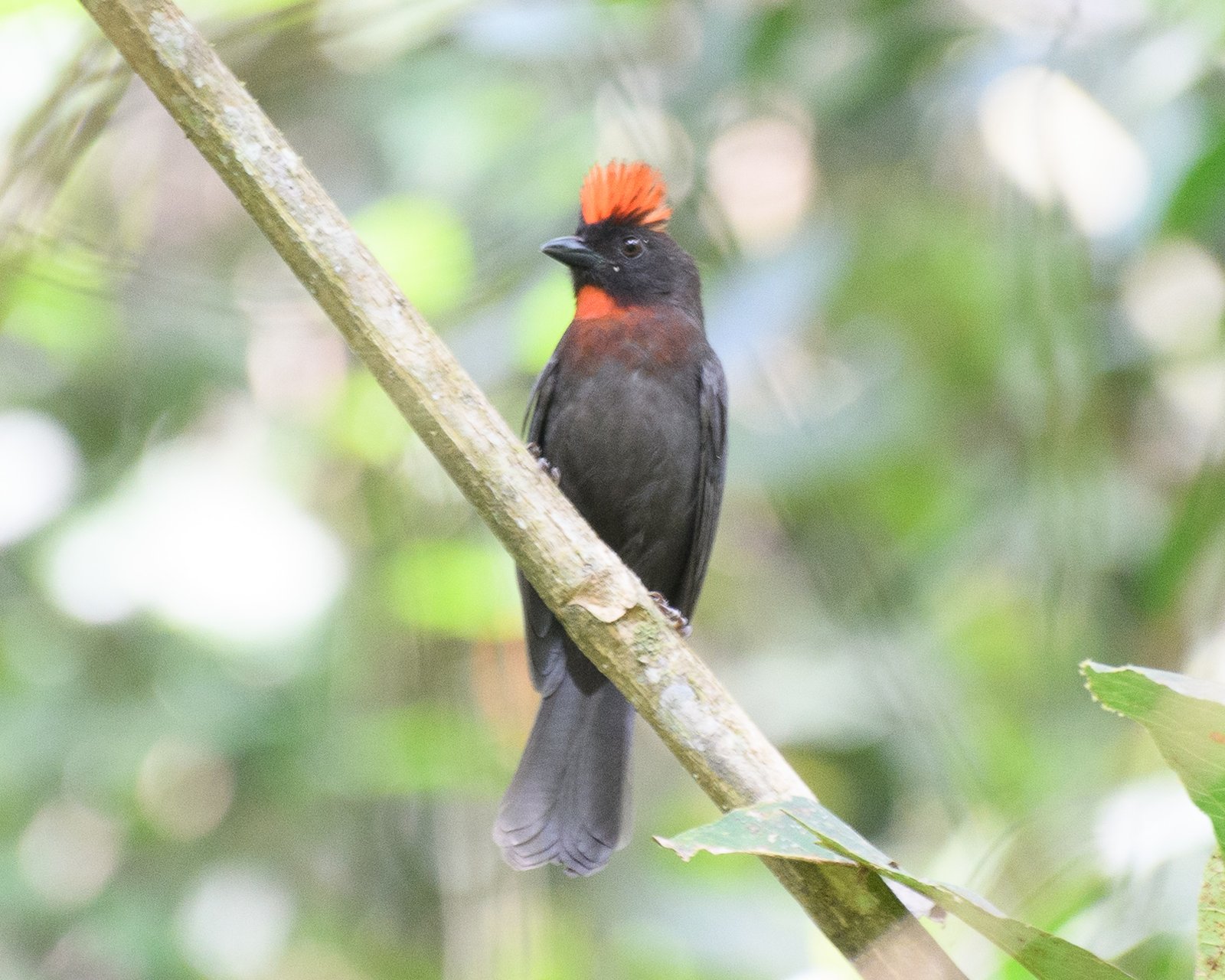
The Sooty Ant Tanager is a dark grey cardinal with a red crest and throat, endemic to northern Colombia. It lives in the undergrowth of humid forest at the northern base of the Andes, from the upper Sinú to the middle Magdalena. Groups move noisily through dense vegetation and join mixed flocks.
Voice
Groups give a harsh, rasping chatter and loud chek calls. The song is a series of clear, whistled phrases, mainly at dawn.
No recording with a suitable Creative Commons licence is available for this species yet.
Identification
19–20 cm, with a fairly long tail and a stout, dark bill. The male is sooty grey to blackish grey, with a scarlet crest that is often held flat and a rosy-red throat. The female is a duller grey, with a smaller, less bright crest and a pinkish-white throat. Young birds are browner grey.
Confusion species
Red-crowned Ant Tanager Habia rubica is dull reddish brown, with a narrow, black-bordered crown stripe. Red-throated Ant Tanager Driophlox fuscicauda is reddish brown and lives in the Caribbean lowlands further north. Crested Ant Tanager Driophlox cristata is a brighter red, with an erectile crest, and lives higher in the Andes. Dusky-faced Tanager Mitrospingus cassinii has a yellow crown and olive-yellow underparts.
Habitat
Undergrowth of humid lowland and foothill forest, forest edges, gaps and older secondary forest, up to about 1000 m. It favours dense growth along streams and on landslide slopes within extensive forest. It lives in pairs or small groups. It eats insects and fruit. The nest is a cup low in the vegetation.
Where the bird is most at home, classified by the vegetation units of the Andes and the west coast.


Range and movements
Endemic to Colombia: from the upper Sinú at the northern end of the Western Andes east along the northern base of the Andes, through the lower Cauca and Nechí region, to the middle Magdalena valley. Absent from Ecuador, Peru, Bolivia and the Galápagos.
- Resident
- dark = core range, pale = thinly spread
How and when to look
In forest along streams in the middle Magdalena valley, for example in Antioquia, listen for the harsh chatter of a group in the undergrowth; watch for the red crest, which is raised only when the bird is excited.
Conservation status
Least Concern. The species has a small range in a region with much deforestation and depends on extensive forest.
Scientific name
Driophlox gutturalis | (Sclater, 1854)
Sclater described the species in 1854 as Phoenicothraupis gutturalis; because it was later moved to another genus, the author and year stand in brackets. The genus Driophlox was introduced in 2024 by Scott, Chesser, Unitt & Burns. The genus name (2024) combines Greek drios, 'thicket', with phlox, 'flame'. The species name is New Latin gutturalis, 'of the throat', after the red throat patch. The specimen the first description was based on came from Colombia.