All species › Passerines › Cardinals and allies › Crested Ant Tanager
Crested Ant Tanager | Driophlox cristata
Kuifmiertangare | Tangara hormiguera copetona | Tiê-de-crista
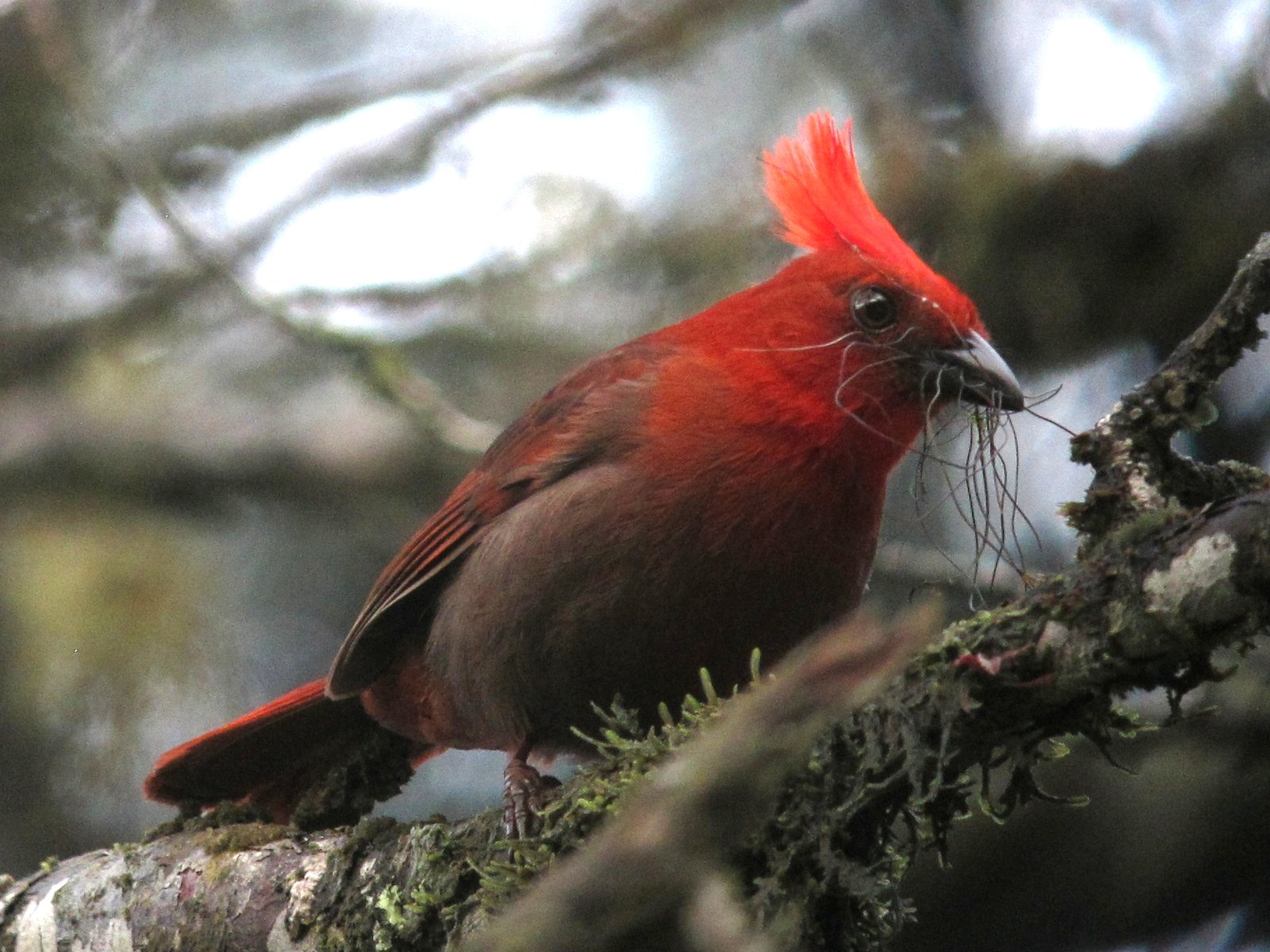
The Crested Ant Tanager is a red cardinal found only in Colombia, in the Western and Central Andes. It lives in pairs or small groups in the dense undergrowth of humid montane forest, often along streams and in ravines. It is the only ant tanager with an erectile scarlet crest.
Voice
The dawn song is a series of repeated che-ik notes. When alarmed a loud, shrill chi-veek. Groups keep in contact with short, harsh calls.
No recording with a suitable Creative Commons licence is available for this species yet.
Identification
18–19 cm, with a fairly long tail and a stout, dark bill. The male is dark red, with a prominent scarlet crest that it can raise; the upperparts shade from red on the shoulders to brownish red on the rump. The throat and breast are bright red, and the belly is greyish with a red tinge. The female resembles the male, but is duller and has a smaller crest. Juveniles lack the crest and are reddish brown above and cinnamon below.
Confusion species
Red-crowned Ant Tanager Habia rubica is a duller reddish brown, with a narrow, black-bordered crown stripe and no crest, and lives in the lowlands east of the Andes. Red-throated Ant Tanager Driophlox fuscicauda is browner, without a crest, and lives lower, in the northern lowlands. Summer Tanager Piranga rubra is a more uniform red, with a pale bill and no crest, and feeds higher in the trees.
Habitat
Undergrowth of humid mid-elevation and montane forest, roughly between 700 and 2000 m, especially in dense growth along streams, in ravines and around landslide openings; sometimes also in more open terrain. It forages in pairs or small groups in the lower levels for insects and other arthropods, as well as palm seeds and fruit; it sometimes catches insects in flight and occasionally follows army-ant swarms. Little is known about breeding.
Where the bird is most at home, classified by the vegetation units of the Andes and the west coast.


Range and movements
Endemic to Colombia: on both slopes of the Western Andes, from Antioquia south to Cauca, and on both slopes of the Central Andes, from Antioquia to Tolima. Absent from Ecuador, Peru, Bolivia and the Galápagos. Does not occur outside the guide area.
- Resident
- dark = core range, pale = thinly spread
How and when to look
In the morning, listen in wooded ravines and along streams on the slopes of the Western and Central Andes for the shrill call of a group; the birds usually stay low in the dense growth.
Conservation status
Least Concern. The species occurs in several protected areas, but its population is declining as montane forest is cleared and fragmented.
Scientific name
Driophlox cristata | (Lawrence, 1875)
Lawrence described the species in 1875 as Phaenicothraupis cristata; because it was later moved to another genus, the author and year stand in brackets. The genus Driophlox was introduced in 2024 by Scott, Chesser, Unitt & Burns. The genus name (2024) combines Greek drios, 'thicket', with phlox, 'flame'. The species name is Latin cristatus, 'crested'. The specimen the first description was based on came from Bogotá, Colombia.