All species › Passerines › Cardinals and allies › Red-hooded Tanager
Red-hooded Tanager | Piranga rubriceps
Karmozijnkoptangare | Piranga capuchirroja | Sanhaço-de-capuz-vermelho
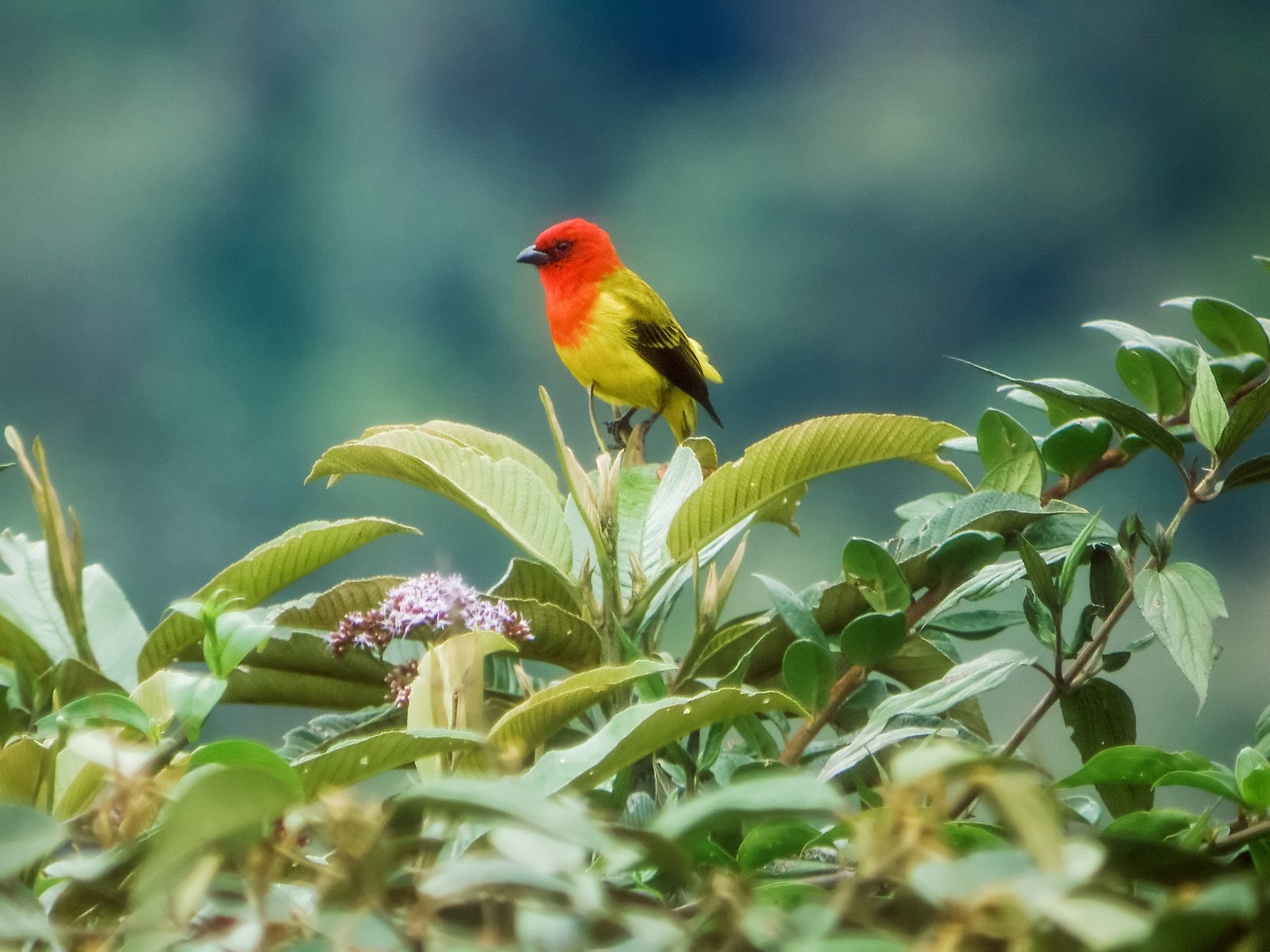
The Red-hooded Tanager is a tanager of the upper montane forest of the northern Andes, with a red hood above a yellow body and black wings. Pairs and small groups forage in the mid-levels and canopy, often at the forest edge and in mossy, epiphyte-laden trees. It joins mixed flocks about half of the time.
Voice
The song mixes thin trills with sweeter, more musical phrases; another song is a repeated series of tsee notes. The call is a sharp spink or tink.
Recording: Juan Freile — CC BY-NC-SA 4.0 · xeno-canto
Identification
17–18 cm, with a fairly thick, pale bill. The male has a crimson hood covering the head, throat and breast; the rest of the underparts is yellow and the back yellowish olive. The wings are black, with a yellow shoulder patch, and the tail is blackish. The female is duller, and the red is restricted to the head and throat. Little is known about juvenile plumage.
Confusion species
Few other birds of montane forest show this combination of red hood, yellow underparts and black wings. Rufous-chested Tanager Thlypopsis ornata is smaller, with a slender bill, a rufous head and breast and a white belly, and lacks black wings. Summer Tanager Piranga rubra is all red in the male and plain yellowish in the female, without a red hood; it usually lives lower.
Habitat
Interior and edges of humid montane forest and cloud forest, especially where mosses and epiphytes are abundant, roughly between 1700 and 3000 m. It hops through branches and foliage in the mid-levels and canopy, taking insects and fruit, often in more open spots. It lives in pairs or small groups and often travels with mixed flocks. Little is known about breeding.
Where the bird is most at home, classified by the vegetation units of the Andes and the west coast.


Range and movements
In Colombia in all three Andean ranges. In Ecuador on the eastern slope of the Andes, mainly between 2200 and 3000 m. In Peru on the eastern slope in the north, south to Huánuco. Absent from Bolivia and the Galápagos. Does not occur outside the guide area.
- Resident
- dark = core range, pale = thinly spread
How and when to look
In cloud forest and at forest edges on the eastern slope, look for a mixed flock in the treetops; the red of the hood stands out against the green of the mossy branches. The sharp spink call helps to locate the birds.
Conservation status
Least Concern. The species is locally rather scarce and depends on montane forest, which is being cleared in parts of its range.
Scientific name
Piranga rubriceps | Gray, 1844
Gray described the species in 1844 and placed it straight away in the genus where it still stands. The genus Piranga was introduced in 1808 by Vieillot. The genus name comes from the Tupi word tijepiranga, the name of an unidentified small bird. The species name comes from Latin ruber, 'red', and -ceps, '-headed', for the red head. The specimen the first description was based on came from Bogotá, Colombia.