All species › Passerines › Cardinals and allies › White-winged Tanager
White-winged Tanager | Piranga leucoptera
Witvleugeltangare | Tángara ala blanca | Sanhaço-de-asa-branca
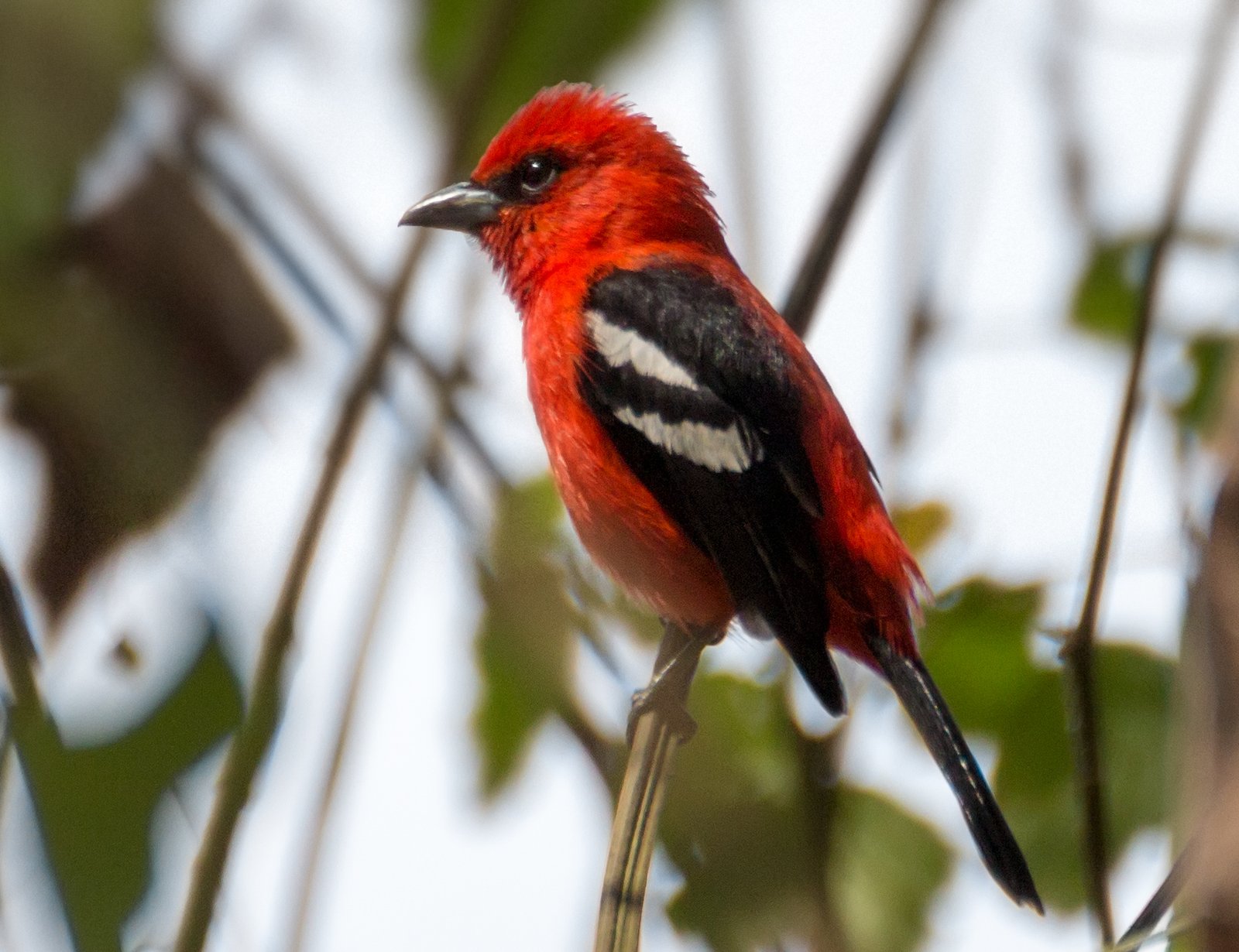
The White-winged Tanager is the smallest Piranga in the guide area, a canopy bird of humid montane forest from Mexico to Bolivia. Both sexes have black wings with two broad white wing bars. Pairs and small groups often travel with mixed flocks in the canopy.
Voice
The song is a high, thin series of whistles, for example see-wee-tseet, often repeated. The call is a thin, two-noted pee-tsee or a dry chip.
Recording: José María Loaiza B. — CC BY-NC-SA 4.0 · xeno-canto
Identification
13–14 cm, with a fairly short, dark bill. The male is scarlet, with a black mask around the eye and bill base, black wings with two broad white wing bars and a black tail. The female is olive-yellow above and yellow below, with the same black wing pattern and also white wing bars, and a narrow dark loral spot. Young males resemble the female, with orange-yellow tones.
Confusion species
Scarlet Tanager Piranga olivacea is larger, with a paler, thicker bill and black wings without white wing bars; it is a winter visitor to the lowlands and foothills. Vermilion Tanager Calochaetes coccineus is larger, bright vermilion with a black throat and no white wing bars. Female Summer Tanagers Piranga rubra are larger and plain yellowish, without dark wings with white bars.
Habitat
Canopy and edges of humid montane forest, foothill forest and cloud forest, also older secondary forest and semi-open country with tall trees, roughly between 1000 and 2500 m, locally lower or higher. It searches the outer branches for insects and fruit, usually high in the trees. It lives in pairs or small groups, often with mixed flocks. The nest is a shallow cup high in a tree.
Where the bird is most at home, classified by the vegetation units of the Andes and the west coast.


Range and movements
In Colombia in all Andean ranges and in the Sierra Nevada de Santa Marta and the Serranía de Perijá. In Ecuador on both slopes of the Andes. In Peru on the eastern slope along the full length of the country. In Bolivia in the Yungas and on the eastern slope to Santa Cruz. Absent from the Galápagos. Outside the guide area from Mexico to Panama and in Venezuela, and in the tepui region of Guyana and Brazil.
- Resident
- dark = core range, pale = thinly spread
How and when to look
In montane forest, look for mixed flocks in the canopy; the white wing bars are visible from below in females too. The high two-noted call often gives the birds away before their colour does.
Conservation status
Least Concern. The species is widespread and tolerates forest edges and secondary forest.
Scientific name
Piranga leucoptera | Trudeau, 1840
Trudeau described the species in 1840 and placed it straight away in the genus where it still stands. The genus Piranga was introduced in 1808 by Vieillot. The genus name comes from the Tupi word tijepiranga, the name of an unidentified small bird. The species name comes from Greek leukos, 'white', and pteron, 'wing', for the white wing bars. The specimen the first description was based on came from Mexico.