All species › Passerines › Cardinals and allies › Summer Tanager
Summer Tanager | Piranga rubra
Zomertangare | Piranga roja | Sanhaço-vermelho
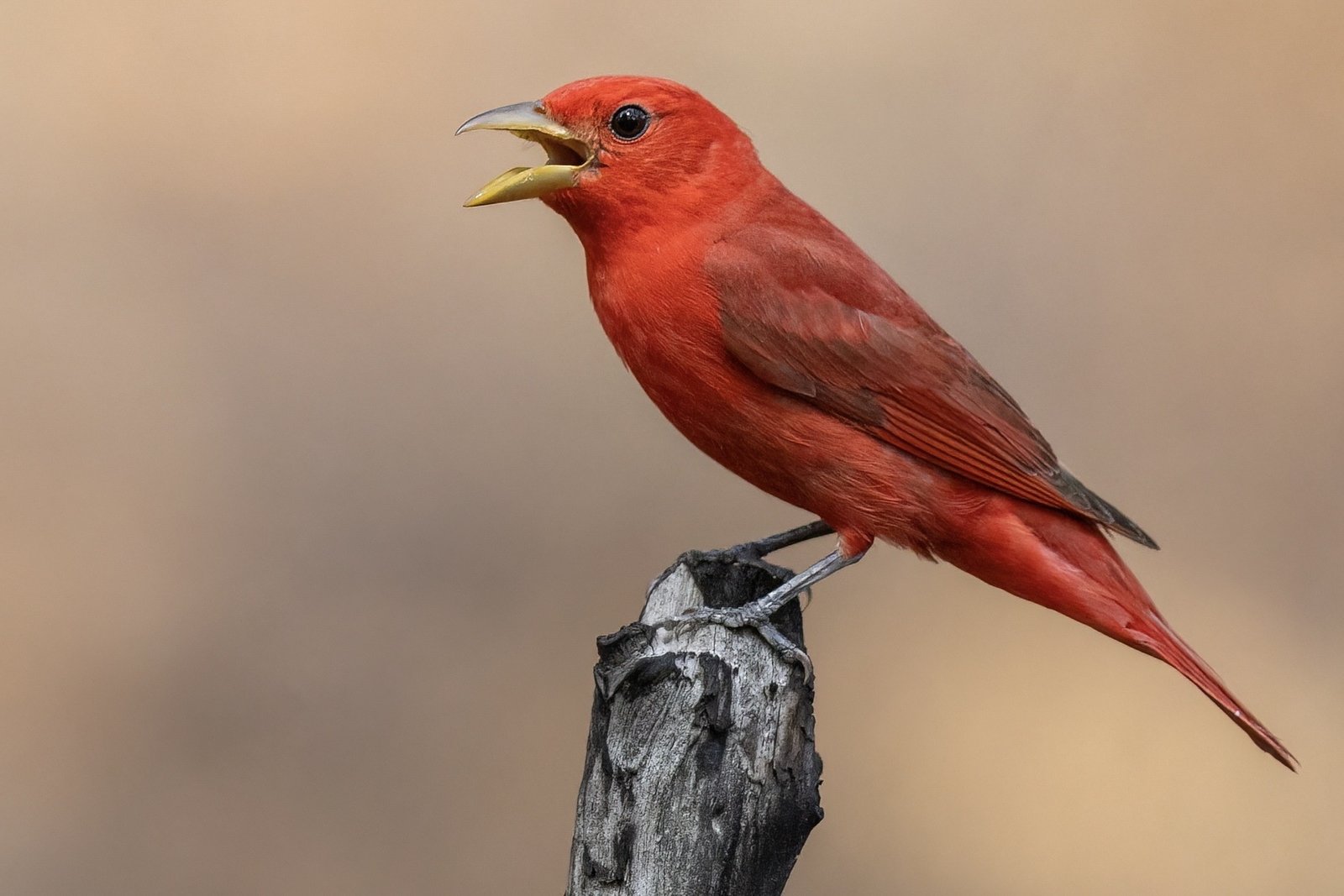
The Summer Tanager is a North American Piranga that migrates in large numbers to north-western South America for the northern winter. The male is plain red all year, which sets it apart among the winter visitors. On the wintering grounds it usually lives alone and eats many bees and wasps.
Voice
The call is a distinctive, staccato pi-tuk or pi-ti-tuk, often heard on the wintering grounds too. The song, a series of clear, robin-like phrases, is rarely heard in the guide area.
Recording: Manuel Grosselet — CC BY-NC-SA 4.0 · xeno-canto
Identification
17–18 cm, with a fairly long, thick, pale bill. The adult male is entirely rose-red, with slightly darker wings; it stays red in winter too. The female is olive-yellow above and ochre-yellow to orange-yellow below, without wing bars. First-winter males resemble the female and acquire red patches during the winter.
Confusion species
Hepatic Tanager Piranga flava has a darker, greyish bill, greyish cheeks and flanks, and is a resident of the Andes. Scarlet Tanager Piranga olivacea has black (male) or dark (female) wings, a shorter bill and a greener tone. White-winged Tanager Piranga leucoptera is smaller, with black wings with white bars. Crested Ant Tanager Driophlox cristata and Red-crowned Ant Tanager Habia rubica are a duller red, with a dark bill, and live in the undergrowth.
Habitat
In winter in forest edges, secondary forest, semi-open country with trees, shade coffee, riverine forest, gardens and parks, from the lowlands to about 2500 m, mainly in the foothills and on the lower slopes. It searches the canopy for insects, especially bees and wasps, which it catches in flight, and also eats fruit. It usually lives alone and sometimes joins mixed flocks. It does not breed in the guide area.
Where the bird is most at home, classified by the vegetation units of the Andes and the west coast.


Range and movements
Winter visitor, mainly October to April. In Colombia common and widespread in the lowlands, the valleys and on the Andean slopes. In Ecuador fairly common on both sides of the Andes. In Peru widespread, mainly in the north and east of the Andes. In Bolivia scarce, mainly in the north. In the Galápagos a rare vagrant. Breeds in the southern United States and northern Mexico and winters from Mexico to Bolivia and western Brazil.
- Winter visitor (c. Oct–Mar)
- dark = core range, pale = thinly spread
How and when to look
In winter, listen in forest edges and gardens for the staccato pi-tuk call. A plain red bird with a pale bill in the treetops between October and April is as a rule a male Summer Tanager.
Conservation status
Least Concern. The species is numerous and on the wintering grounds also uses secondary growth, shade coffee and gardens.
Scientific name
Piranga rubra | (Linnaeus, 1758)
Linnaeus described the species in 1758 as Fringilla rubra; because it was later moved to another genus, the author and year stand in brackets. The genus Piranga was introduced in 1808 by Vieillot. The genus name comes from the Tupi word tijepiranga, the name of an unidentified small bird. The species name comes from Latin ruber, 'red', for the red male. The specimen the first description was based on came from South Carolina, United States.