All species › Passerines › Cardinals and allies › Hepatic Tanager
Hepatic Tanager | Piranga flava
Levertangare | Piranga bermeja | Sanhaço-de-fogo
In the taxonomy followed here, the Hepatic Tanager is a widespread Piranga from the south-western United States to Argentina, in which the Andean form (lutea) and the lowland form (flava) are combined. In the guide area it is a resident of semi-open woodland, forest edges and dry forest on the Andean slopes. The bill has a small tooth in the edge of the upper mandible.
Voice
The song is a series of clear, whistled phrases, a little fuller than that of Summer Tanager. The call is a short, dry chuck or chup.
Recording: Paul Molina Abril — CC BY-NC-SA 4.0 · xeno-canto
Identification
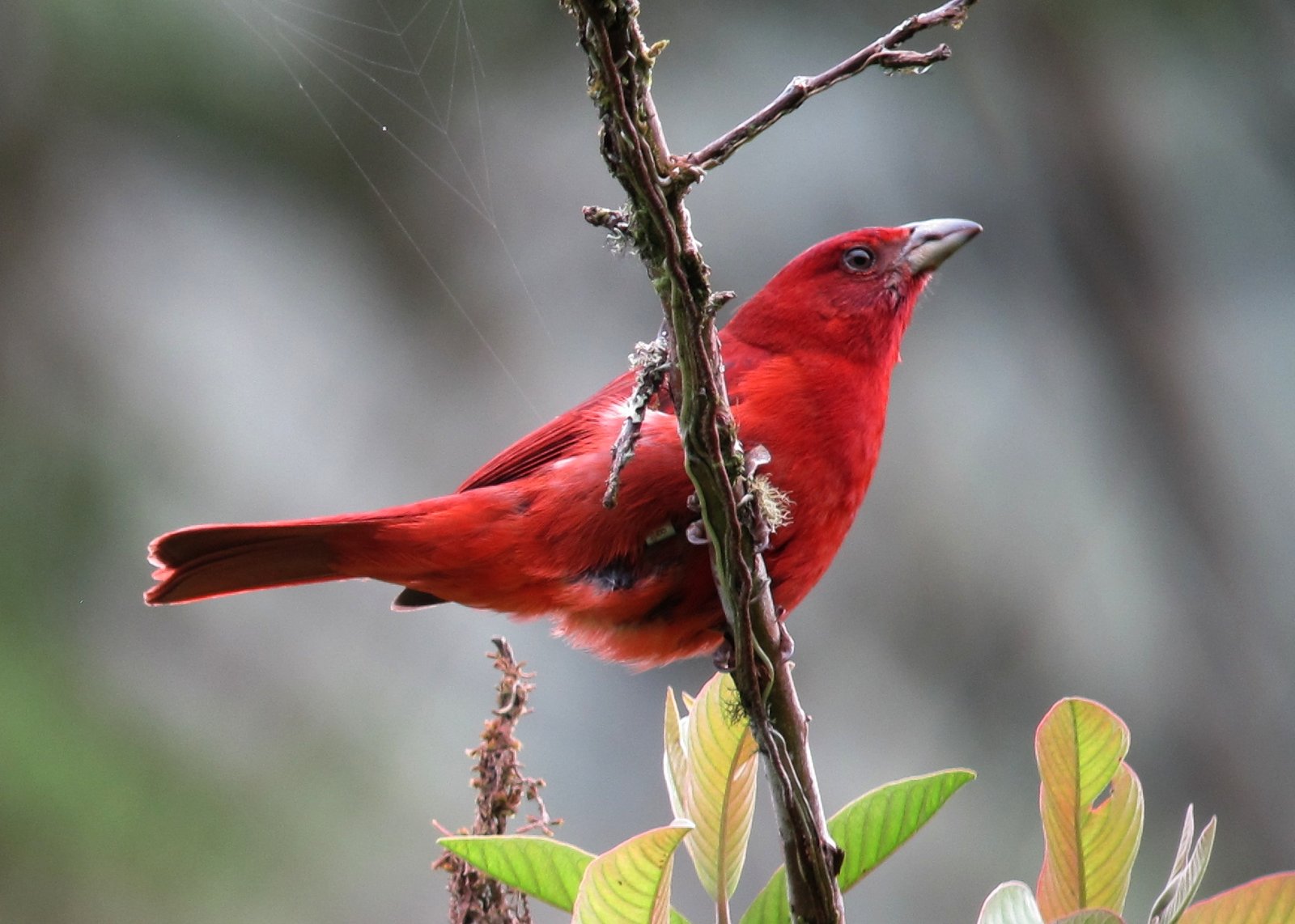
17–18 cm, with a stout, dark grey to horn-coloured bill. The male is red, slightly duller and greyer on the back and cheeks; the Andean form is brighter red than the North American forms. The female is olive-green above and yellow to ochre-yellow below, with greyish cheeks. Young males resemble the female, with orange tones on the head and breast.
Confusion species
Summer Tanager Piranga rubra has a paler, horn-coloured bill, lacks the grey on the cheeks and flanks and is a winter visitor from North America. White-winged Tanager Piranga leucoptera is smaller, with black wings with white wing bars. Vermilion Cardinal Cardinalis phoeniceus has a tall, pointed crest and lives in the arid north-east of Colombia.
Habitat
Semi-open woodland, forest edges, secondary forest, dry and semi-deciduous forest on slopes and in valleys, and open country with scattered trees, mainly between 1000 and 2500 m, locally lower in the arid west; in Bolivia also in wooded savanna. It searches the canopy for insects and fruit, usually in pairs. The nest is a shallow cup high in a tree.
Where the bird is most at home, classified by the vegetation units of the Andes and the west coast.


Range and movements
In Colombia in the Andes, the Sierra Nevada de Santa Marta and the Serranía de Perijá. In Ecuador on both slopes of the Andes and in the dry valleys, also in the arid south-west. In Peru on both slopes of the Andes and in the inter-Andean valleys. In Bolivia on the eastern slope of the Andes and in the eastern lowlands. Absent from the Galápagos. Outside the guide area from the south-western United States to Central America, and in Venezuela, the Guianas, Brazil, Paraguay, Uruguay and Argentina.
- Resident
- dark = core range, pale = thinly spread
How and when to look
At middle elevations, look in semi-open woodland and at forest edges for a red Piranga with a dark bill. Listen for the dry chuck call.
Conservation status
Not evaluated in the taxonomy followed here. The species is fairly common in the guide area and tolerates semi-open country and forest edges well.
Scientific name
Piranga flava | (Vieillot, 1822)
Vieillot described the species in 1822 as S[altator] Flavus; because it was later moved to another genus, the author and year stand in brackets. The genus Piranga was introduced in 1808 by Vieillot. The genus name comes from the Tupi word tijepiranga, the name of an unidentified small bird. The species name comes from Latin flavus, 'yellow', for the yellowish plumage of the female. The specimen the first description was based on came from Paraguay.