All species › Passerines › Cardinals and allies › Scarlet Tanager
Scarlet Tanager | Piranga olivacea
Zwartvleugeltangare | Piranga escarlata | Sanhaço-escarlate
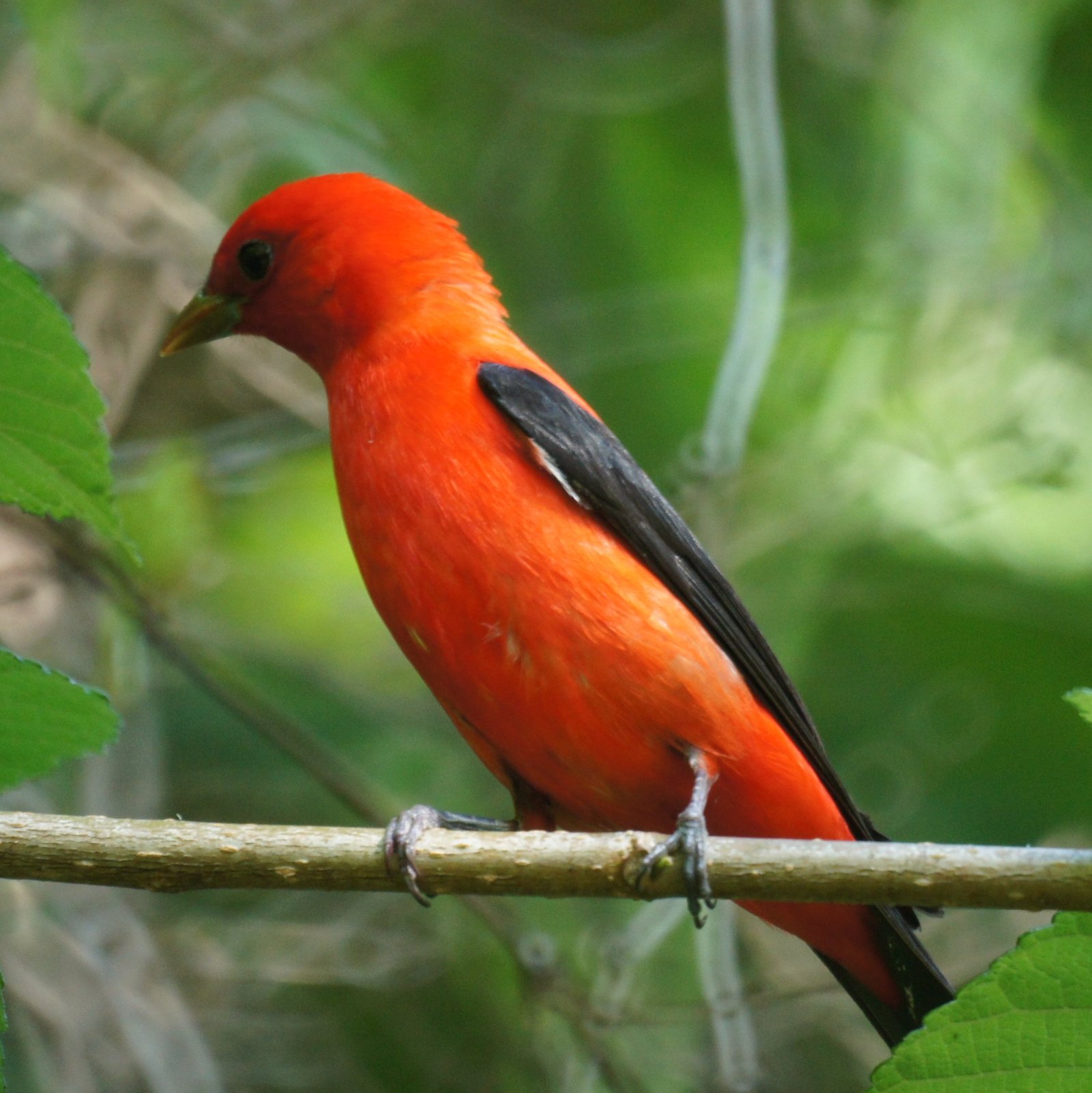
The Scarlet Tanager is a North American Piranga that winters mainly in the western Amazon basin. In breeding plumage the male is scarlet with black wings and tail, but in the guide area it is usually seen in its yellow-green winter plumage. It passes through Colombia in autumn and spring.
Voice
The call is a hoarse, distinctive chip-burr. The song, a hoarse, robin-like series of phrases, is rarely heard in the guide area, sometimes shortly before the return migration.
Recording: Bobby Wilcox — CC BY-NC-SA 4.0 · xeno-canto
Identification
16–17 cm, with a fairly short, thick, pale bill. The male in winter is olive-green above and yellow below, with black wings and tail; from February and March red feathers appear, and before the return migration it is often largely scarlet already. The female is olive-green and yellow, with dark grey to brownish-grey wings without wing bars. Young males resemble the female, with slightly darker wings.
Confusion species
Female Summer Tanager Piranga rubra is a warmer ochre-yellow, with a longer bill and wings no darker than the back. White-winged Tanager Piranga leucoptera is smaller, with two white wing bars, and is a resident of montane forest. Female Hepatic Tanagers Piranga flava have a dark bill and greyish cheeks.
Habitat
In winter in the canopy and at the edges of humid lowland and foothill forest, in várzea and on river islands, and on migration also in secondary forest, forest edges and higher on the Andean slopes, up to about 2500 m. It searches high in the trees for insects and fruit, usually alone and often with mixed flocks. It does not breed in the guide area.
Where the bird is most at home, classified by the vegetation units of the Andes and the west coast.


Range and movements
Winter visitor and passage migrant, mainly October to April. In Colombia mainly a passage migrant, in the north and in the Andes, and a winter visitor in the eastern lowlands. In Ecuador and Peru mainly a winter visitor in the eastern lowlands and foothills, scarce west of the Andes. In Bolivia a winter visitor in the north. In the Galápagos a rare vagrant. Breeds in eastern North America and winters mainly in north-western South America.
- Winter visitor (c. Oct–Mar)
- Passage (Mar–Apr, Oct–Nov)
- dark = core range, pale = thinly spread
How and when to look
In winter, watch in the treetops of humid lowland forest for a yellow-green bird with black wings, often in a mixed flock. Listen for the hoarse chip-burr call.
Conservation status
Least Concern. The species is numerous, but depends on forest on both its breeding and wintering grounds.
Scientific name
Piranga olivacea | (Gmelin, 1789)
Gmelin described the species in 1789 as Tanagra olivacea; because it was later moved to another genus, the author and year stand in brackets. The genus Piranga was introduced in 1808 by Vieillot. The genus name comes from the Tupi word tijepiranga, the name of an unidentified small bird. The species name comes from Latin olivaceus, 'olive-green', for the plumage of females and non-breeding males. The specimen the first description was based on came from New York, United States.