All species › Passerines › Cardinals and allies › Blue Grosbeak
Blue Grosbeak | Passerina caerulea
Blauwe bisschop | Picogrueso azul | Azulão-do-norte
The Blue Grosbeak is a North and Central American cardinal that winters south to Panama. The guide area lies just outside the normal wintering range; in north-western Colombia it is a rare visitor. It is the largest species in the genus Passerina.
Voice
The call is a loud, metallic chink. The song is a fast, rich warble of alternately rising and falling notes; rarely heard in the wintering area.
Recording: Manuel Grosselet — CC BY-NC-SA 4.0 · xeno-canto
Identification
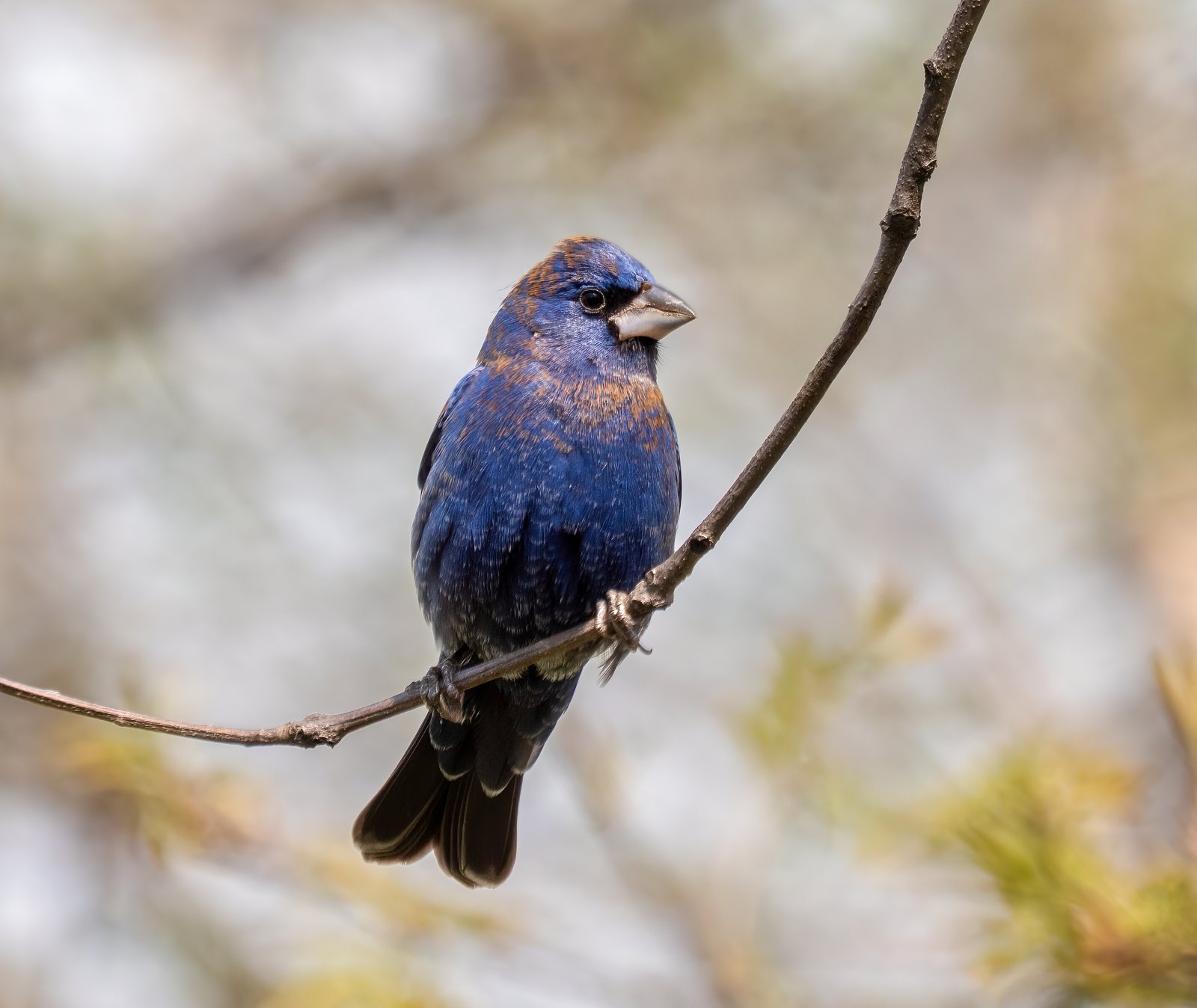
15–17 cm, with a heavy, conical bill with a pale grey lower mandible. The male is deep blue, with a blackish area around the base of the bill and two broad, rufous wing bars; in winter the blue feathers are partly edged brown. The female is warm brown, slightly paler below, with two rufous to buff wing bars and often a tinge of blue on the rump. Young males are brown with blue patches.
Confusion species
Indigo Bunting Passerina cyanea is smaller, with a smaller bill and no rufous wing bars. Blue-black Grosbeak Cyanoloxia cyanoides is a darker blackish blue, without wing bars, and lives in humid forest. Ultramarine Grosbeak Cyanoloxia brissonii has bright pale blue highlights and no rufous wing bars.
Habitat
In winter in semi-open country with shrubs and tall grass: rough pastures, field edges, rice fields, shrubby forest edges and gardens, mainly in the lowlands. It eats seeds of grasses and herbs, and also insects. It does not breed in the guide area.
Where the bird is most at home, classified by the vegetation units of the Andes and the west coast.


Range and movements
Colombia: rare winter visitor, mainly in the north-west near the border with Panama and on the islands of San Andrés and Providencia. Elsewhere in the guide area at most an exceptional vagrant. Absent as a regular species from Ecuador, Peru, Bolivia and the Galápagos. Outside the guide area the species breeds from the United States to Costa Rica and winters from Mexico to Panama.
How and when to look
In winter in north-western Colombia and on San Andrés, check flocks of seed-eaters in rough grassland; a large, brown or blue bunting with rufous wing bars may be this species.
Conservation status
Least Concern. The North American population is stable to increasing.
Scientific name
Passerina caerulea | (Linnaeus, 1758)
Linnaeus described the species in 1758 as Loxia caerulea; because it was later moved to another genus, the author and year stand in brackets. The genus Passerina was introduced in 1816 by Vieillot. The genus name comes from Latin passerinus, 'sparrow-like'. The species name is Latin caeruleus, 'blue'. The specimen the first description was based on came from South Carolina, United States.