All species › Passerines › Cardinals and allies › Northern Cardinal
Northern Cardinal | Cardinalis cardinalis
Rode kardinaal | Cardenal rojo | Cardeal-do-norte
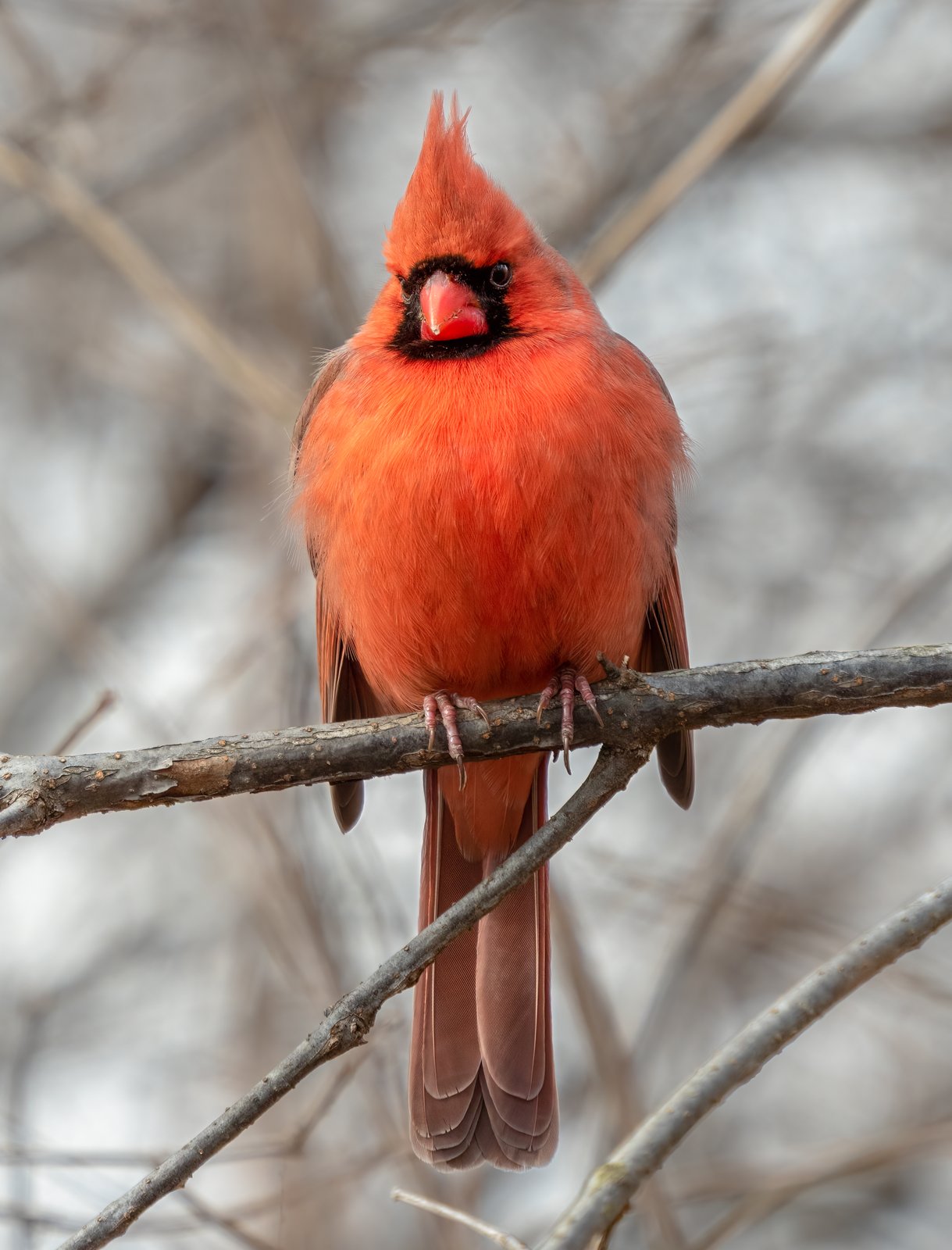
The Northern Cardinal is the well-known crested red cardinal of eastern North America, Mexico and northern Central America. It is a resident that hardly migrates. In the guide area it occurs only as a rare vagrant; isolated records may also involve escaped cage birds.
Voice
The song is a series of loud, clear whistles, such as wheet-wheet-wheet or cheer cheer cheer. The call is a sharp, metallic chip.
Recording: Scott Crabtree — CC BY-NC-SA 4.0 · xeno-canto
Identification
21–23 cm, with a pointed crest, a fairly long tail and a heavy, conical, red-orange bill. The male is bright red, with a black face and a black throat around the base of the bill. The female is warm grey-brown, with red tones in the crest, wings and tail, a narrow dark face and also a red-orange bill. Young birds resemble the female, but have a dark bill.
Confusion species
Vermilion Cardinal Cardinalis phoeniceus of the dry north of Colombia has a longer, narrower crest, a pale grey bill and no black face. Summer Tanager Piranga rubra has no crest and a pale, slimmer bill. Red-crowned Ant Tanager Habia rubica and related ant tanagers are a duller red, without a crest, and live in the forest undergrowth.
Habitat
Forest edges, scrub, gardens and parks, semi-open country with shrubs and dense growth along water. It eats seeds, fruit and insects, often on the ground. The nest is a loose cup of twigs and grasses in a dense shrub.
Where the bird is most at home, classified by the vegetation units of the Andes and the west coast.


Range and movements
In Colombia, Ecuador, Peru, Bolivia and the Galápagos only as a rare vagrant, with at most a few isolated records of uncertain origin. Outside the guide area in south-eastern Canada, the eastern and southern United States, Mexico and northern Central America; introduced to Hawaii and Bermuda.
How and when to look
A crested red cardinal in the guide area is more often a Vermilion Cardinal or an escaped cage bird; check the bill colour and the black face.
Conservation status
Least Concern. The species is numerous and benefits from gardens and semi-open farmland.
Scientific name
Cardinalis cardinalis | (Linnaeus, 1758)
Linnaeus described the species in 1758 as Loxia cardinalis; because it was later moved to another genus, the author and year stand in brackets. The genus Cardinalis was introduced in 1838 by Bonaparte. The genus name comes from Latin cardinalis, 'cardinal', after the red robes of cardinals. The species name repeats Latin cardinalis, 'cardinal', after the red plumage. The specimen the first description was based on came from South Carolina, United States.