All species › Passerines › Mitrospingid tanagers › Red-billed Pied Tanager
Red-billed Pied Tanager | Lamprospiza melanoleuca
Roodsnaveltangare | Tangara piquirroja | Pipira-de-bico-vermelho
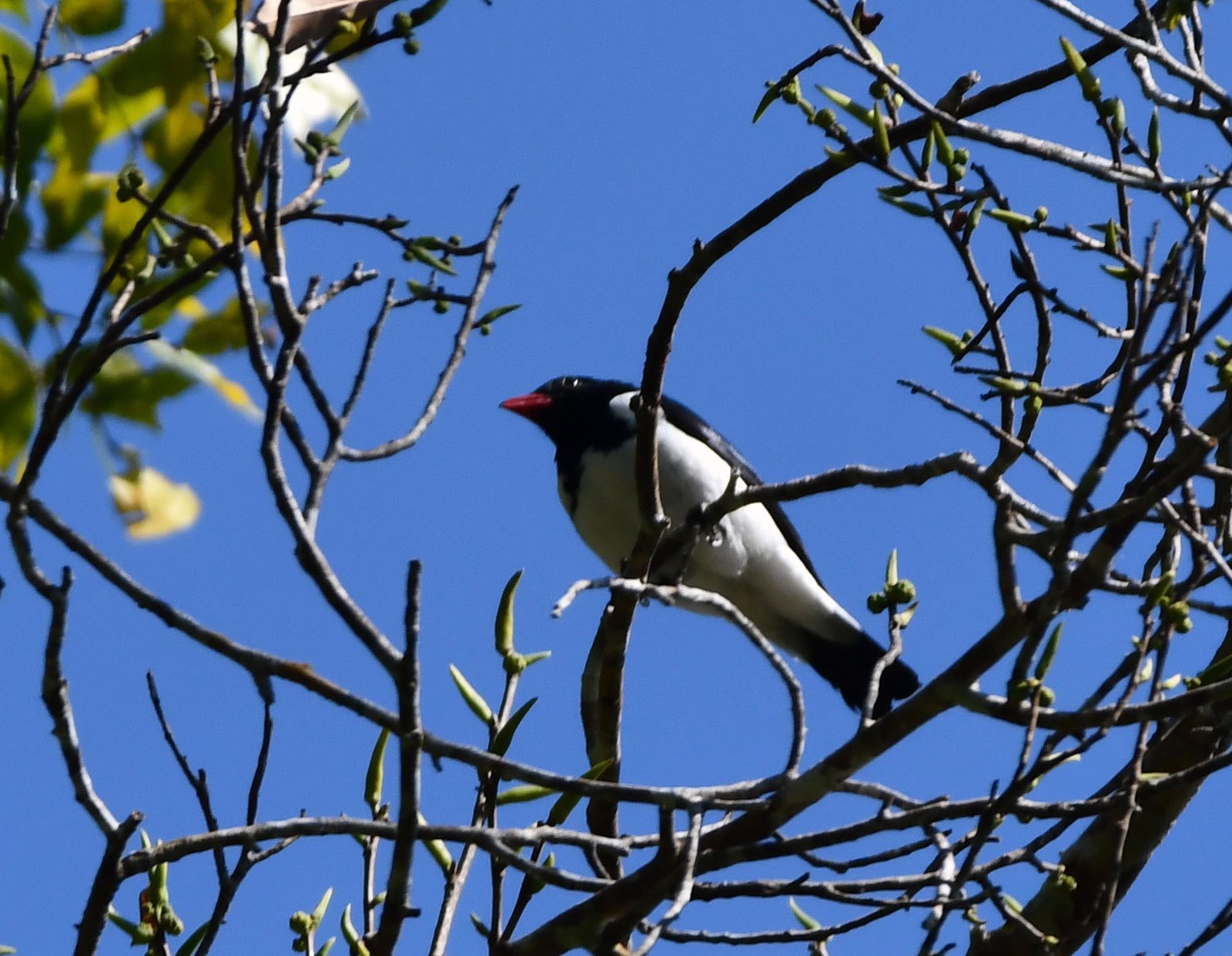
The Red-billed Pied Tanager is a black-and-white tanager of the Amazonian canopy, with a coral-red bill. Together with Dusky-faced Tanager it belongs to a small family of its own, the Mitrospingidae, related to the true tanagers and the cardinals. Small groups move noisily through the tallest trees, sometimes with mixed flocks.
Voice
The song is a semi-musical, jumbled series of notes. Groups give a call of a series of high ee-ee-ee notes with a falling yuu at the end.
Recording: JAYRSON ARAUJO DE OLIVEIRA — CC BY-NC-SA 4.0 · xeno-canto
Identification
17–18 cm, with a stout, coral-red bill. The male is glossy blue-black on the head, upperparts, throat and breast, and pure white on the belly and flanks; the border between black and white runs sharply across the breast. The female resembles the male, but has a grey nape, back and rump. Juveniles have a black bill, a white upper back with a mottled black-and-white lower back, and white underparts with some black.
Confusion species
The combination of pied plumage and red bill is unique in the guide area. Magpie Tanager Cissopis leverianus is larger, with a long, white-tipped tail, a black bill and a yellow iris, and lives lower at forest edges. Male White-lined Tanagers Tachyphonus rufus are all black, with a pale bill base and white only under the wing.
Habitat
Canopy and emergent trees of humid terra firme lowland forest, also at forest edges, up to about 900 m. It lives in groups of three to eight birds, which hop from branch to branch and sometimes catch flying prey; it eats berries, seeds, beetles and Cecropia catkins. Little is known about breeding.
Where the bird is most at home, classified by the vegetation units of the Andes and the west coast.


Range and movements
In Peru locally in the eastern lowlands, mainly in the south-east. In Bolivia in the northern lowlands. Absent from Colombia, Ecuador and the Galápagos. Outside the guide area in Amazonian Brazil and the Guianas.
- Resident
- dark = core range, pale = thinly spread
How and when to look
In south-eastern Peru and northern Bolivia, scan the crowns of tall trees at forest edges and along rivers for a group of black-and-white birds with red bills; from a canopy tower or a clearing the treetops are easier to view.
Conservation status
Least Concern. The species is widespread, but occurs only locally in the guide area and depends on closed lowland forest.
Scientific name
Lamprospiza melanoleuca | (Vieillot, 1817)
Vieillot described the species in 1817 as Saltator melanoleucus; because it was later moved to another genus, the author and year stand in brackets. The genus Lamprospiza was introduced in 1847 by Cabanis. The genus name comes from Greek lampros, 'shining', and spiza, 'finch'. The species name comes from Greek melas, 'black', and leukos, 'white', for the black-and-white plumage. The specimen the first description was based on came from Cayenne, French Guiana.