All species › Passerines › Mitrospingid tanagers › Dusky-faced Tanager
Dusky-faced Tanager | Mitrospingus cassinii
Roetmaskertangare | Tangara carinegruzca | Sanhaço-de-cara-escura
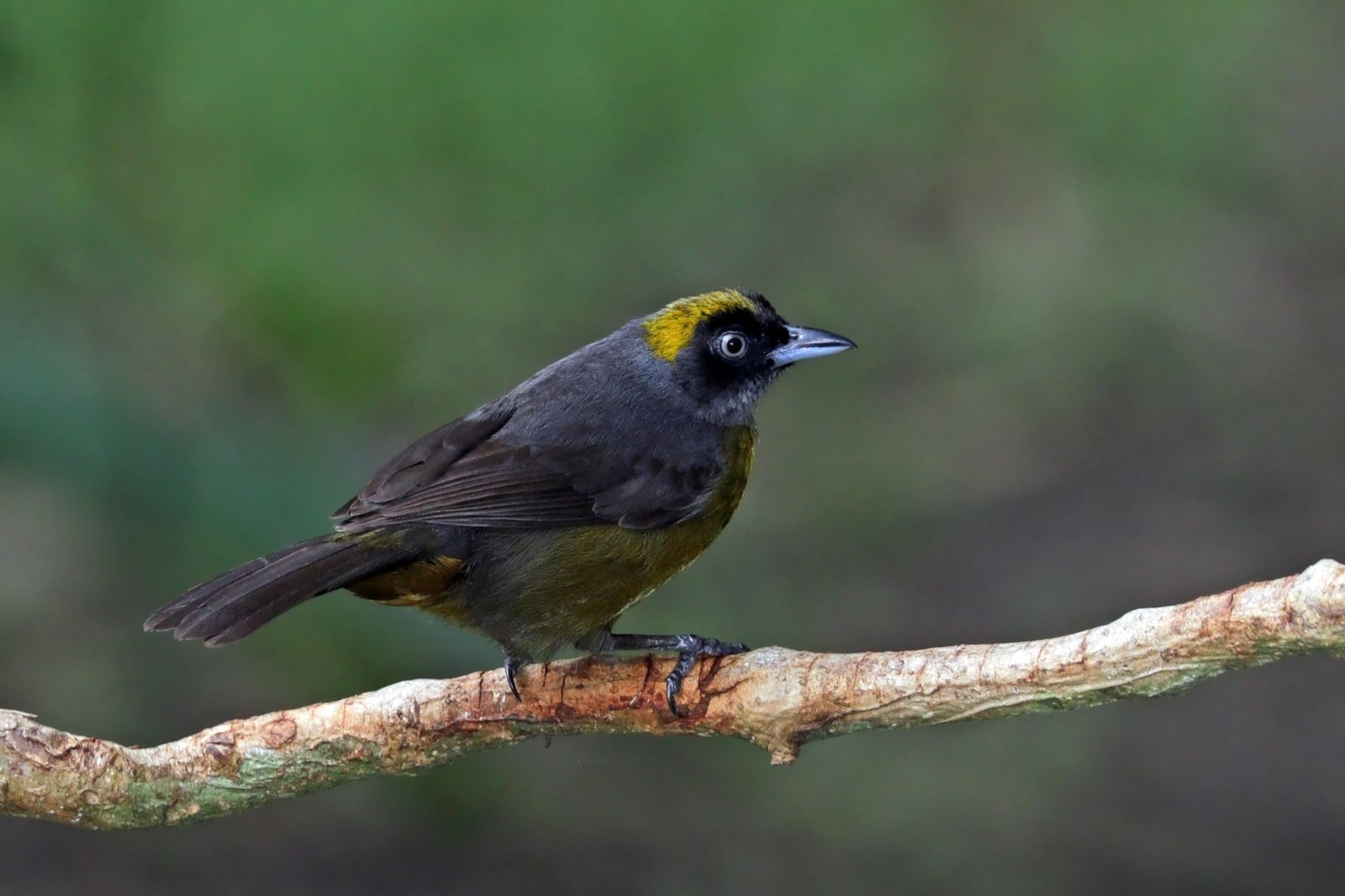
The Dusky-faced Tanager is a dark, group-living tanager of thickets and forest edges in the humid lowlands west of the Andes, from Costa Rica to Ecuador. With its blackish mask, pale iris and mustard-yellow crown it is recognisable in the undergrowth. Together with Red-billed Pied Tanager it belongs to the small family Mitrospingidae.
Voice
The dawn song is a repeated series of see-tee phrases. During the day groups give constant sputtering, chattering calls, such as chet or chet-ut.
Recording: Brian Cox — CC BY-NC-SA 4.0 · xeno-canto
Identification
18 cm, with a fairly long tail and a stout, dark bill. A large blackish mask covers the face, and the iris is pale grey. The crown and nape are mustard-yellow and the upperparts lead-grey. The throat is pale grey, the breast and flanks olive-yellow, and the belly greyish olive-yellow. The sexes are alike. Juveniles have less yellow on the crown and a buffy tinge to the underparts.
Confusion species
Lemon-spectacled Tanager Chlorothraupis olivacea is olive-green, with yellow spectacles and lores and a dark iris, and lacks the dark mask. Ochre-breasted Tanager Chlorothraupis stolzmanni is olive-green with an ochre breast, without a yellow crown or mask. Female Flame-rumped Tanagers Ramphocelus flammigerus have a pale bill and a yellow or orange rump.
Habitat
Dense, low shrubbery, thickets and second growth in the humid lowlands, also at forest edges, in forest gaps, along streams and in swampy ground, up to about 800 m, locally higher. It lives in noisy groups that move low through the vegetation. It eats mainly fruit, as well as insects and seeds. The nest is an open cup in a shrub; sometimes more than two adults help feed the young.
Where the bird is most at home, classified by the vegetation units of the Andes and the west coast.


Range and movements
In Colombia in the lowlands and foothills on the Pacific side and in the north-west, and locally in the middle Magdalena valley. In Ecuador in the north-western and western lowlands, south to Guayas. Absent from Peru, Bolivia and the Galápagos. Outside the guide area in Costa Rica and Panama.
- Resident
- dark = core range, pale = thinly spread
How and when to look
Listen along forest edges, streams and in thickets in the Chocó for the sputtering chatter of a group; the birds often appear briefly at the edge of the vegetation and then dive back in.
Conservation status
Least Concern. The species tolerates second growth and forest edges, but is declining locally through deforestation in the western lowlands.
Scientific name
Mitrospingus cassinii | (Lawrence, 1861)
Lawrence described the species in 1861 as Tachyphonus Cassinii; because it was later moved to another genus, the author and year stand in brackets. The genus Mitrospingus was introduced in 1898 by Ridgway. The genus name comes from Greek mitra, 'cap' or 'head-dress', and spingos, 'finch'. The species name honours John Cassin (1813–1869), American ornithologist at the Academy of Natural Sciences in Philadelphia. The specimen the first description was based on came from Lion Hill, Panama.