All species › Passerines › Tanagers and allies › Vermilion Tanager
Vermilion Tanager | Calochaetes coccineus
Vermiljoentangare | Tangara bermellón | Sanhaço-vermelhão
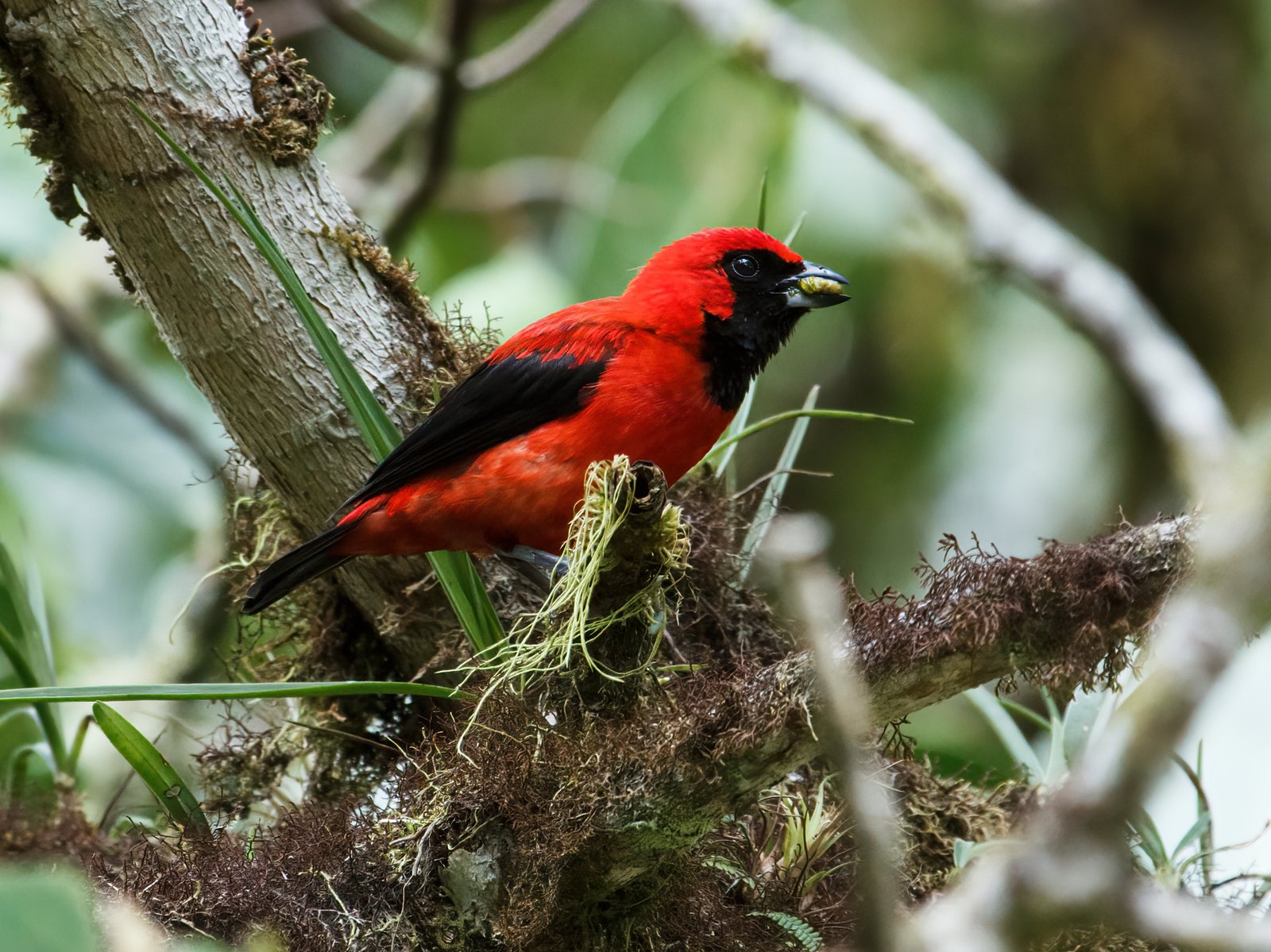
The Vermilion Tanager is a large, almost entirely red tanager of montane forest on the eastern slope of the Andes. It lives in the canopy and often joins mixed tanager flocks. The genus Calochaetes contains only this species.
Voice
Not very vocal; gives high, thin, hissing calls and short tsip notes, mainly in a mixed flock. A song is poorly described.
Recording: Daniel F. Lane — CC BY-NC-SA 4.0 · xeno-canto
Identification
18 cm, with a fairly heavy, pointed bill. The plumage is mostly bright vermilion, including the back and rump. The lores, chin and throat form a black mask and bib; the wings and tail are black. The sexes are alike. Young birds are duller, with less pure red.
Confusion species
Masked Crimson Tanager Ramphocelus nigrogularis also has a black mask, but a black back, a silvery-white bill base, and lives in the lowlands. Red-hooded Tanager Piranga rubriceps has only the head and breast red, with an olive-yellow back and belly. Male Scarlet Tanager Piranga olivacea has black wings and tail, but a red throat without black. Hepatic Tanager Piranga flava is duller red and lacks the black.
Habitat
The canopy and upper levels of humid montane forest and forest edge on the eastern slope, mainly between about 1000 and 2000 m. It lives in pairs or small groups, often with other tanagers, searching for insects along mossy branches and among epiphytes, and also eats fruit. Little is known about the nest.
Where the bird is most at home, classified by the vegetation units of the Andes and the west coast.


Range and movements
In Colombia on the eastern slope in the south, in Caquetá and Putumayo. In Ecuador along the whole eastern slope. In Peru on the eastern slope south to Cusco. Absent from Bolivia and the Galápagos. Does not occur outside the guide area.
- Resident
- dark = core range, pale = thinly spread
How and when to look
Look in mixed canopy flocks along roads on the eastern slope, for example around the Cordillera de Guacamayos in Ecuador or along the Manu road in Peru. The black throat and wings on an otherwise red body stand out in a flock.
Conservation status
Least Concern. Its habitat on the eastern slope is still largely forested, but is cleared locally for farming and roads.
Scientific name
Calochaetes coccineus | (Sclater, 1858)
Sclater described the species in 1858 as Euchaetes coccineus; because it was later moved to another genus, the author and year stand in brackets. The genus Calochaetes was introduced in 1879 by Sclater. The genus name combines Ancient Greek kalos, 'beautiful', and khaitē, 'mane'; it replaced Euchaetes, which was already in use for a moth genus. The species name is Latin coccineus, 'scarlet-coloured'. The specimen the first description was based on came from Río Napo, Ecuador.