All species › Passerines › Tyrant flycatchers and allies › Ochre-faced Tody-Flycatcher
Ochre-faced Tody-Flycatcher | Poecilotriccus plumbeiceps
Bruinkeelschoffelsnavel | Titirijí cabecicanela | Tororó
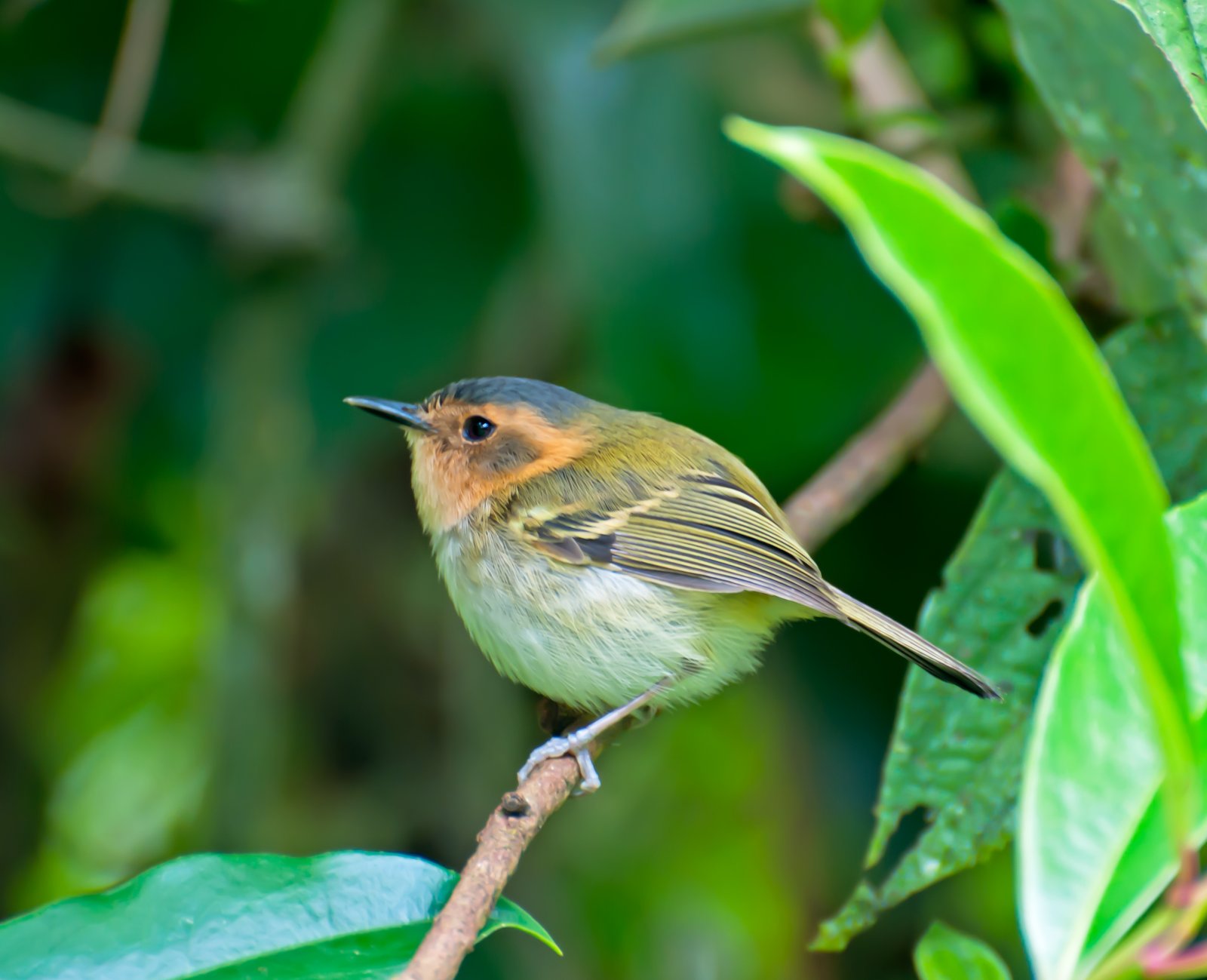
The Ochre-faced Tody-Flycatcher is a small tyrant with a grey crown and an ochre face. In the guide area it lives in the understorey of the Yungas of south-eastern Peru and Bolivia; a second, separate population inhabits the Atlantic Forest of south-eastern Brazil and surroundings.
Voice
A dry, frog-like rattle trrrrr, often with a short introductory note; also soft tik calls.
Recording: Marcos E. Sosa — CC BY-NC-SA 4.0 · xeno-canto
Identification
9.5 cm, with a flat bill. The crown and nape are grey, the face and lores warm ochre-brown. The back is olive. The wings are dark with two buff wing bars and yellowish edgings. The throat is whitish, the breast greyish with a buff wash, the belly whitish. The sexes are alike.
Confusion species
Yungas Tody-Tyrant Hemitriccus spodiops has an olive crown, a pale iris and faint streaks on the underparts. Rusty-fronted Tody-Flycatcher Poecilotriccus latirostris has a similar pattern but lives in the lowlands. Pygmy tyrants of the genus Lophotriccus have a crest and a streaked breast.
Habitat
Dense undergrowth, bamboo and scrub in humid montane forest and at forest edges, also in secondary forest, roughly between 1000 and 3000 m. It forages in pairs low in the vegetation for insects, which it picks from the undersides of leaves with short sallies.
Where the bird is most at home, classified by the vegetation units of the Andes and the west coast.


Range and movements
Peru: the south-east, on the eastern Andean slope in Cusco and Puno. Bolivia: the Yungas and montane forests of La Paz, Cochabamba, Santa Cruz, Chuquisaca and Tarija. Absent from Colombia, Ecuador and the Galápagos. Outside the guide area in north-western Argentina and, as a separate population, in south-eastern Brazil, Paraguay, Uruguay and north-eastern Argentina.
- Resident
- dark = core range, pale = thinly spread
How and when to look
Listen in bamboo and dense undergrowth along roads through the Yungas of Bolivia and south-eastern Peru for the dry, frog-like rattle; the bird usually stays low and hidden.
Conservation status
Least Concern. The species has a large range and tolerates secondary vegetation.
Scientific name
Poecilotriccus plumbeiceps | (de Lafresnaye, 1846)
De Lafresnaye described the species in 1846 as T[odirostrum] plumbeiceps; because it was later moved to another genus, the author and year stand in brackets. The genus Poecilotriccus was introduced in 1884 by Berlepsch. The genus name comes from Greek poikilos, 'variegated, pied', and trikkos, a small unidentified bird, used in ornithology for tyrant flycatchers. The species name comes from Latin plumbeus, 'leaden', and -ceps, 'headed', for the grey crown. The specimen the first description was based on came from Paraguay.